

Hyaluronic acid is the fast-acting hydrator that plumps skin within minutes; peptides are slower-acting messengers that support collagen and firmness over weeks. They’re not competing ingredients, they’re solving different problems. If you want visible plumpness today and structural improvement over time, layer hyaluronic acid first, then a peptide serum, then seal with moisturizer and SPF.
TL;DR:
- Hyaluronic acid provides quick, temporary skin plumping by attracting water, especially when applied on damp skin, but does not improve skin structure long-term.
- Peptides signal skin cells to produce more collagen and elastin over weeks, with clinical improvements averaging around 30% in wrinkles and fine lines after 8 to 12 weeks of consistent use.
- Combining HA and peptides is effective when layered from thin to thick, with HA applied first on damp skin followed by peptides, then sealed with moisturizer and SPF in the morning.
- Product formulation details like multiple molecular weight forms of HA and delivery technology for peptides significantly influence efficacy and should be visible on ingredient labels.
- Both ingredients are generally safe, low-irritant, and complementary, but expect gradual, cumulative improvements rather than immediate or dramatic results.
Table of Contents
- Hyaluronic Acid vs Peptides: What Each One Actually Does
- What Are Peptides and How Do They Signal Skin Repair?
- What Does the Clinical Evidence Actually Show?
- How Fast Will You Actually See Results?
- How Should You Layer Hyaluronic Acid and Peptides?
- What Should You Look for on the Ingredient Label?
- Are Hyaluronic Acid and Peptides Safe to Use Together?
- The Gap Between What Ingredient Lists Promise and What Skin Actually Needs
- A One-Product Way to Cover Both Bases
- Primary Studies and Resources to Read Next
- Sources
- FAQ
Hyaluronic Acid vs Peptides: What Each One Actually Does
Hyaluronic acid (HA) is a glycosaminoglycan, a naturally occurring sugar chain your skin already produces to hold water in place. Applied topically, it acts as a humectant, meaning it grabs water molecules from the air and from deeper skin layers and pulls them toward the surface. That’s why a good HA serum can visibly plump fine lines in under an hour. The effect is real but temporary; it lasts only as long as the water stays put.
Molecular weight determines how HA behaves once it’s on your skin. High-molecular-weight HA sits on the surface and forms a film that locks in moisture and smooths texture immediately. Low-molecular-weight HA penetrates further into the epidermis, where it can support hydration at a deeper level. Penetration studies confirm this split: low-MW HA gets deeper, high-MW HA stays surface-level, and the two work better together than either does alone.
Sodium hyaluronate shows up on ingredient labels almost as often as “hyaluronic acid” itself, and for good reason.
- It’s the salt form of HA, smaller in molecular size and more stable in formulation.
- It absorbs into skin more easily than pure HA.
- It holds up better against heat, light, and pH changes during storage, so the product performs the same on day 90 as it did on day one.
Multi-molecular HA formulas, blending high, mid, and low weights, tend to outperform single-weight versions because they hydrate at more than one skin depth simultaneously.
What Are Peptides and How Do They Signal Skin Repair?
Peptides are short chains of amino acids, fragments of the proteins your skin uses to rebuild itself. Instead of holding water like HA, they act as chemical messengers. A peptide fragment that resembles a piece of broken-down collagen can trick skin cells into thinking damage occurred, which triggers those cells to produce more collagen and elastin in response.
Not all peptides send the same message. A few families dominate skincare formulas:
- Signal peptides (matrikines), like palmitoyl pentapeptide-4, mimic collagen fragments to stimulate new collagen synthesis.
- Carrier peptides, such as copper peptides (GHK-Cu), deliver trace minerals like copper directly to cells to support enzyme activity involved in tissue repair.
- Neurotransmitter-inhibiting peptides, like acetyl hexapeptide-8, relax the micro-contractions in facial muscles that deepen expression lines over time.
The formulation challenge is real: most peptides are too large to cross the skin barrier on their own. Skin generally resists molecules heavier than roughly 500 Daltons, and many peptides exceed that threshold by a wide margin. Brands get around this through lipid conjugation (attaching a fatty tail so the peptide can slip through the lipid layer) or encapsulation in delivery vehicles like liposomes. A peptide serum with no delivery strategy mentioned on the label is a serum that may never reach the cells it’s meant to signal.
Pro Tip: Don’t judge a peptide serum by concentration alone. A 5% peptide blend with no delivery system can underperform a 1% blend that uses lipid conjugation, because the lower dose actually gets where it needs to go.
Realistically, structural improvement from peptides shows up over weeks, not days. Collagen remodeling is slow biology, and no topical product changes that timeline.
What Does the Clinical Evidence Actually Show?
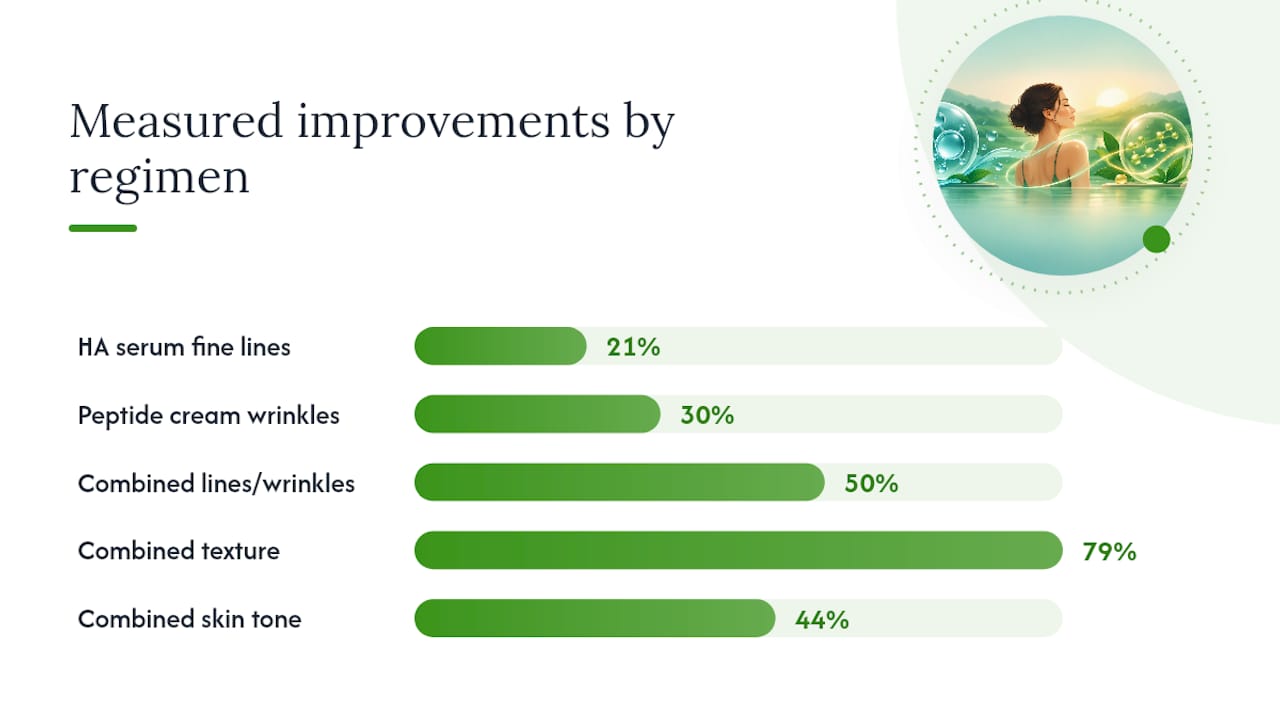
The strongest available trial data comes from a study that tracked both an HA-based serum and a peptide-rich cream, first separately over 8 weeks, then together over 12 weeks. The hyaluronic acid serum trial recorded a 31% improvement in crow’s feet, 23% in forehead wrinkles, and 21% in overall fine lines after 8 weeks of twice-daily use.
| Regimen | Duration | Measured improvement |
|---|---|---|
| HA-based serum | 8 weeks | Crow’s feet 31%, forehead wrinkles 23%, fine lines 21% |
| Peptide-rich cream | 8 weeks | Fine lines/wrinkles 30% |
| Combined HA serum + peptide cream | 12 weeks | Facial texture 79%, lines/wrinkles 50%, skin tone 44% |
When the two were combined over 12 weeks, the numbers moved further: 79% improvement in facial texture, 50% in lines and wrinkles, and 44% in skin tone, with high subject satisfaction reported throughout the study.
Those figures deserve context. Sample sizes in dermatology trials like this one are typically small, and results depend heavily on the exact formulation tested, not “hyaluronic acid” or “peptides” as generic categories. Other peptide research shows modest wrinkle reduction for compounds like palmitoyl pentapeptide-4 and copper peptides, but notes those trials are sometimes funded by the companies selling the product. None of that erases the results, it just means you should read “30% improvement” as a signal from one well-designed study, not a universal guarantee for every peptide serum on the shelf.
How Fast Will You Actually See Results?
Hydration and structural repair run on completely different clocks, and confusing the two leads to disappointment.
- HA delivers visible plumping within minutes to a few days, and that effect holds only as long as skin stays hydrated.
- Peptides need consistent twice-daily use for 6 to 12 weeks before structural changes become measurable, based on the trial data above.
- Don’t mistake the immediate smoothing from HA for proof that peptides are “working” early. They’re separate mechanisms on separate timelines.
- SPF matters more than most routines admit. UV exposure degrades collagen faster than peptides can rebuild it, so skipping sunscreen quietly cancels out weeks of peptide progress.
Think of HA as the ingredient that changes how your skin looks today, and peptides as the one that changes what your skin can do six weeks from now.
How Should You Layer Hyaluronic Acid and Peptides?
The rule of thumb for layering actives is thinnest to thickest, and HA plus peptides follows it closely.
- Cleanse, then apply toner or essence if you use one.
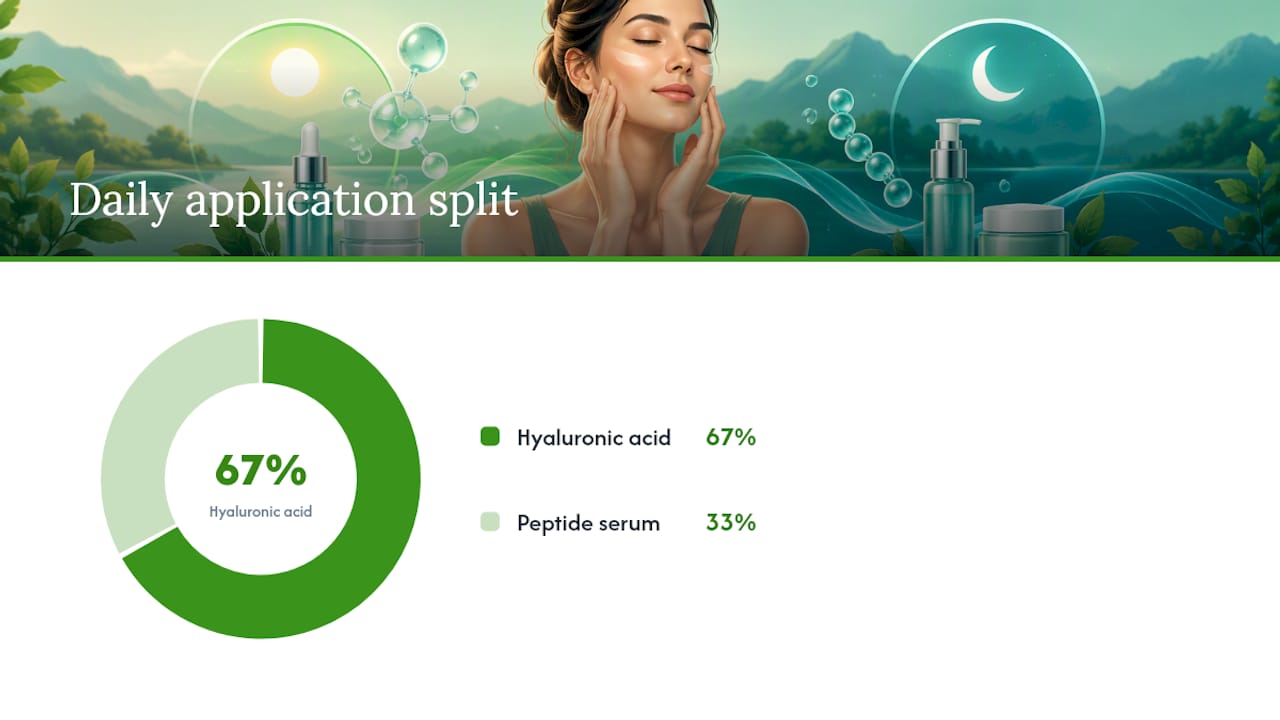
- Apply your hyaluronic acid serum to slightly damp skin. This matters more than most people realize. HA on bone-dry skin can pull moisture from deeper layers instead of the air, leaving skin feeling tighter, not softer.
- Wait 30 to 60 seconds to let the HA absorb before moving on.
- Apply your peptide serum, patting rather than rubbing it in.
- Seal everything with a moisturizer to lock hydration in and give the peptides a stable base to work from.
- In the morning, finish with SPF. At night, this step is optional.
Compatibility questions come up constantly, and the answers are simpler than the internet makes them sound. Peptides pair fine with niacinamide. AHA and BHA exfoliants should generally go on before HA and peptides, with a short wait between steps, since lowering skin’s pH first can help actives absorb, though it can also destabilize certain peptides if applied back to back. Retinoids are the one active worth spacing out entirely, alternate nights with peptides if your skin is sensitive, since combining two active ingredients aimed at cell turnover and signaling can overwhelm a reactive complexion.
Pro Tip: If your skin is sensitive or new to actives, use the peptide serum once daily at night and the HA serum twice daily. You get structural support without doubling your exposure to a newer ingredient before you know how skin will react.
For a deeper walkthrough on stacking these two ingredients with other actives, see this guide on combining HA and peptides, or check specific timing guidance for peptide serums.
What Should You Look for on the Ingredient Label?
Reading a label tells you more about whether a product will actually perform than any marketing claim on the front of the bottle.
- Look for multiple forms of HA listed together, like “sodium hyaluronate” and “hydrolyzed hyaluronic acid,” which signals a multi-molecular-weight approach that hydrates at more than one depth.
- Peptide names often start with prefixes like “palmitoyl” (a lipid-conjugated version built for better skin penetration) or specific compounds like GHK-Cu (copper peptide).
- Formulas that mention delivery technology, liposomal encapsulation, lipid carriers, are usually more transparent about actually getting the peptide where it needs to go, rather than just listing it for the label appeal.
- Stability matters. Peptides are sensitive to pH and light, so a well-formulated product often comes in opaque or airless packaging, which protects the active ingredient between applications.
For basic daily hydration, a moisturizer with HA further down the ingredient list is often enough. If you’re targeting visible fine lines or want measurable firmness gains, a concentrated serum with both hyaluronic acid and peptides, applied as a dedicated step rather than folded into a moisturizer, gives you a stronger dose of both. For more on how sodium hyaluronate compares to standard HA in real formulations, this comparison guide breaks down the differences.
Are Hyaluronic Acid and Peptides Safe to Use Together?
Both ingredients carry a low irritation profile compared with retinoids or chemical exfoliants, which makes the “can you use peptides with hyaluronic acid” question mostly moot for a general audience. Patch-testing any new product on your inner arm for 24 to 48 hours is still worth doing, especially if you have reactive or compromised skin.
- HA feels drying only when applied to skin that’s already bone dry with nothing to pull moisture from; damp application and a moisturizer chaser fix this.
- Peptides are not a retinoid substitute. They work through cell signaling, not accelerated cell turnover, so they don’t cause the peeling, redness, or sun sensitivity associated with retinoid use.
- Watch for marketing red flags: claims of “instant collagen boost” or “retinol-level results overnight” oversell what any peptide can realistically deliver in that timeframe.
- Neither ingredient causes photosensitivity, a persistent myth that likely got attached to peptides through confusion with retinoids.
The Gap Between What Ingredient Lists Promise and What Skin Actually Needs
Most skincare marketing treats hyaluronic acid and peptides as interchangeable “anti-aging” buzzwords, and that’s the part worth pushing back on. They’re not interchangeable, and treating them that way is why so many people buy one expecting the results of the other.
The honest read on the evidence is this: hyaluronic acid has more consistent, better-replicated short-term data because measuring hydration and surface smoothness is straightforward. Peptide research is directionally encouraging, the 30% fine-line improvement figures are real, but the field still leans on smaller trials and formulation-specific results more than HA does. That doesn’t make peptides a lesser choice. It means you should expect steady, cumulative change rather than a dramatic before-and-after at week two.
. What I’d push readers toward is patience with peptides and skepticism toward any serum, HA or peptide, that doesn’t specify molecular weight, delivery method, or concentration. For readers who want to see how these two ingredients perform stacked together over months, our guide on firming HA and peptide pairings goes deeper into product-level specifics.
— British
A One-Product Way to Cover Both Bases
If you’d rather not manage two separate serums and their timing, the Copper Peptide Anti-Aging Serum combines high-purity copper peptides with medical-grade hyaluronic acid in a single formula, so you get the immediate humectant benefit and the peptide signaling in one step instead of layering two products correctly every morning and night.
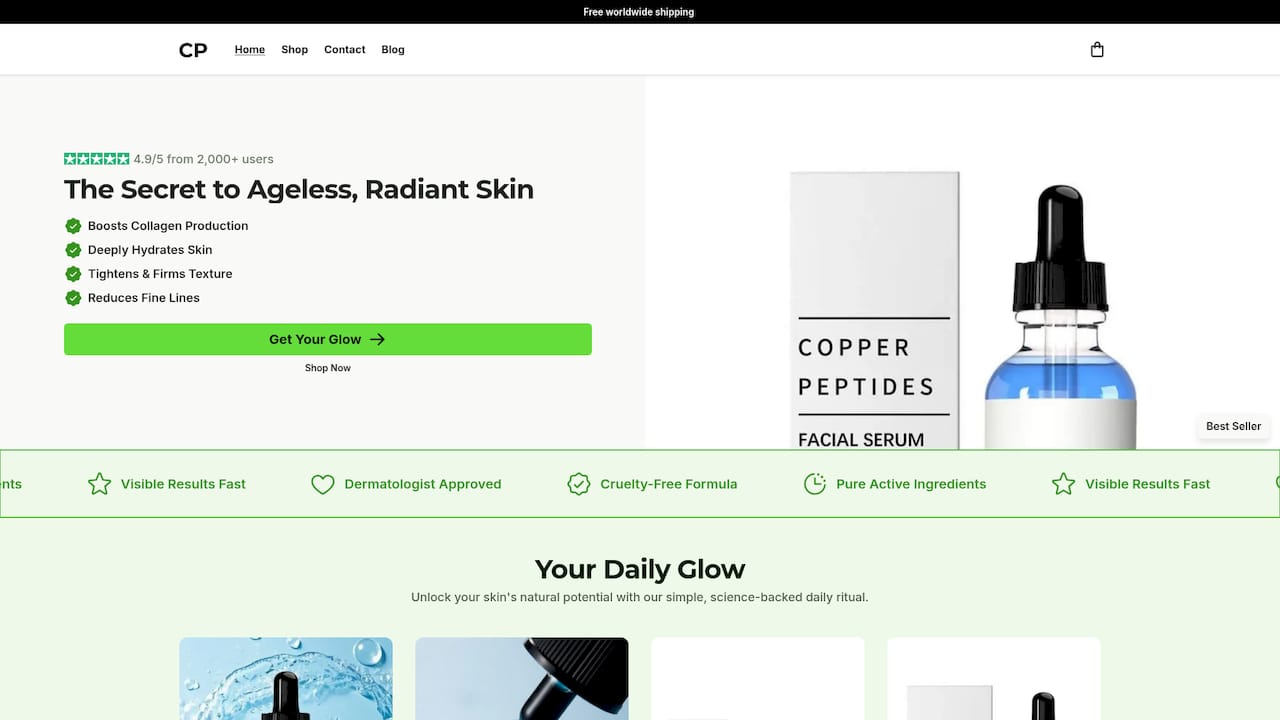
The brand describes its formulation as dermatologist-endorsed, gentle enough for sensitive skin, and designed to show visible results in several weeks with consistent use. It is also supported by a money-back guarantee, which offers some assurance to customers. If you’ve read this far and want to skip the two-serum routine, the full product collection is the place to compare formulation options and start with a single serum that covers hydration and firmness together.
Primary Studies and Resources to Read Next
The clinical claims in this article draw primarily from one controlled trial and supporting review literature.
- HA serum and peptide cream trial (PMC), the source for the 8-week and 12-week improvement percentages cited above.
- PubMed review on topical HA evidence, covering hydration and wrinkle-depth findings across multiple trials.
- PubMed peptide clinical trial reference, on palmitoyl pentapeptide-4 and copper peptide performance.
Sources
- Efficacy and tolerability of a hyaluronic acid‐based serum and a peptide‐rich cream for the face and neck in subjects with photodamaged skin
- PubMed clinical/review entries on topical HA and related trials
FAQ
Can You Use Peptides and Hyaluronic Acid Together?
Yes, they’re designed to complement each other rather than compete. HA provides the immediate hydration, and peptides provide the longer-term signaling for collagen and elastin support, so combining them in one routine, or one product like the Copper Peptide Anti-Aging Serum, covers both goals at once.
Can Hyaluronic Acid Plump Lips?
Topical HA in a serum can create a temporary surface-plumping effect by drawing water into the outer skin layers, including the lip area, but the effect is mild and short-lived compared with injectable HA fillers. For lasting lip volume, injectable treatments work through a different mechanism entirely and require a licensed provider.
Why Do Some Dermatologists Have Concerns About Hyaluronic Acid?
The concern usually isn’t HA itself but misuse. Applying it to dry skin without sealing it with a moisturizer can pull moisture from deeper layers and leave skin feeling tighter afterward, which is a formulation and application issue, not a flaw in the ingredient.
Do Peptides Actually Work for Wrinkles?
Clinical trial data shows measurable improvement. One 8-week study of 25 subjects using a peptide-rich cream found roughly a 30% improvement in fine lines and wrinkles, with additional improvement in redness and uneven tone. Results are formulation-dependent, so delivery method and peptide type both affect how well a specific product performs.
Which Is Better, Peptides or Hyaluronic Acid?
Neither is objectively better because they solve different problems. Choose HA for immediate dehydration and dullness, choose peptides for firmness and long-term structural concerns, or use both together for hydration plus collagen support, which is what the combined 12-week trial data above supports most strongly.