

Most peptide serums work whether you apply them in the morning, at night, or both, so pick whichever schedule you’ll actually stick with. Nighttime application has a slight theoretical edge because skin repair processes ramp up while you sleep, and it sidesteps any photostability guesswork. If you already wear SPF 30 or higher every day, morning application is fine too. Twice-daily use is common in cosmetic trials and safe for most formulations.
TL;DR:
- Applying peptide serums twice daily aligns with most clinical trial protocols and maximizes collagen signaling benefits.
- Nighttime application is preferable if you are inconsistent with sunscreen or use clear packaging without antioxidants.
- Proper layering involves applying peptides after cleansing and before heavier products, with a 10 to 20-minute gap between vitamin C and peptides.
- Copperpeptides’ serum suits both morning and evening routines, emphasizing consistent use over perfect timing for results.
- Patch testing and gradual introduction are recommended to minimize reactions, with timing choices mainly affecting user convenience and product stability.
Table of Contents
- Peptide serum morning or night: what the science and trials actually say
- How to layer peptides with vitamin C, retinol, acids, and niacinamide
- How to apply peptide serum for the best results
- When morning use of peptide serum actually raises concerns
- How to choose a peptide serum that fits your routine
- Why Copperpeptides fits either schedule
- What morning versus nighttime application actually feels like
- Common side effects and how timing affects them
- Prioritize habits over perfect timing
- Getting a peptide serum that works with your schedule, not against it
- Sources
Peptide serum morning or night: what the science and trials actually say
Skin doesn’t behave the same at 8 a.m. as it does at midnight. Research on skin’s internal clock shows that keratinocyte turnover and procollagen production peak overnight, which is the biological argument people cite for saving repair-focused ingredients, like peptides, for your PM routine. The logic holds up: if your skin is naturally doing more collagen-building work while you sleep, feeding it peptide signals at that moment seems like good timing.
Here’s the catch. Nobody has run a controlled trial comparing peptide serum applied only in the morning against the same serum applied only at night, tracking wrinkle depth or firmness as the outcome. The current evidence on AM versus PM peptide timing is mechanistic, not clinical. That distinction matters when you’re deciding how much weight to put on the “nighttime is better” argument. It’s a reasonable tiebreaker, not a proven advantage.
What the trials actually do tell us: most peptide efficacy studies, including those on well-known ingredients like Matrixyl, test twice-daily application over 60 to 84 days. That’s the protocol behind most of the “visible results in weeks” claims you see on product packaging. It also means twice-daily use isn’t some aggressive off-label habit. It’s how the ingredient was studied in the first place.
Photodegradation is the other piece of this puzzle, and it’s more nuanced than “never use peptides in daylight.” Some peptide sequences contain amino acids that react to UV exposure, but a proper SPF routine blocks most of that risk before it reaches your skin. The bigger photostability question isn’t what happens on your face. It’s what happens to the product sitting on your bathroom shelf.
- If you’re inconsistent with sunscreen, default to PM application for your peptide serum.
- If you wear a broad-spectrum sunscreen daily without fail, morning use carries little added risk.
- If you want maximum signaling for collagen support, twice-daily application matches how most trials were actually run.
- If your product comes in clear packaging with no antioxidants listed, treat that as a nudge toward nighttime use.
Pro Tip: Consistency beats perfect timing. A formulation guide built around cosmetic trial data notes that daily application predicts results far more reliably than optimizing the exact hour you apply it.
How to layer peptides with vitamin C, retinol, acids, and niacinamide
Layering order isn’t arbitrary. Get it wrong and you either waste product or actively cancel out an ingredient’s benefits.
- Cleanse first, always, on both dry and slightly damp skin depending on your routine.
- Apply thinnest, most water-based products before thicker, oil-based ones. A peptide serum typically goes on before a heavier moisturizer or facial oil.
- Layer actives from lowest to highest viscosity, then seal with moisturizer, and SPF if it’s morning.
Vitamin C is where most people run into trouble. L-ascorbic acid, the most researched and most unstable form of vitamin C, works at a low pH, and that acidity can chemically interact with peptide bonds, potentially breaking them down before they get a chance to work. The cleanest fix is separating them by time of day, vitamin C in the morning, peptides at night. If you want to use both in the same routine, wait 10 to 20 minutes between layers and watch for irritation or pilling.
Retinol has its own scheduling logic. It’s a nighttime active for the vast majority of users because sunlight degrades it and it increases photosensitivity. If your routine already includes retinol most nights, you have two reasonable options: alternate nights between retinol and your peptide serum, or check your specific product’s instructions, since some peptide formulas are explicitly designed to layer under retinol without conflict. Our comparison of peptide serums versus retinol walks through how to build that kind of alternating schedule.
Niacinamide and hyaluronic acid are the easy part. Both are generally compatible with peptides and can be layered in the same routine without special timing rules. A simple AM sequence might run cleanser, niacinamide, peptide serum, moisturizer, SPF. A PM sequence could be cleanser, peptide serum, hyaluronic acid, moisturizer, with retinol swapped in on alternating nights.
How to apply peptide serum for the best results
Application technique matters almost as much as timing. Peptides need direct, prolonged contact with skin to do their job, and how you apply them affects both absorption and how well they play with the rest of your routine.
- Cleanse your face and pat it mostly dry, leaving skin slightly damp.
- Apply an optional toner or essence if that’s part of your routine.
- Dispense two to three drops or a single pump of peptide serum and press it into skin rather than rubbing it in.
- Wait about a minute for it to absorb before applying moisturizer.
- In the morning, finish with SPF 30 or higher as your last step.
Damp skin actually helps here. It improves how well a water-based serum spreads and absorbs, and it reduces the pilling that happens when you stack too many products with mismatched textures. If you’re layering peptides with other actives and notice product balling up under your fingers, you’re either using too much of one layer or not waiting long enough between steps.
On frequency, twice-daily use is well within normal range and matches how most cosmetic peptide trials are structured. If you’re new to peptides or have reactive skin, start with once daily for the first one to two weeks and patch test on your inner arm or jawline before committing to full-face use.

Pro Tip: If your routine already feels crowded, anchor your peptide serum to a habit you never skip, like brushing your teeth. Apply it right after you wash your face at night, before you can talk yourself out of one more step.
When morning use of peptide serum actually raises concerns
Not every peptide product handles daylight the same way. Certain amino acid residues, particularly tyrosine, phenylalanine, and tryptophan, absorb UV light and can generate reactive byproducts that degrade the peptide structure over repeated light exposure. That’s a formulation-level concern, not necessarily a skin-safety one.
Two things reduce that risk substantially: antioxidants like vitamin E or ferulic acid mixed into the formula, and packaging that blocks light, think opaque bottles, airless pumps, or dark glass instead of clear jars. Brands that expect their product to be used in daylight tend to build in both.
Here’s the practical distinction worth remembering: SPF protects your skin from UV damage, but it does nothing to protect the serum sitting in a clear bottle on your counter for months. Bottle-level degradation happens regardless of when you apply the product.
- Check whether the packaging is opaque, tinted, or airless rather than clear.
- Look for antioxidants like vitamin E, ferulic acid, or green tea extract on the ingredient list.
- Read the usage instructions for explicit AM or PM guidance rather than guessing.
Pro Tip: If a peptide serum ships in a clear bottle with no antioxidant support and no usage guidance, treat that as a signal to use it at night and store it away from direct light, not as a reason to avoid peptides altogether.
How to choose a peptide serum that fits your routine
A short checklist saves you from wasted money on a product that was never going to perform, regardless of when you apply it.
- Choose leave-on formats. Peptides in rinse-off cleansers are unlikely to deliver meaningful results because they don’t stay on skin long enough to work.
- Look for supportive ingredients, especially hyaluronic acid, which pairs naturally with peptides for hydration and improved skin texture. Our breakdown of hyaluronic acid with peptides covers why that combination shows up so often.
- Favor opaque or airless packaging over clear jars, especially if you plan to use the product every morning.
- Check for clear usage guidance on the label, ideally specifying AM, PM, or twice-daily use and pairing advice with vitamin C or retinol.
- Watch for red flags: undisclosed peptide concentrations, vague “clinically proven” claims with no context, or peptides listed far down an ingredient panel where they’re unlikely to be present in meaningful amounts.
| What to check | Why it matters |
|---|---|
| Leave-on format (serum or cream) | Rinse-off peptides don’t get enough contact time to work |
| Opaque or airless packaging | Reduces light-driven degradation before you even open it |
| Listed antioxidants | Adds a buffer against photooxidation |
| Clear AM/PM usage instructions | Removes guesswork from your routine |
| Disclosed formulation details | Signals the brand isn’t hiding behind vague marketing claims |
Why Copperpeptides fits either schedule
Copperpeptides formulates its serum with high-purity copper peptides and medical-grade hyaluronic acid in a leave-on format, which is the delivery method dermatology sources point to for actual results. The brand states dermatologists endorse its gentle, transformative effect, with visible improvements typically reported within four to six weeks of consistent use.
Because the formulation pairs copper peptides with hyaluronic acid rather than leaving them isolated, it’s built to layer cleanly into either a morning or nighttime routine. Use it in the morning under SPF 30 or higher, or make it your last step before bed. Both approaches are consistent with how peptide serums are studied and used in practice. What matters most is applying it daily, not chasing a perfect hour.
What morning versus nighttime application actually feels like
Morning use pairs peptides with your skin’s daytime defense mode. You’re layering a collagen-supporting ingredient underneath your SPF and makeup, and the main practical benefit is convenience: one less thing to remember before bed.
Nighttime use aligns with the window when your skin theoretically does more of its own repair work, based on the circadian patterns in epidermal renewal discussed earlier. There’s also a psychological benefit some users report anecdotally: a nighttime skincare step feels less rushed than a morning one, which can translate into better, more consistent application.
Neither timing changes the ingredient itself. A copper peptide molecule doesn’t behave differently at 7 a.m. than at 10 p.m. What changes is the environment around it, sun exposure, product layering order, and how likely you are to actually remember to use it. If you’re chasing a specific benefit, like reducing the appearance of fine lines around the eyes, timing consistency over eight to twelve weeks matters more than which half of the day you chose.
Common side effects and how timing affects them
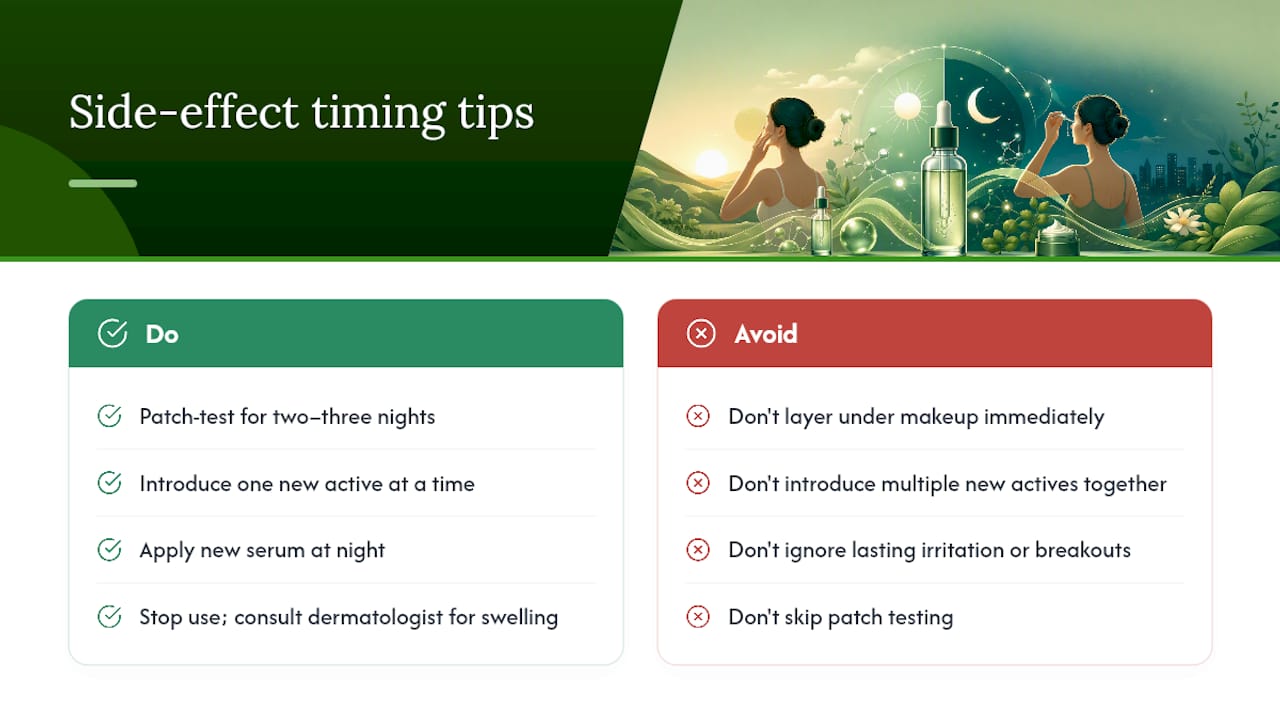
Peptide serums are generally well tolerated, more so than retinoids or high-strength acids, but reactions do happen. Mild redness, temporary tingling, or slight dryness are the most commonly reported effects, usually in the first one to two weeks as skin adjusts.
Timing plays a real role in how noticeable these reactions feel. Applying a new peptide serum at night means any temporary redness or tingling resolves while you sleep, and you wake up to see how your skin actually settled. Morning application means you’re heading into your day with a product still absorbing, which can matter if you’re sensitive to layering under makeup or SPF right away.
If you’re combining peptides with other actives, like a low-pH vitamin C or a retinoid, side effects are more likely to stem from that interaction than from the peptides themselves. Introducing one new active at a time, rather than overhauling your entire routine in a week, makes it far easier to identify what’s actually causing irritation if something goes wrong.
Patch testing matters here more than people admit. Apply a small amount to your inner forearm or along your jawline for two to three nights before committing to full-face use, especially if you have reactive or eczema-prone skin. If irritation persists beyond the initial adjustment window, or if you notice swelling or breakouts, stop use and check with a dermatologist rather than pushing through.
Prioritize habits over perfect timing
The honest takeaway after wading through the biology and the trial data: your consistency matters more than whether you apply peptides at 7 a.m. or 11 p.m. Skin doesn’t reward perfectionism, it rewards repetition. Pick a slot in your day you won’t skip, ideally right after your morning SPF or as the last step before bed, and treat it as non-negotiable.
If you’re unsure about layering with retinol or a low-pH vitamin C, patch test first and adjust based on how your skin actually responds, not based on what worked for someone else’s routine. When in doubt, a dermatologist can give you guidance specific to your skin.
— British
Getting a peptide serum that works with your schedule, not against it
Whether you land on morning, night, or twice-daily use, the product itself needs to hold up to that routine, packaging that protects it, a formula that layers cleanly, and ingredients that actually support what peptides are trying to do. Copperpeptides built its serum around that logic, pairing high-purity copper peptides with medical-grade hyaluronic acid in a single leave-on formula, rather than asking you to juggle separate products for hydration and firming.
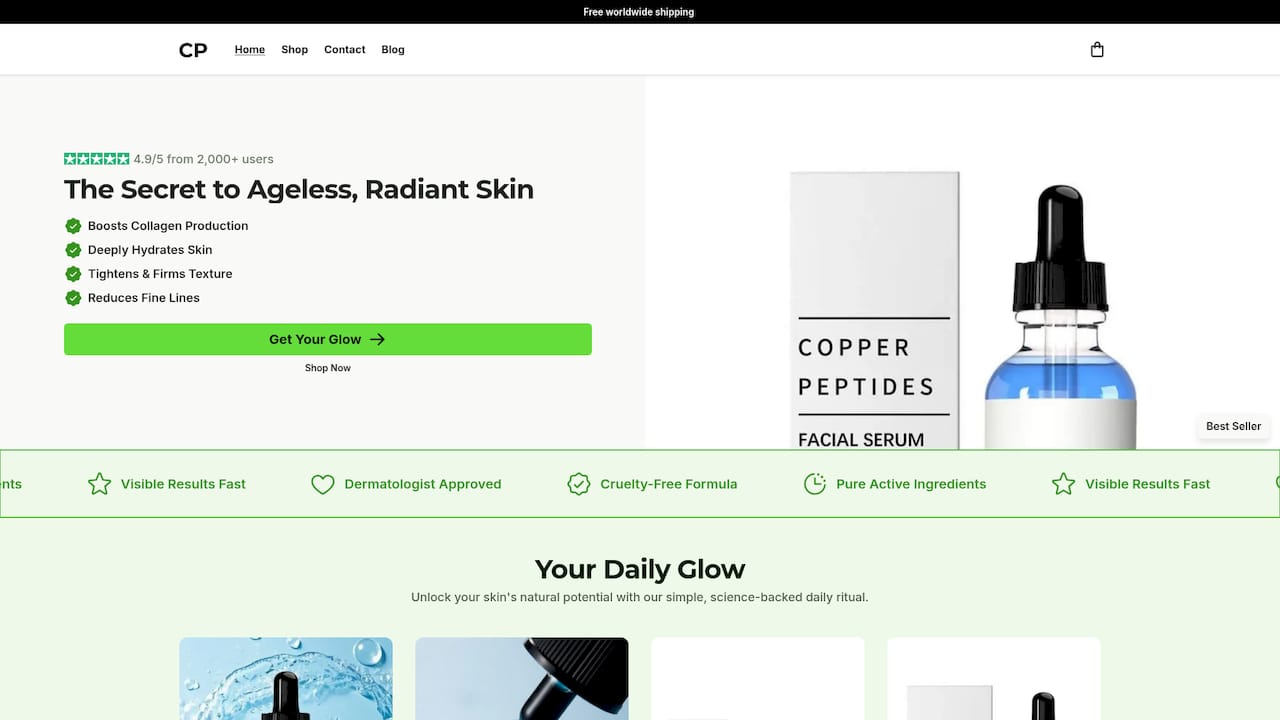
The product page lays out specific AM and PM usage directions so you’re not guessing how it fits into whatever routine you land on. If you’ve read this far, you already know the real decision isn’t morning versus night, it’s whether you’ll use something consistently. Visit the Copperpeptides serum page to check current usage instructions and see if it fits the routine you’re about to commit to.
Sources
- Circadian biology and skin repair (PMCID article)
- Peptide Serum AM or PM: When to Apply for Best Results | FormBlends
- Polypeptides in skincare — Byrdie