

Sodium hyaluronate is the form you will almost always find in serums and moisturizers. It is the stable, water-soluble salt of hyaluronic acid, and formulators prefer it for good reason. But here is the part most product labels skip: the salt-versus-acid distinction matters far less than molecular weight, which is what actually controls how deep the ingredient reaches into your skin.
- Surface plumping: Look for high molecular weight (HMW) HA or sodium hyaluronate, which sits on the skin’s surface and forms a moisture-holding film.
- Deeper hydration: Seek low molecular weight (LMW) sodium hyaluronate or hydrolyzed hyaluronic acid, which can penetrate into the upper epidermis.
- Best overall results: Choose a product with a multi-molecular-weight blend. Clinical evidence backs this approach over single-weight formulas.
Pro Tip: When you scan an ingredient list, ignore whether the front label says “hyaluronic acid” or “sodium hyaluronate.” Flip to the INCI list and look for multiple entries at different molecular weights, or the word “hydrolyzed” alongside the standard name.
Key Takeaways
Sodium hyaluronate and hyaluronic acid are the same molecule in different ionic states; molecular weight, not the acid-versus-salt label, determines how deep the ingredient penetrates and how well it performs.
| Point | Details |
|---|---|
| MW drives penetration | Low MW HA reaches the upper epidermis; high MW forms a surface film. The salt-vs-acid label does not change this. |
| Multi-MW blends outperform | Pavicic et al. (2011) found significant improvements in skin hydration with multi-weight blends compared with single-weight formulas. |
| Apply to damp skin | Always apply HA to slightly damp skin and follow immediately with a moisturizer or occlusive to prevent moisture loss. |
| Read the INCI list | Ignore front-label claims; look for multiple HA entries (Sodium Hyaluronate, Hydrolyzed Hyaluronic Acid) in the INCI for real multi-MW coverage. |
| Copperpeptides serum | Combines medical-grade HA with copper peptides for hydration and collagen support, dermatologist-endorsed for all skin types. |
This article is general information, not a substitute for advice from a qualified doctor. Consult a qualified healthcare professional about your own circumstances before acting on anything here.
Table of Contents
- What is the difference between hyaluronic acid and sodium hyaluronate?
- How molecular weight drives what HA actually does in your skin
- What benefits do both forms actually deliver?
- How these ingredients appear on labels and the variants worth knowing
- How to use HA products correctly and what to know about safety
- Which form should you choose for your skin goal?
- Common myths about HA and sodium hyaluronate, corrected
- A practical perspective on what actually matters
- The Copperpeptides serum pairs medical-grade HA with copper peptides
- Sources
What is the difference between hyaluronic acid and sodium hyaluronate?
They are, chemically speaking, the same molecule in two different ionic states. Hyaluronic acid (HA) is a naturally occurring polysaccharide found in skin, connective tissue, and synovial fluid. Sodium hyaluronate is its sodium salt form, created when the acid’s carboxyl groups are neutralized with sodium. Once either form contacts the slightly acidic environment of your skin, both behave as the same negatively charged polyanion.
The practical difference shows up in the lab, not on your face. Sodium hyaluronate is more water-soluble and chemically stable than the free acid form, which makes it easier to dissolve into serums and gels, and far more shelf-stable across the pH ranges typical cosmetics require. The free acid form degrades faster and is harder to work with at cosmetic concentrations, so commercial manufacturing overwhelmingly supplies sodium hyaluronate as the powder or solution used in skincare products.
This gap between front-of-pack marketing and INCI reality trips up a lot of shoppers. A product that says “hyaluronic acid serum” on the bottle almost certainly lists “Sodium Hyaluronate” in its ingredient deck. That is not deceptive; it is just how the industry works. The INCI (International Nomenclature of Cosmetic Ingredients) system standardizes ingredient names for safety and regulatory purposes, and “Sodium Hyaluronate” is the accepted INCI name for the form used in virtually all topical products.
What to look for when reading a label:
- “Sodium Hyaluronate” is the standard INCI name; expect to see it near the top of the list in well-formulated products.
- Multiple HA-related entries (e.g., both “Sodium Hyaluronate” and “Hydrolyzed Hyaluronic Acid”) signal a multi-weight approach.
- “Crosspolymer” in the name (e.g., Sodium Hyaluronate Crosspolymer) indicates a modified form designed for longer surface hydration.
- Position in the ingredient list matters: ingredients listed before the 1% threshold (usually near preservatives) are present at meaningful concentrations.
How molecular weight drives what HA actually does in your skin
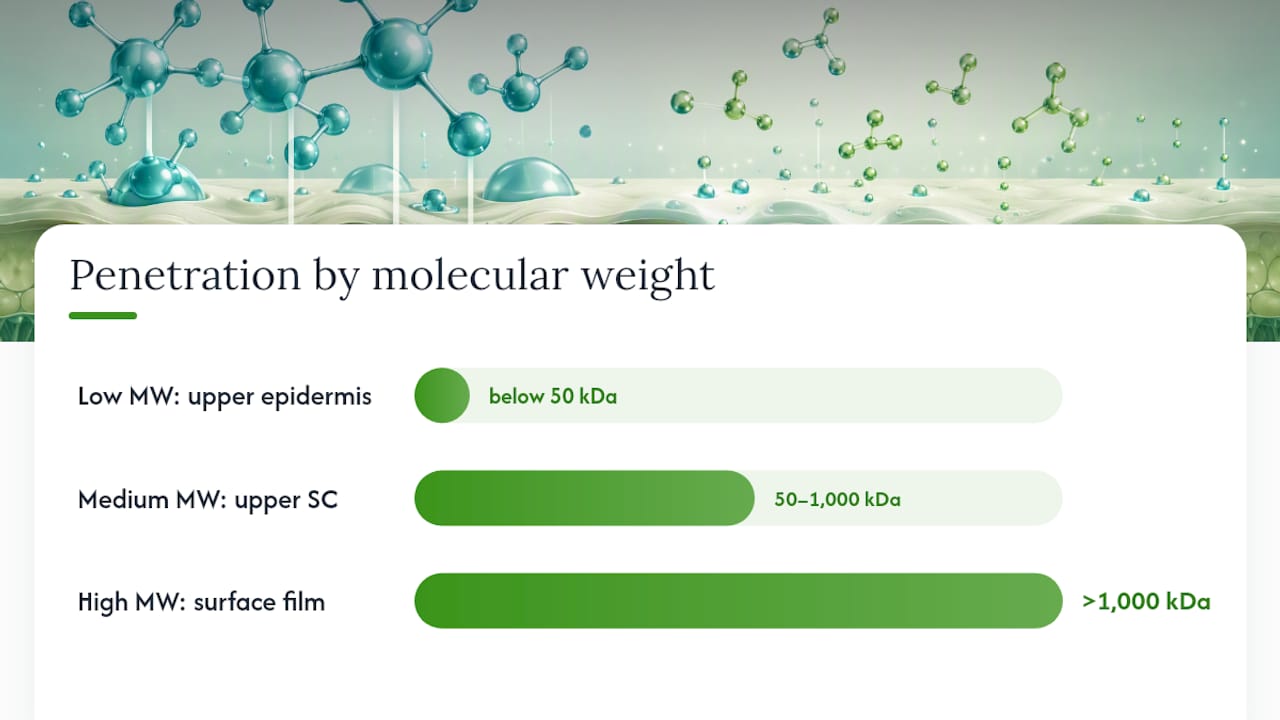
Molecular weight is the real performance variable. Permeability studies confirm that smaller hyaluronan fragments penetrate the epidermis more readily, while high molecular weight chains remain at the surface. This is a physical size effect, not a chemistry effect. Whether the ingredient is labeled “hyaluronic acid” or “sodium hyaluronate” does not change how far it travels.
Here is how the size spectrum plays out in practice:
- High molecular weight HA (above ~1,000 kDa): Stays on the skin surface. Forms a breathable, moisture-retaining film that immediately smooths and plumps the appearance of fine lines. Think of it as a temporary hydration blanket.
- Medium molecular weight HA (50–1,000 kDa): Reaches the upper layers of the stratum corneum. Provides hydration with some structural benefit and is the most common range in standard serums.
- Low molecular weight HA (below ~50 kDa) and hydrolyzed HA: Penetrates into the upper epidermis. Associated with deeper moisture delivery and some evidence of stimulating skin’s own HA production.
- Multi-molecular-weight blends: Combine the surface film of HMW with the deeper action of LMW in a single formula. This is the strategy behind the strongest clinical results.
The multi-weight approach is not just marketing. A randomized clinical study by Pavicic et al. (2011) in 76 women found that a multi-molecular-weight HA blend produced significant improvements in measured skin hydration over several weeks compared with a single-weight formula. That gap is meaningful for anyone choosing between a basic serum and a more sophisticated formulation.
Pro Tip: Product texture can hint at molecular weight. Thicker, more viscous serums often rely on HMW HA for their gel-like feel. Watery, fast-absorbing serums typically use LMW or a blend. Neither texture is automatically better — it depends on your skin goal.
Sodium hyaluronate’s lower solution viscosity also makes it easier for formulators to achieve a lightweight, non-sticky finish, which is one reason it dominates in serums marketed for oily or combination skin.
What benefits do both forms actually deliver?
Both hyaluronic acid and sodium hyaluronate are effective humectants. They attract and hold water molecules in the stratum corneum, which is the skin’s outermost layer. Review-level evidence confirms that topical HA increases stratum corneum hydration and can reduce trans-epidermal water loss (TEWL) when paired with appropriate barrier care, such as a moisturizer or occlusive applied on top.
The clinically supported benefits include:
- Immediate surface plumping: HMW HA visibly smooths fine lines within minutes of application by filling the surface with a hydrating film.
- Sustained hydration: Multi-MW blends maintain hydration longer than single-weight formulas, as shown in the Pavicic et al. 2011 study.
- Improved skin elasticity: Consistent use correlates with measurable improvements in elasticity metrics in clinical trials, though results vary with concentration and MW.
- Reduced TEWL: When HA is sealed in with an occlusive, it helps the skin barrier retain moisture rather than lose it to the environment.
- Compatibility: Both forms are well-tolerated across skin types, including sensitive and acne-prone skin, at cosmetic concentrations.
Harvard Health notes that HA’s popularity has outpaced clinical nuance, and that correct use matters more than the specific form. The ingredient will not rebuild your skin barrier on its own. It needs a partner, whether that is a ceramide-rich moisturizer, a facial oil, or a cream applied immediately after.
How these ingredients appear on labels and the variants worth knowing
Reading an ingredient list for HA-related entries takes about 30 seconds once you know what to look for. The most common INCI names and what they signal:
- Sodium Hyaluronate: The standard form. Could be any molecular weight; the label alone does not tell you which.
- Hydrolyzed Hyaluronic Acid: Enzymatically broken into smaller fragments. Generally lower MW, associated with better epidermal penetration.
- Sodium Acetylated Hyaluronate: A modified form with improved film-forming and water-resistance properties. Tends to stay on the surface longer and resist washing off.
- Sodium Hyaluronate Crosspolymer: Cross-linked for extended surface hydration and a longer-lasting moisture effect. Common in overnight masks and long-wear formulas.
- Hyaluronic Acid: Occasionally listed as the free acid form, but rare in finished products. More often a marketing term on the front label than the actual INCI entry.
Pro Tip: A product listing both “Sodium Hyaluronate” and “Hydrolyzed Hyaluronic Acid” in its INCI is giving you two molecular weight ranges in one formula. That is a better signal of formulation quality than any front-label claim.
Sodium hyaluronate’s dominance in commercial formulations comes down to workability: it dissolves readily in water, produces lower solution viscosity for easier serum and gel textures, and stays stable across the pH ranges cosmetics require. The free acid form is rare in finished products because it degrades faster and is harder to handle at scale.
For shoppers focused on deeper hydration, “Hydrolyzed Hyaluronic Acid” near the top of the INCI list is a stronger buying signal than a product simply labeled “hyaluronic acid serum.” For long-lasting surface hold, look for “Crosspolymer” in the name. For a comprehensive approach, multi-weight blends that combine standard and hydrolyzed forms offer the broadest coverage.
How to use HA products correctly and what to know about safety
Application method matters as much as formulation. Dermatologist guidance is consistent: apply HA to damp skin, then seal it in. In low-humidity environments, HA applied to dry skin can actually pull moisture from deeper skin layers toward the surface and then lose it to the air, leaving skin feeling tighter than before.
Core usage steps:
- Cleanse and pat skin until slightly damp, not dripping.
- Apply your HA serum immediately while skin is still moist.
- Follow within 60 seconds with a moisturizer, facial oil, or cream to lock in the hydration.
- Use morning and evening for consistent results; HA is stable enough for twice-daily use.
Layering with other actives:
- Vitamin C: Apply vitamin C first (lower pH), let it absorb, then layer HA on top.
- Retinoids: HA applied after retinol or tretinoin helps buffer dryness and irritation without interfering with efficacy.
- Exfoliants (AHAs/BHAs): Use exfoliants first, rinse, then apply HA to soothe and rehydrate.
Safety considerations:
- At cosmetic concentrations (typically 0.1–2% for topicals), both forms are generally well-tolerated with few reported side effects.
- Sensitive and acne-prone skin: HA and sodium hyaluronate are non-comedogenic and unlikely to trigger breakouts. Patch-test new serums if your skin reacts to preservatives or fragrance in the formula, not the HA itself.
- Pregnancy and lactation: topical HA at cosmetic concentrations is widely considered safe. Consult your OB-GYN if you have concerns, particularly about any other actives in the same formula.
- When to see a dermatologist: persistent irritation, redness, or breakouts after introducing a new HA product usually point to another ingredient in the formula, not the HA.
Which form should you choose for your skin goal?
The honest answer is that you are almost always choosing between formulations, not between “hyaluronic acid” and “sodium hyaluronate” as distinct ingredients. Here is a practical decision path:
By skin goal:
- Immediate surface smoothing and plumping: Prioritize HMW sodium hyaluronate or sodium acetylated hyaluronate. A gel or serum texture works well.
- Lasting deep hydration: Look for hydrolyzed hyaluronic acid or a multi-MW blend. Pair with a rich moisturizer.
- Dry or dehydrated skin: A multi-MW serum followed by a cream or oil gives the most complete coverage.
- Oily or combination skin: A lightweight, water-based serum with LMW or standard sodium hyaluronate absorbs without heaviness.
- Aging or mature skin: Multi-MW blends with sodium acetylated hyaluronate or crosspolymer offer the broadest benefit across surface and deeper layers.
- Post-procedure or compromised barrier: Gentle, fragrance-free formulas with standard sodium hyaluronate are the safest starting point. Avoid actives until the skin has healed.
Practical shopping checklist:
- Check the INCI list for multiple HA entries, not just one.
- Look for “Hydrolyzed” or “Crosspolymer” variants for specific performance goals.
- Confirm HA appears in the first half of the ingredient list, above the 1% threshold.
- Choose fragrance-free if your skin is sensitive or reactive.
- Pair any HA product with an occlusive or moisturizer, regardless of how the serum is marketed.
Multi-MW products typically cost more, but the Pavicic et al. 2011 clinical data suggests the performance gap over single-weight formulas is real enough to justify the premium for anyone targeting sustained hydration improvements.
Common myths about HA and sodium hyaluronate, corrected
Myth 1: Sodium hyaluronate penetrates deeper because it is a different molecule. False. Penetration depth is a molecular weight effect, not a salt-versus-acid effect. A high molecular weight sodium hyaluronate stays at the surface just as a high MW free acid would. The permeability research is clear on this point: size determines depth, not the counter-ion.
Myth 2: “Hyaluronic acid” on the front label means the product contains the free acid form. Almost never true. The front label is marketing copy. The INCI list is the legal declaration. Most products that say “hyaluronic acid” on the front list “Sodium Hyaluronate” in the INCI, because that is what is actually in the formula.
Myth 3: HA alone is a moisturizer. HA is a humectant, not a moisturizer. It draws water to the skin’s surface but does not seal it in. Without an occlusive or emollient on top, Harvard Health confirms that HA can actually increase water loss in dry environments. The moisturizer step is not optional.
Myth 4: Higher concentration always means better results. Not necessarily. Concentration matters up to a point, but molecular weight distribution and formulation quality have a larger impact on outcomes.
Pro Tip: When a brand highlights “pure hyaluronic acid” as a selling point over sodium hyaluronate, treat it as a marketing claim, not a formulation advantage. Ask instead: what molecular weights are present, and is there a multi-MW blend?
A practical perspective on what actually matters
The skincare industry has done a thorough job of making hyaluronic acid feel like a category with dozens of meaningfully different options. In reality, the core decision is simpler: molecular weight, and whether the formula pairs the humectant with something that seals it in.
The acid-versus-salt debate consumes far more consumer attention than it deserves. Formulators settled this question years ago. Sodium hyaluronate is the standard because it works, it is stable, and it is easy to formulate. The meaningful variables are MW distribution, concentration, and what you layer on top.
What gets underestimated is the occlusive step. A well-formulated multi-MW serum applied to damp skin and followed by a ceramide cream will outperform an expensive single-weight serum used on dry skin with nothing on top, every time. The ingredient is only half the equation.
For anyone pairing HA with other actives, copper peptides are worth considering alongside it. Copper peptides support collagen production and skin repair, and they layer well with HA humectants without competing for the same mechanism. The combination addresses both hydration and structural skin support, which is a more complete anti-aging strategy than either ingredient alone.
The Copperpeptides serum pairs medical-grade HA with copper peptides
If you want a formula that puts the multi-MW strategy into practice, the Copperpeptides copper peptide anti-aging serum is built around medical-grade hyaluronic acid combined with high-purity copper peptides. It is dermatologist-endorsed, cruelty-free, and formulated to work across all skin types, including sensitive skin.
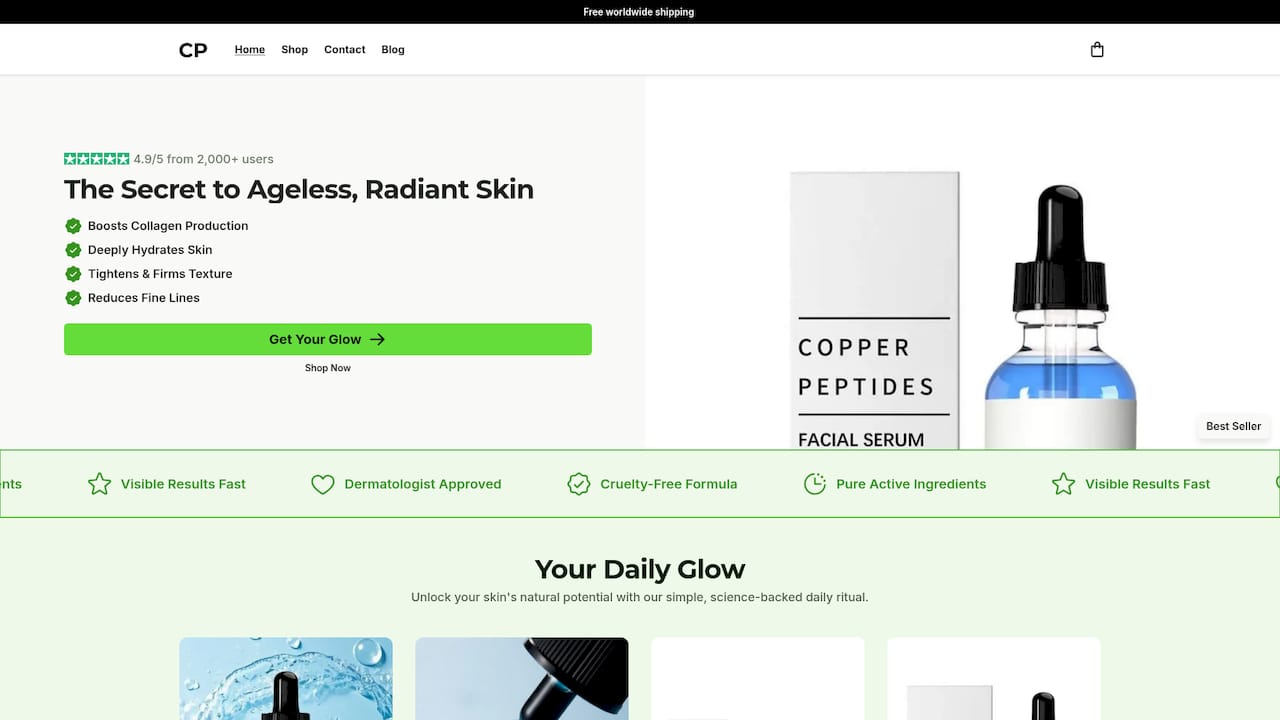
The serum addresses both sides of the anti-aging equation: HA delivers deep hydration and surface plumping, while copper peptides support collagen production and skin firmness. Most users see visible results within four to six weeks. It is available directly through Copperpeptides, with a return policy that removes the risk from trying it. If the guidance in this article resonates, the serum is a straightforward next step.
Sources
Recommended
- Best Hyaluronic Acid Serums for Firming Skin: Copper Peptide Pairings – Copper Peptides Store
- Best Hydrating Serums for Firming and Anti-Aging Skin – Copper Peptides Store
- Copper Peptides vs Matrixyl: Which One Actually Works? – Copper Peptides Store
- Copper Peptide Benefits: A Science-Backed Skin Guide – Copper Peptides Store