

Yes, you can use peptides with azelaic acid, and most people should. The simplest safe approach: apply your thinnest serum first, thicker gels or creams after, and give each layer thirty to sixty seconds to sink in before the next. If your skin flags or reacts, alternate them on different nights instead of stacking both. Patch test for a few days first, and expect real pigmentation or texture changes over four to eight weeks, not overnight.
TL;DR:
- Combining peptides with azelaic acid is safe if applied with proper layering, waiting 30 to 60 seconds between products, and patch testing beforehand.
- Tyrosinase-inhibiting peptides like Decapeptide-12 complement azelaic acid for pigmentation issues, with clinical improvements seen within eight to sixteen weeks.
- Peptides that support skin structure, such as signal or carrier peptides, effectively enhance anti-aging and repair when paired with azelaic acid without redundancy.
- For sensitive or reactive skin, alternating nightly between peptides and azelaic acid reduces irritation, especially if redness persists or stinging lasts longer than twenty minutes.
- The effectiveness of peptide serums depends heavily on formulation delivery systems, like liposomal carriers and hyaluronic acid, rather than just peptide names.
Table of Contents
- Your Copyable AM/PM Routine for Peptides With Azelaic Acid
- Which Peptide Classes Actually Pair Well With Azelaic Acid?
- How to Layer Azelaic Acid and Peptides Step by Step
- What Not to Mix With Azelaic Acid or Peptides
- What Does the Clinical Evidence Actually Show?
- Where This Combination Helps Most: Pigmentation, Acne, Rosacea, and Aging Skin
- How Does This Combination Compare to Other Anti-Aging Pairings?
- What Formulation Actually Delivers Results?
- How Azelaic Acid and Peptides Actually Work on Skin
- Our Take on Combining Peptides and Azelaic Acid
- A Peptide-First Option Worth Adding to Your Routine
- Sources
Your Copyable AM/PM Routine for Peptides With Azelaic Acid
You don’t need a complicated system to get this right. You need one primary active per session and a sequence that respects how each product is formulated.
Morning routine:
- Gentle cleanser
- Peptide serum (this is where signal or carrier peptides do their best work)
- Moisturizer to lock in hydration
- Sunscreen, non-negotiable, since both peptides and azelaic acid work better on protected skin
Azelaic acid can go in the morning too, but only if you’re already using a broad-spectrum sunscreen daily. Otherwise push it to nighttime.
Evening routine, option A (alternating nights):
- Monday, Wednesday, Friday: cleanse, then azelaic acid gel or cream
- Tuesday, Thursday, Saturday: cleanse, then peptide serum
- Sunday: rest night, moisturizer only
Evening routine, option B (same-night layering, for tolerant skin):
- Cleanse
- Peptide serum, wait sixty seconds
- Azelaic acid over the top
- Moisturizer to buffer and seal
If you’re new to either ingredient, start slow: two to three nights a week for the first two weeks, then build to nightly as your skin tolerates it. Skipping this step is the single most common reason people write off a good ingredient as “too harsh.” A hyaluronic acid layer between peptides can also cushion the transition if your skin runs on the dry or reactive side.
Which Peptide Classes Actually Pair Well With Azelaic Acid?
Not all peptides do the same job, so pairing them with azelaic acid isn’t a one-size-fits-all decision. The peptide’s function determines whether it complements azelaic acid’s anti-inflammatory and tyrosinase-inhibiting action or just sits on top of it doing something unrelated.
Tyrosinase-inhibiting peptides, like Decapeptide-12, block the enzyme responsible for excess melanin production. Since azelaic acid works on a similar pathway, this pairing is arguably the most logical combination for anyone dealing with melasma, sun spots, or post-acne marks. One trial on Decapeptide-12 recorded a 50% improvement in melasma appearance after 16 weeks, with visible change showing up as early as eight weeks. A separate split-face trial on a PTPD-12 cream found a measurable drop in melanin index over eight weeks with good tolerability, reinforcing that this peptide class has real clinical backing, not just marketing language.
Signal peptides send messages to fibroblasts to produce more collagen and elastin. They target structure and firmness rather than pigment, which makes them a good complementary layer rather than a redundant one when paired with azelaic acid.
Carrier peptides, including copper peptides like GHK-Cu, transport trace minerals that support collagen synthesis and wound healing. These tend to be gentler and layer easily under azelaic acid without competing for the same biological target.
- Tyrosinase-inhibiting peptides: best for dark spots and melasma
- Signal peptides: best for fine lines and sagging
- Carrier peptides: best for overall repair and hydration support
Pro Tip: Don’t shop by peptide name alone. A peptide’s molecular weight, its cyclization, and how well it actually penetrates skin matter more than whether the label sounds sophisticated. A 2025 review on peptide design found that cyclic peptides in the 400 to 600 Da range tend to show better stability and membrane permeability than their linear counterparts. Formulation science beats brand storytelling every time.
How to Layer Azelaic Acid and Peptides Step by Step
Sequencing isn’t arbitrary. Product texture and molecular size dictate the order, and skipping the wait time between layers is where most irritation complaints start.
- Cleanse with a gentle, non-stripping formula. Azelaic acid and peptides both work better on a calm base.
- Apply the thinnest product first. Watery peptide serums usually go before azelaic acid gels or creams, since thicker formulas can block a thinner serum from absorbing if applied first.
- Wait 30 to 60 seconds. This isn’t a formality. It gives the first layer time to actually absorb instead of getting diluted or pushed aside by the next product.
- Apply azelaic acid, focusing on areas of concern rather than the whole face if you’re still building tolerance.
- Seal with a moisturizer. This buffers azelaic acid’s mild tingling sensation and helps peptides stay put.
- In the morning, always finish with sunscreen.
When to alternate instead of layer same-night:
- If you notice redness lasting more than twenty minutes after application
- If your skin runs naturally sensitive or rosacea-prone
- If you’re introducing both actives for the first time in the same week
Troubleshooting pilling and redness:
- Pilling usually means a product hasn’t fully absorbed, or you’re using too many layers with silicone-heavy textures. Fix it by waiting longer between steps or dropping one product that night.
- Mild tingling from azelaic acid is normal for the first few uses. Persistent stinging or visible redness is not, and it’s a signal to scale back frequency.
- If irritation happens, stop both actives for two to three nights, moisturize only, then reintroduce one at a time starting with whichever caused less reaction.
If you’re also using exfoliating acids in your routine, the sequencing gets more complex. Our guide to layering peptides with AHAs and BHAs breaks down where those fit into the same week.
What Not to Mix With Azelaic Acid or Peptides
Azelaic acid is one of the gentler acids on the market, and peptides are famously low-irritation, but that doesn’t mean every combination is safe to stack in the same routine.
Ingredients to be cautious with:
- High-strength retinoids used the same night, especially prescription-strength tretinoin, since combining two active ingredients that both affect cell turnover raises irritation risk
- Strong exfoliating acids (high-percentage glycolic or salicylic acid) used without buffering, which can compound azelaic acid’s mild tingling into real stinging
- Professional peels or in-office treatments done the same week as starting a new azelaic acid or peptide routine, since freshly treated skin has a compromised barrier
DermNet NZ notes that azelaic acid’s most common side effects are mild irritation, dryness, and temporary redness, and recommends patch testing plus gradual introduction, exactly the approach outlined earlier in this guide.
Watch for these warning signs:
- Stinging that lasts more than a few minutes
- Redness that persists for hours rather than fading within twenty to thirty minutes
- Flaking, tightness, or a barrier that feels compromised, where normally hydrating products suddenly sting
If any of these show up, don’t push through it. Cut back to two nights a week, apply a thicker moisturizer as a buffer layer underneath, or switch to alternating azelaic acid and peptides on separate nights entirely. Persistent reactions that don’t improve within a week or two are worth a conversation with a dermatologist, particularly if you have rosacea or an already compromised barrier. If your skin needs a full reset, our comparison of peptides versus ceramides for barrier repair explains which to prioritize while healing.
What Does the Clinical Evidence Actually Show?
Peptide research for pigmentation has moved well past theoretical mechanism papers into actual trial data, which is more than most trending skincare ingredients can claim.
The strongest data point comes from Decapeptide-12, where a clinical trial recorded a 50% reduction in melasma severity by week 16, with measurable improvement visible by week eight. A separate trial on a PTPD-12 cream formulation showed a significant drop in melanin index over the same eight-week window, with good tolerability reported by both investigators and patients.
The real bottleneck for topical peptides isn’t the molecule itself. It’s getting it through the skin barrier intact. A 2025 review on peptide delivery points out that most peptides suffer from poor permeability, and that formulations increasingly rely on microneedling, liposomal carriers, or chemical penetration enhancers to actually get the active where it needs to go, though some of those enhancers carry their own irritation risk.
That same permeability problem is why a separate review on peptide design found that molecular weight, polarity, and cyclization determine how well a peptide performs, not the marketing claim on the bottle.
What this means for your shelf:
- Look for brands that mention delivery systems or stability testing, not just the peptide’s name
- Favor peptides in a lower molecular weight range when possible, since larger molecules struggle to penetrate
- Understand that “clinically tested” claims mean more when a specific study, timeline, and percentage are attached to them
Formulation quality decides whether a peptide serum does anything at all. The name on the label is the least useful piece of information you have.
Where This Combination Helps Most: Pigmentation, Acne, Rosacea, and Aging Skin
Azelaic acid and peptides don’t solve the same problem, and that’s exactly why pairing them works across such a wide range of concerns.
For pigmentation, azelaic acid interrupts excess melanin production while tyrosinase-inhibiting peptides reinforce the same pathway from a different angle. Together they tend to produce more even results than either ingredient alone, based on the trial data already discussed.
For acne, azelaic acid’s antibacterial and anti-inflammatory properties address active breakouts, while carrier peptides support the skin’s repair process afterward, which matters since post-acne marks are often what people are really trying to fix.
For rosacea, azelaic acid is a well-established option for redness and inflammation. Gentle signal or carrier peptides can support barrier strength alongside it without adding fragrance or harsh actives that flare sensitive skin.
For anti-aging, azelaic acid’s mild exfoliating action smooths texture while signal peptides encourage collagen production underneath. Neither ingredient is a retinoid substitute, but together they build a milder, more sustainable routine for people who can’t tolerate stronger actives.
The overlap in mechanism is what makes this pairing efficient rather than redundant. You’re not doubling up on the same job. You’re covering pigment, inflammation, and structure with two ingredients that were never competing for the same task in the first place.
How Does This Combination Compare to Other Anti-Aging Pairings?
Azelaic acid plus peptides isn’t the only combination worth considering, and it helps to know where it sits relative to other common pairings.
Retinoid plus vitamin C is popular for aging skin but often too aggressive for reactive or rosacea-prone skin, and the two actives frequently need to be used on separate schedules to avoid irritation.
Niacinamide plus peptides is a gentler pairing that supports barrier function and tone, but niacinamide doesn’t have azelaic acid’s targeted anti-tyrosinase action, so it’s a weaker choice specifically for pigmentation.
Hydroquinone plus peptides delivers faster pigment fading in some cases but comes with stricter usage limits and a higher irritation profile, making it a less sustainable long-term routine for most people.
Against these alternatives, azelaic acid with peptides lands in a practical middle ground: real efficacy data on pigmentation and structure, a lower irritation ceiling than hydroquinone or aggressive retinoid combinations, and enough flexibility to fit acne, rosacea, or aging concerns without needing three separate routines. It’s not the fastest option on the market. It’s the one most people can actually stick with long enough to see the eight to sixteen week results the clinical trials describe.
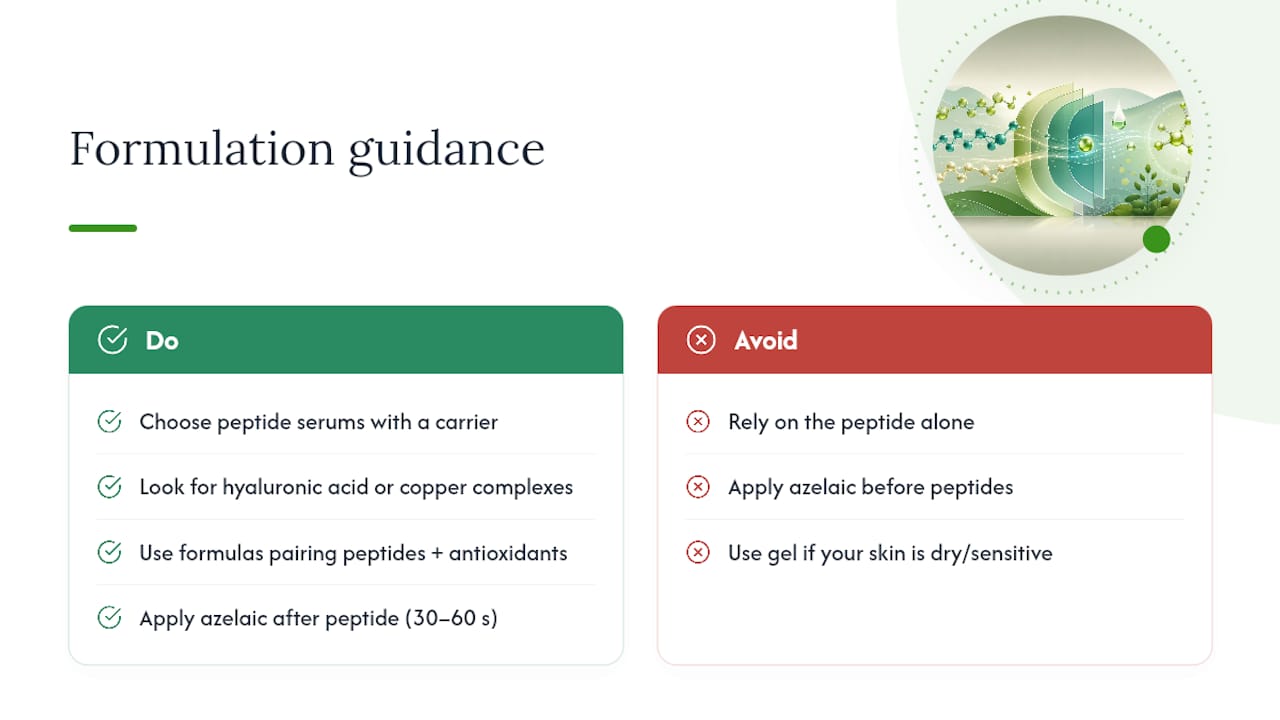
What Formulation Actually Delivers Results?
Two peptide serums can list identical ingredients on the label and perform completely differently, and the difference almost always comes down to delivery.
Look for peptide serums built around a carrier system, whether that’s a stabilized copper peptide complex or a formulation that pairs peptides with medical-grade hyaluronic acid. Hyaluronic acid doesn’t just hydrate. It helps hold moisture at the skin surface long enough for peptides to actually get absorbed rather than evaporating with the water in a poorly designed formula.
Consumer roundups, including a 2026 Forbes review of top peptide serums, consistently point to this same pattern: the best-performing formulas combine peptides with hyaluronic acid and antioxidants rather than relying on the peptide alone. That combination approach shows up again and again because it addresses both delivery and hydration in the same step.
For azelaic acid specifically, gel and cream formulations behave differently. Gels tend to absorb faster and suit oilier skin, while creams offer more cushioning for dry or sensitive skin types layering underneath a peptide serum. Whichever texture you choose, apply it after your peptide serum has had its thirty to sixty seconds to settle in, not before.
If you want a non-topical boost alongside your routine, red light therapy tools are increasingly used to support collagen production and can complement a topical peptide and azelaic acid routine without adding another active ingredient into the mix.
How Azelaic Acid and Peptides Actually Work on Skin
Azelaic acid works through several mechanisms at once, which is part of why it shows up in treatment plans for such different conditions. It inhibits tyrosinase, the enzyme that drives melanin production, which is why it helps fade dark spots. It also has antibacterial properties against the bacteria involved in acne, and anti-inflammatory effects that calm the redness associated with rosacea.
Peptides work differently depending on their class, which is the whole reason peptide selection matters more than treating “peptides” as one interchangeable category. Signal peptides act as chemical messengers that prompt fibroblasts to produce more collagen and elastin. Carrier peptides, like copper peptides, transport trace minerals that support enzymatic processes involved in tissue repair. Tyrosinase-inhibiting peptides work on the same pigment pathway as azelaic acid, just through a different molecular interaction.
When you combine azelaic acid with a tyrosinase-inhibiting peptide, you’re hitting the same target from two directions, which likely explains why the clinical results for combined pigmentation approaches tend to outperform single-ingredient routines. When you pair azelaic acid with a signal or carrier peptide instead, you’re addressing pigment and structural aging simultaneously rather than layering redundant actives. Either way, the skin isn’t just absorbing two products. It’s receiving two distinct biological instructions that happen to work well together.
Our Take on Combining Peptides and Azelaic Acid
Copperpeptides formulates around high-purity copper peptides paired with medical-grade hyaluronic acid, and that combination exists specifically because delivery and hydration determine whether a peptide serum does anything meaningful once it’s on your skin. That’s the same principle that should guide how you think about pairing peptides with azelaic acid: the peptide’s job matters, but so does whether it’s formulated to actually reach the layers of skin where that job gets done.
Users commonly report visible changes in firmness and texture within several weeks, a timeline that lines up closely with the eight-week windows seen in the Decapeptide-12 and PTPD-12 trials discussed earlier. Some peptide serums have been endorsed by dermatologists for their gentle formulation, making them reasonable candidates for layering into routines that include azelaic acid, provided users follow sequencing and patch-test guidance.
— British
A Peptide-First Option Worth Adding to Your Routine
If you’re building a routine around azelaic acid and want a peptide serum that actually pulls its weight, the Copper Peptide Anti-Aging Serum is formulated with high-purity copper peptides and medical-grade hyaluronic acid, the same combination consumer reviews consistently flag as the difference between a peptide serum that works and one that just sits on the surface.
It layers in easily before azelaic acid gel or cream: apply it on cleansed skin, wait about a minute, then follow with your azelaic acid product and seal with moisturizer. Some peptide serums are formulated for firming, hydration, and collagen support rather than pigment correction, potentially complementing azelaic acid instead of competing with it for the same job. Many users have reported firmer, more hydrated skin within several weeks, and some dermatologists have endorsed such formulations as gentle enough for regular use, including on sensitive skin. Visit the Copperpeptides product page to check current availability and start building your routine around a formula designed for real absorption, not just a good-sounding ingredient list.