

The most effective firming serum for face is one built around copper peptides and medical-grade hyaluronic acid. If you want a single recommendation, the Copper Peptide Anti-Aging Serum from Copperpeptides is the standout option: dermatologist-endorsed, formulated for all skin types including sensitive, and designed to deliver visible firmness improvements within several weeks.
Why this pick holds up:
- Peptides for collagen support. Copper peptides signal the skin to produce more collagen and elastin, the structural proteins responsible for firmness and bounce.
- Medical-grade hyaluronic acid for immediate plumping. This grade of HA draws moisture deep into the dermis, giving you visible results while the longer-term remodeling happens underneath.
- Dermatologist-endorsed with a clear timeline. Clinical expectations are set at 4–6 weeks for measurable improvement, not vague promises.
Pro Tip: Start with the Copper Peptide Anti-Aging Serum before adding any prescription retinoids to your routine. Introducing peptides first builds collagen-support continuity and typically improves tolerability when you do layer in stronger actives later.
Table of Contents
- What is a firming serum, and how is it different from other face serums?
- Key active ingredients to look for in a firming serum
- How do firming serums actually produce firmer-looking skin?
- Who benefits most from a firming serum, and when should you start?
- How to apply a firming serum and build a routine that works
- What results can you realistically expect, and when?
- Are firming serums safe? Side effects and how to patch-test
- How to choose the right firming serum for your skin
- The clinical case for copper peptides and medical-grade hyaluronic acid
- Key Takeaways
- Why a peptide-first approach makes more sense for most people
- The Copper Peptide Anti-Aging Serum is worth trying
- Useful sources and further reading
What is a firming serum, and how is it different from other face serums?
A firming serum is a lightweight, concentrated formula built specifically to address the skin’s support network: collagen, elastin, and the extracellular matrix that keeps skin taut. That is a different job than a hydrating serum (which primarily replenishes moisture) or a brightening serum (which targets pigmentation and radiance). The actives are different, the mechanisms are different, and the timelines are different.
Common goals a skin tightening serum addresses:
- Lifting the appearance of sagging zones (jawline, jowls, neck)
- Improving elasticity and bounce
- Plumping fine lines caused by volume loss
- Slowing the visible progression of laxity with preventive use
The distinction matters because ingredient concentration drives results. A serum delivers actives at higher concentrations than a moisturizer, and a firming-specific serum prioritizes those actives — peptides, retinoids, growth factors — over fragrance or emollients. If you are shopping for a serum for skin elasticity, you need to be looking at the actives list, not the marketing copy on the front of the bottle.
Key active ingredients to look for in a firming serum
Editorial testing consistently shows that the most effective anti-aging serums for face combine peptides, hyaluronic acid, and niacinamide. Here is what each major active does and why it belongs in a firming formula.
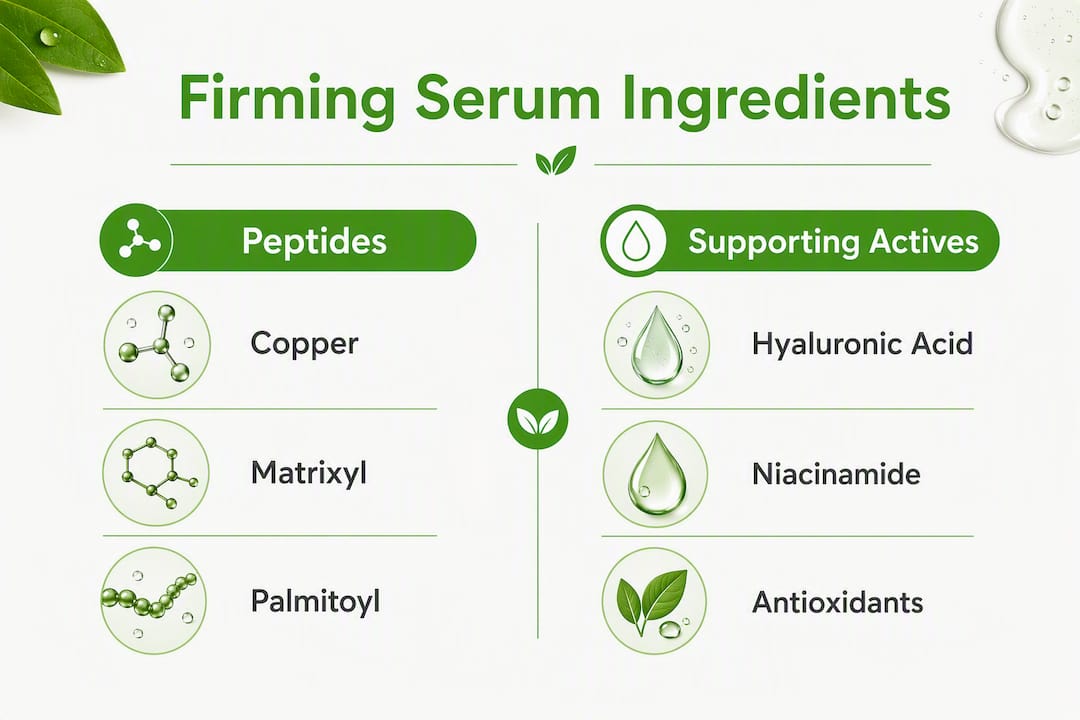
| Ingredient | Primary Effect | Tolerance Notes |
|---|---|---|
| Copper peptides | Collagen and elastin synthesis, tissue repair | Well tolerated; suitable for sensitive skin |
| Palmitoyl peptides (e.g., Matrixyl) | Matrix protein stimulation, wrinkle reduction | Generally gentle; patch-test if reactive |
| Medical-grade hyaluronic acid | Deep hydration, immediate plumping | Suitable for all skin types |
| Niacinamide (vitamin B3) | Texture refinement, barrier support, calming | Very well tolerated; pairs well with peptides |
| Retinol / retinoid derivatives | Cell turnover, collagen induction | Introduce slowly; avoid during pregnancy |
| Vitamin C (ascorbic acid) | Antioxidant protection, collagen co-factor | Can sting on sensitized skin; use AM |
| Resveratrol | Antioxidant, anti-glycation | Gentle; good for mature or reactive skin |
The combination that delivers the most balanced result for firmness is copper peptides paired with medical-grade hyaluronic acid: peptides drive the long-term structural work while HA gives you visible plumping within days. You get early feedback that keeps you consistent, and the collagen remodeling builds underneath.
Pro Tip: If your skin is sensitive or reactive, start with peptides and niacinamide only for the first four weeks. Add retinol or vitamin C only after your skin has adjusted. Introducing everything at once is the fastest way to trigger irritation and abandon a routine that would otherwise work.
How do firming serums actually produce firmer-looking skin?
The mechanism is not magic, and it is not instant. Firming serums work through three overlapping pathways:
- Peptide-driven collagen synthesis. Copper peptides and matrix peptides signal fibroblasts to produce new collagen and elastin. This is a biological process that takes weeks, not days.
- Hyaluronic acid hydration and volume. HA binds water in the dermis, physically plumping the skin from within and reducing the appearance of fine lines almost immediately.
- Retinoid-driven cell turnover. Retinol accelerates the shedding of old, damaged cells and stimulates new collagen production through a separate pathway from peptides.
- Antioxidant protection. Vitamin C and resveratrol neutralize free radicals and slow glycation, the process by which sugar molecules damage collagen fibers and accelerate sagging.
The science behind copper peptides shows they also support skin repair at the tissue level, making them particularly useful for skin that has experienced sun damage or significant laxity. The visible outcome of all these mechanisms together: lifted appearance in sagging zones, smoother texture, and reduced depth in fine lines over time.
Supporting practices amplify what the serum does. Daily broad-spectrum SPF is non-negotiable because UV exposure degrades collagen faster than any serum can rebuild it. Sleep and nutrition, particularly adequate protein and antioxidant intake, also support collagen signaling at the cellular level.
Who benefits most from a firming serum, and when should you start?
Any adult noticing early laxity, fine lines, or reduced skin bounce is a candidate. So is anyone who wants to get ahead of those changes before they become pronounced.
User profiles where a firming serum makes the most sense:
- Early prevention (30s). Collagen production begins declining in your mid-20s. Starting a peptide-based routine in your 30s builds a foundation before visible laxity sets in.
- Visible laxity (40s and beyond). This is where corrective use begins. Expect a longer timeline for meaningful change, but consistent use does produce measurable results.
- Post-weight-loss skin changes. Rapid volume loss can leave skin with reduced support. Peptide serums support the repair process, though they are not a substitute for professional intervention in severe cases.
- Mature skin seeking non-invasive support. For those who prefer topical options over procedures, a well-formulated firming serum for mature skin is the most accessible starting point.
A note on safety: If you are pregnant or breastfeeding, avoid retinol-containing formulas. Copper peptides and hyaluronic acid are generally considered safe, but always confirm with your OB or dermatologist before adding new actives during pregnancy. If you are already using prescription-strength retinoids, consult your dermatologist before layering additional peptide serums to avoid interactions.
Pro Tip: For prevention, use a peptide serum in the evening three to four nights per week to start. For corrective use, daily application morning and evening tends to produce faster visible results — but build up gradually if your skin is reactive.
How to apply a firming serum and build a routine that works
Order matters. Applying a serum over a heavy moisturizer blocks absorption; applying it to dry, unwashed skin reduces penetration. Here is the correct sequence.
Morning routine:
- Cleanse with a gentle, pH-balanced cleanser.
- Apply toner or essence if you use one (optional).
- Apply 3–4 drops of your firming serum to damp skin. Press gently into the face, jawline, and neck — do not rub.
- Follow with a lightweight moisturizer.
- Apply broad-spectrum SPF 30 or higher. This step is not optional.
Evening routine:
- Double-cleanse if you wear SPF or makeup.
- Apply 3–4 drops of serum to clean, slightly damp skin. Press into face, neck, and décolletage.
- Follow with a richer moisturizer or facial oil if needed.
- If you use retinol, apply it on alternating nights rather than simultaneously with peptides until your skin has adjusted.
The pairing of hyaluronic acid with peptides is particularly effective because HA draws moisture into the skin while peptides work at the structural level. You get the immediate plumping effect alongside the longer-term firming signal.
Pro Tip: Never layer a low-pH acid (like glycolic or lactic acid) directly on top of a peptide serum in the same application. Acids can destabilize certain peptide bonds. If you use both, apply the acid on separate evenings or wait 20–30 minutes between applications.
Avoid combining retinol and strong exfoliating acids on the same night, especially when you are new to either. Irritation from over-layering is the most common reason people abandon routines that would otherwise work.
What results can you realistically expect, and when?
Measurable improvements in firmness commonly appear within several weeks of consistent daily use. Fuller results, including visible reduction in sagging zones and improved elasticity, typically develop over a few months as collagen remodeling progresses.
Here is how the timeline breaks down:
- Days 1–7 (immediate plumping). Medical-grade hyaluronic acid delivers visible hydration and a plumper surface texture almost immediately. Fine lines look softer.
- Weeks 2–6 (early firming). Editorial testing and consumer reviews consistently report a firmer feel and improved texture within this window, consistent with the timeline for early collagen stimulation.
- Weeks 8–12 and beyond (structural remodeling). This is where the deeper work shows: improved jawline definition, reduced laxity in the cheek and neck area, and more resilient skin overall.
Practical tracking tips: take a photo in consistent lighting at the same angle every two weeks. Focus on one zone, like the jawline or nasolabial folds, rather than trying to assess your whole face at once. Progress in a single zone is easier to see and keeps you motivated through the slower middle weeks.
Pro Tip: Do not rotate between multiple firming serums during your first 8–12 weeks. Switching products mid-cycle makes it impossible to know what is working. Commit to one formula, track one zone, and evaluate after three months.
Are firming serums safe? Side effects and how to patch-test
Most firming serums are well tolerated, particularly those built around copper peptides and hyaluronic acid. The risk of irritation rises when formulas combine retinol with acids or when users layer too many actives at once.
Common side effects to watch for:
- Mild redness or stinging on first application (usually resolves within minutes)
- Dryness or flaking, especially with retinol-containing formulas
- Occasional purging (small breakouts in the first 2–4 weeks with retinoids)
- Persistent irritation, which signals you are using too many actives simultaneously
How to patch-test a new serum:
- Apply a small amount to the inside of your forearm or behind your ear.
- Leave it on for 24 hours without washing.
- Check for redness, itching, or swelling.
- If no reaction occurs, apply to a small area of your face for 2–3 days before full use.
Pro Tip: Introduce new actives one at a time, spaced at least two weeks apart. This way, if a reaction occurs, you know exactly which ingredient caused it.
The beginner’s guide to peptide introduction recommends starting with peptides and niacinamide before adding retinoids or acids, a sequence that significantly reduces the chance of irritation. If you are using a prescription retinoid, talk to your dermatologist before adding copper peptides to the same routine.
How to choose the right firming serum for your skin
The best facial firming serum for you is the one with the right actives, at effective concentrations, in packaging that protects them, from a brand that stands behind the product.
Checklist for evaluating any firming serum:
- Actives and concentration transparency. The label should list key actives (peptides, HA, retinol) with concentrations or at minimum position them near the top of the ingredient list.
- Dermatologist endorsement or clinical data. Look for evidence of testing on real skin, not just marketing claims.
- Packaging integrity. Airless pumps or dark glass protect peptides and vitamin C from oxidation. Jar packaging exposes actives to air and light with every use.
- Return policy. A brand confident in its product offers a meaningful return window. This is a direct signal of quality assurance.
- Price per milliliter. A 30 mL serum at $60 is a better value than a 15 mL serum at $50 if the formulations are comparable.
- Skin type match. Oily skin benefits from lightweight, water-based serums. Dry or mature skin can handle richer textures. Sensitive skin should prioritize fragrance-free, minimal-active formulas.
Questions to ask on any product page:
- Are the key actives listed with concentrations or ingredient-list position?
- Is there a stated clinical timeline or dermatologist endorsement?
- What is the return or satisfaction policy?
- Is the formula fragrance-free or low-fragrance?
For a direct comparison of peptide types and what to expect from each, the copper peptides vs. Matrixyl breakdown is a useful reference when you are deciding between formulas.
The clinical case for copper peptides and medical-grade hyaluronic acid
Copper peptides combined with medical-grade hyaluronic acid represent one of the most evidence-supported pairings in topical firming. Copper peptides work by binding to the GHK-Cu tripeptide complex, which activates fibroblasts to produce collagen, elastin, and glycosaminoglycans. Medical-grade HA, distinguished from cosmetic-grade by its molecular weight and purity, penetrates more effectively and holds significantly more water in the dermis.
The Copper Peptide Anti-Aging Serum from Copperpeptides is formulated around this pairing: high-purity copper peptides for structural support and medical-grade hyaluronic acid for immediate hydration and plumping. It is dermatologist-endorsed, cruelty-free, and formulated for all skin types, including sensitive skin.
The expert-vetted roundup of copper peptide serums highlights consistent customer satisfaction patterns and positions the Copperpeptides formula as a leading option for firmness, backed by a return policy that reflects the brand’s confidence in the product. Dermatologist endorsement is documented on the product page, and the stated visible-results timeline of 4–6 weeks aligns with the clinical literature on peptide-driven collagen stimulation.
Pro Tip: Look for the dermatologist-approved skincare guidance on the Copperpeptides blog for detailed clinical context on what “dermatologist-endorsed” actually means and what to look for in a credentialed recommendation.
Key Takeaways
The most effective approach to facial firming combines copper peptides for collagen stimulation with medical-grade hyaluronic acid for immediate plumping, used consistently for a minimum of 4–6 weeks.
| Point | Details |
|---|---|
| Peptide-first approach | Copper peptides drive collagen synthesis; introduce them before retinoids for better tolerability. |
| Realistic timeline | Visible plumping appears within days; measurable firmness improvements develop over 4–6 weeks. |
| Daily SPF is required | UV exposure degrades collagen faster than any serum rebuilds it; broad-spectrum SPF protects your results. |
| Ingredient transparency matters | Choose serums that list actives clearly and use airless or dark-glass packaging to protect them. |
| Copperpeptides recommendation | The Copper Peptide Anti-Aging Serum combines high-purity copper peptides with medical-grade hyaluronic acid, dermatologist-endorsed and suitable for all skin types. |
Why a peptide-first approach makes more sense for most people
The conventional wisdom in anti-aging skincare has long defaulted to retinol as the gold standard. And retinol does work. But for a significant portion of people, especially those with sensitive skin or those new to actives, retinol-first routines produce irritation, peeling, and frustration before they produce results. Many people quit before the benefits arrive.
Peptides, particularly copper peptides, offer a different path. The tolerability profile is genuinely better. You can use them daily from week one without the adjustment period that retinol demands. The collagen-support mechanism is different but complementary, and the combination of peptides with medical-grade hyaluronic acid gives you visible feedback early, which matters for consistency.
The practical trade-off is speed. Retinoids, especially prescription-strength tretinoin, can produce faster structural changes in some users. But faster is only better if you actually stay on the routine. A peptide-based regimen that someone uses every day for six months will outperform a retinoid routine that gets abandoned after three weeks of irritation.
The other thing worth saying plainly: peptides and retinoids are not mutually exclusive. Once your skin is adapted to a peptide routine, adding a low-dose retinol on alternating evenings is a logical next step, not a replacement. The peptide-first approach is a sequencing strategy, not a permanent limitation.
Pair either approach with daily SPF and you are protecting the investment. Skip the SPF and you are rebuilding collagen during the day while UV exposure tears it down.
The Copper Peptide Anti-Aging Serum is worth trying
If you have read this far, you already know what to look for in a top-rated firming serum: peptides at the top of the ingredient list, medical-grade hyaluronic acid, dermatologist endorsement, and a brand that stands behind the product with a real return policy.
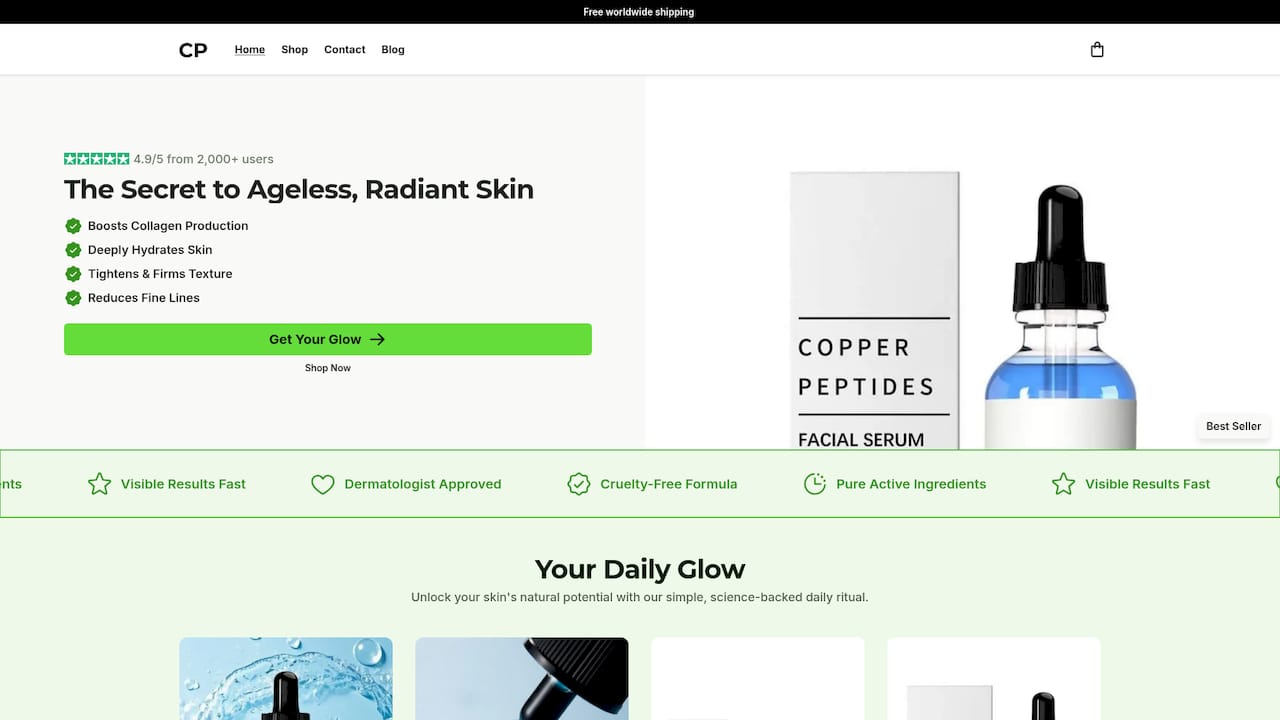
The Copper Peptide Anti-Aging Serum from Copperpeptides checks every one of those boxes. High-purity copper peptides for collagen stimulation. Medical-grade hyaluronic acid for immediate plumping and deep hydration. Dermatologist-endorsed, cruelty-free, and formulated to work on all skin types, including sensitive. The visible-results timeline is 4–6 weeks, and the return policy reflects the brand’s confidence in that claim.
A practical starter routine: use the serum every morning and evening after cleansing, pressing 3–4 drops into damp skin before moisturizer. In the morning, follow with SPF. Give it eight weeks before you judge the results.
Visit Copperpeptides to order and review the full product details, including ingredient transparency and the satisfaction guarantee.
Useful sources and further reading
The claims in this article are supported by the following sources. Copperpeptides-owned links are brand resources; the others are independent editorial or reference sources.
Independent editorial sources:
Copperpeptides brand resources: 3. Copper Peptide Anti-Aging Serum — product page 4. Copper peptide benefits: science-backed skin guide 5. Best hydrating serums for firming and anti-aging skin 6. Best hyaluronic acid serums for firming skin: copper peptide pairings 7. How to boost collagen production for younger skin 8. Peptides for beginners: copper peptide serums guide 9. Best copper peptide serums: expert-vetted picks for 2026 10. Dermatologist-approved skincare: best copper peptide serum
This article is general skincare information, not medical advice. Confirm ingredient suitability with a board-certified dermatologist, particularly if you are pregnant, breastfeeding, or using prescription topicals.
Recommended
- Best Hydrating Serums for Firming and Anti-Aging Skin – Copper Peptides Store
- Best Hyaluronic Acid Serums for Firming Skin: Copper Peptide Pairings – Copper Peptides Store
- Best Wrinkle Serums: Dermatologist Picks for Fine Lines – Copper Peptides Store
- Best Copper Peptide Serums: Expert-Vetted Picks for 2026 – Copper Peptides Store