

Peptides are the more reliable topical anti-aging choice for most people because short-chain molecules penetrate skin better and have more consistent finished-formula clinical data. Growth factors are biologically powerful signaling proteins with strong evidence for injected use in wound care, but topical cosmetic versions face real delivery and stability hurdles. Start with a well-formulated peptide serum. Reserve growth-factor products for cases with clear finished-formula human evidence or direct clinician guidance, and always introduce one new active at a time.
TL;DR:
- Topical growth factors face delivery and stability challenges, making peptides a more reliable and research-backed anti-aging option for most users.
- Small peptides penetrate skin more effectively than full-sized growth factors, allowing better cellular signaling and collagen support without requiring injections.
- Limited clinical evidence supports the use of topical growth factors, while improvements from peptide serums are more consistently documented in well-designed trials.
- Compatibility and proper storage are critical, as peptides and growth factors degrade quickly if exposed to light, air, or improper pH, affecting their effectiveness.
- Choose products with transparent ingredient lists, proven human studies, and protective packaging, avoiding marketing claims that lack supporting clinical data.
Table of Contents
- Growth Factors vs Peptides: The Core Definitions
- Evidence and Limitations for Topical Growth Factors
- What Are Peptides in Skincare?
- How Well Do Topical Peptides Actually Work?
- Can You Use Peptides and Growth Factors Together?
- How to Choose Between a Peptide Product and a Growth-Factor Product
- Where Copper Peptides Fit in the Peptide Landscape
- Molecule Size Is the Real Divide Between These Two Categories
- How Each One Actually Triggers a Cellular Response
- Do Growth Factors and Peptides Work Better Together?
- Why Storage and Shelf Life Change Everything
- Myths Worth Retiring
- When Each Approach Actually Makes Sense
- A Peptide-First Option Worth Knowing About
- Sources
- FAQ
Growth Factors vs Peptides: The Core Definitions
Growth factors are receptor-mediated signaling proteins that tell cells to divide, migrate, or rebuild tissue. Epidermal growth factor (EGF), fibroblast growth factor (FGF), and platelet-derived growth factor (PDGF) are the names you’ll see most often on ingredient lists. These are full-sized proteins, and protein size is exactly why growth factors vs peptides is a meaningful distinction rather than a marketing gimmick: bigger molecules have a harder time getting where they need to go when applied to intact skin.
Clinical medicine uses growth factors two very different ways, and conflating them causes most of the confusion around this topic.
- Injectable/intralesional use: Recombinant growth factors are injected directly into wound beds for conditions like diabetic foot ulcers, where the skin barrier is already compromised and the protein reaches living tissue directly.
- Topical cosmetic use: The same class of molecule, formulated into a cream or serum, has to survive storage, cross the stratum corneum, and stay biologically active. That’s a much taller order.
The distinction matters because a growth factor that performs brilliantly in a hospital wound-care protocol doesn’t automatically perform the same way in a jar on your bathroom shelf. Formulation, packaging, and storage conditions determine whether the protein is even intact by the time you apply it, let alone whether it can penetrate.
Evidence and Limitations for Topical Growth Factors
The clinical picture splits sharply depending on how the growth factor is delivered. Intralesional recombinant human EGF performed well in a multicenter randomized placebo-controlled trial for diabetic foot ulcers, improving granulation tissue and speeding healing in 149 patients. These are genuine, hard clinical evidence, but it’s injected directly into an open wound, not applied to intact skin for anti-aging purposes.
Trial result: A split-face randomized study of topical EGF ointment after fractional CO2 laser resurfacing found no significant difference from plain petrolatum on scab shedding, redness, water loss, or post-inflammatory pigmentation, across 19 subjects.
That single trial is a useful reality check on cosmetic-grade topical EGF claims. Context matters, though, because growth factors aren’t uniformly useless topically. A split-face study of topical rhEGF cream for acne found a 33.5% reduction in inflammatory lesions on the treated side compared to control, suggesting real, if narrow, topical benefit in specific conditions.
Common limitations show up across this body of research:
- Small sample sizes, often under 25 participants
- Inconsistent endpoints (some trials measure erythema, others measure wrinkle depth, others measure lesion count)
- Genuine penetration and formulation-stability concerns for large protein molecules
- Packaging and storage instability that can degrade the active ingredient before it ever touches skin
What Are Peptides in Skincare?
Peptides are short chains of amino acids, typically far smaller than intact growth-factor proteins, which is the practical reason they show up so often in over-the-counter serums. Smaller size generally means easier penetration and more stable formulation, and cosmetic chemists have built entire ingredient categories around exploiting that size advantage.
- Signal peptides tell fibroblasts to produce more collagen, mimicking the downstream effect of a growth factor without needing the full protein structure.
- Carrier peptides, the category that includes GHK-Cu (copper peptide), transport trace elements like copper into skin, supporting enzymatic processes tied to collagen remodeling.
- Neurotransmitter-affecting peptides work more like a topical relaxant for expression lines, softening the muscle contractions that deepen fine lines over time.
Formulators pair peptides with vehicles designed to help them cross the skin barrier, often combining them with hyaluronic acid for hydration and lipophilic carriers to aid absorption. A 2016 literature review on cosmetic growth-factor and matrikine products notes that matrikine-like peptides can mimic growth-factor signaling while being small enough for better penetration, which is a big part of why peptides have become the more dependable topical category. Peptides also carry a generally favorable safety profile, with low irritation rates across most published formulations, which is one reason they dominate mainstream anti-aging serums rather than sitting in a niche clinical category.
How Well Do Topical Peptides Actually Work?
The clinical support for topical peptides is more consistent than for topical growth factors, though it’s still an evolving picture. A 2024 systematic review of topical peptide and exosome therapies found improvements in fine lines, elasticity, and skin thickness across several early trials, but the reviewers were candid about the field’s weaknesses.
The review’s authors flagged heterogeneous study designs and a shortage of long-term follow-up data as the biggest gaps in current peptide research.
That caution is worth taking seriously, but it doesn’t erase the positive signal. One 12-week randomized, double-blind, placebo-controlled trial found measurable improvement in expression lines from a peptide serum, which is the kind of finished-formula evidence that actually tells you something about a product you can buy.
A few things worth keeping in mind:
- No topical peptide currently holds FDA approval as a drug therapeutic; peptides in skincare are regulated as cosmetics, meaning claims are limited by law to appearance, not disease treatment.
- The ingredient name on a label tells you almost nothing about whether that specific product works. The formulation does.
- Judge a product by its own human trial data whenever it’s available, not by borrowed credibility from the peptide’s general reputation.
Can You Use Peptides and Growth Factors Together?
Layering peptides and growth-factor products is possible, but compatibility depends on formulation chemistry, not just ingredient lists. pH mismatches, incompatible preservative systems, and packaging that exposes actives to air or light can all undercut a routine that looks fine on paper.
Before combining products, check a few practical things:
- Follow the manufacturer’s stated layering order; many brands publish this for a reason.
- Favor products in airless pumps or opaque packaging, since both peptides and growth-factor proteins degrade faster with light and air exposure.
- Note any pH guidance on the label. Big pH swings between layered products can destabilize actives or increase irritation.
Pro Tip: Introduce one new active every one to two weeks and patch-test on your inner arm for 48 hours first. If you’re layering onto a post-procedure regimen prescribed by a dermatologist, check with them before adding an over-the-counter peptide or growth-factor product. Post-laser or post-peel skin has a compromised barrier, and that changes both absorption and irritation risk.
How to Choose Between a Peptide Product and a Growth-Factor Product
The decision principle is simple even when the label copy isn’t: match the ingredient’s delivery profile and evidence base to your actual use case, not to how impressive the ingredient sounds.
- Read the full INCI list. Look for the specific named active, such as GHK-Cu or sh-Oligopeptide-1, rather than trusting a vague “growth factor technology” claim on the front of the bottle.
- Check for disclosed concentration. Transparent brands tell you roughly how much active is in the formula; brands hiding behind proprietary blends often have less to disclose.
- Look for finished-formula human studies, not just cell-culture or animal data on the raw ingredient.
- Confirm the packaging. Airless pumps and opaque bottles protect unstable actives; a clear jar you dip your fingers into is a red flag for anything peptide- or protein-based.
- Read the storage and usage instructions. Products meant to be refrigerated or used within weeks of opening are telling you something true about their stability.
Red flags worth walking away from: marketing language built entirely around “growth factor technology” with no named ingredient, zero human trial data anywhere on the brand’s site, and claims that promise dramatic results in days rather than weeks.
Prioritize differently depending on your goal. Sensitive skin calls for the shortest, best-tolerated ingredient list you can find. Post-procedure repair calls for clinician-directed products with documented compatibility for compromised skin. Daily anti-aging maintenance is where a well-evidenced peptide serum earns its keep.
Where Copper Peptides Fit in the Peptide Landscape
Copper peptides, specifically the GHK-Cu family, belong to the carrier-peptide category described earlier. They aren’t growth factors and don’t attempt to replicate a full signaling protein. Instead, they transport copper into skin to support the enzymatic processes involved in collagen remodeling, which is a fundamentally different mechanism than what EGF or FGF does at the receptor level.
The brand describes a copper peptide formulation combined with medical-grade hyaluronic acid, dermatologist endorsement, and visible results reported within weeks, backed by a money-back guarantee. Those are the kinds of specifics worth checking against the buyer checklist above: named active ingredient, disclosed formulation quality, and a defined result timeline instead of a vague promise. You can read more about the underlying biochemical action of copper peptides and how the clinical timeline for use typically unfolds.
Molecule Size Is the Real Divide Between These Two Categories
Growth factors run large as far as topical actives go. Full-sized proteins like EGF and FGF weigh in at several thousand daltons, and the stratum corneum acts as a size-based filter that heavily favors smaller molecules. Most peptides used in cosmetics are dramatically smaller, often single-digit to low double-digit amino acid chains, which gives them a real structural advantage for crossing skin.
This is why matrikines, the peptide fragments that mimic pieces of growth-factor signaling without carrying the whole protein, have become such a popular formulation strategy. They’re designed to trigger a similar cellular response using a molecule small enough to actually reach the dermis in meaningful concentration, rather than sitting on the skin’s surface doing very little.
That size gap explains a lot of the real-world performance difference discussed throughout this article. It’s not that growth factors are inherently weaker biologically. Intralesional EGF’s strong results in wound care prove the opposite. It’s that the topical route punishes large molecules in a way injection simply doesn’t. A cosmetic chemist can’t inject a serum, so the practical workaround has been shrinking the active molecule down to something the skin barrier will actually let through.
This is also why ingredient lists matter more than category labels. A product boasting “growth factor complex” might rely almost entirely on small matrikine peptides riding on the reputation of the larger protein family, and that’s not necessarily a bad thing. It just means the honest evaluation criterion is the specific molecule, not the buzzword attached to it.
How Each One Actually Triggers a Cellular Response
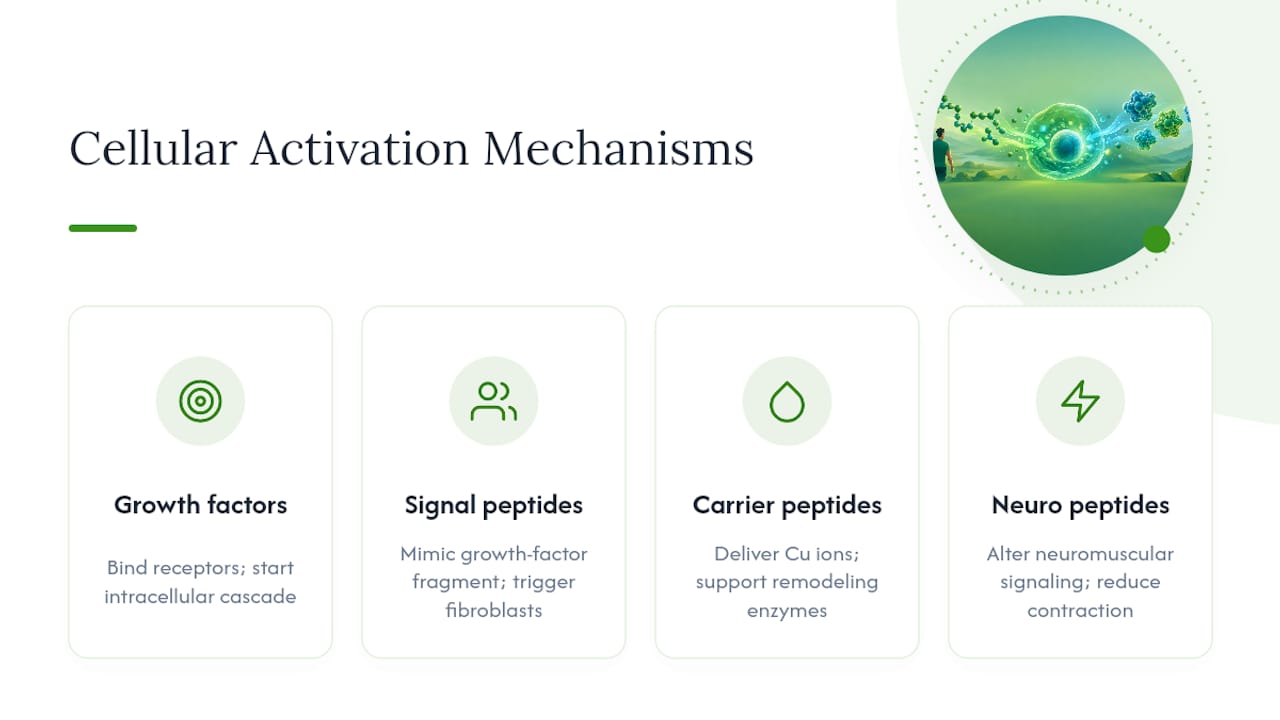
Growth factors work by binding to specific receptors on the cell surface, kicking off a signaling cascade inside the cell that tells fibroblasts to proliferate, migrate, or ramp up collagen and elastin production. It’s a precise, receptor-lock-and-key mechanism, which is part of why growth factors are so potent in wound healing: the signal is specific and strong.
Peptides work through a few different mechanisms depending on their category. Signal peptides, like growth factors, can trigger fibroblast activity, sometimes by partially mimicking the fragment of a growth-factor protein that binds the receptor, without needing the full molecule. Carrier peptides such as GHK-Cu work differently, delivering copper ions that support enzymes involved in tissue remodeling and antioxidant defense rather than binding a growth-factor receptor directly. Neurotransmitter-affecting peptides work at the neuromuscular junction, interfering with the signal that tells a facial muscle to contract, which is a mechanism that has nothing to do with collagen production at all.
The practical upshot: “peptides” isn’t one mechanism, it’s several unrelated ones sharing a size classification. When you’re comparing growth factors vs peptides on a label, you’re really comparing one relatively uniform mechanism (receptor signaling) against three or four distinct cellular pathways bundled under a single ingredient category name. That’s worth remembering the next time a product claims peptides and growth factors “work the same way.” They usually don’t.
Do Growth Factors and Peptides Work Better Together?
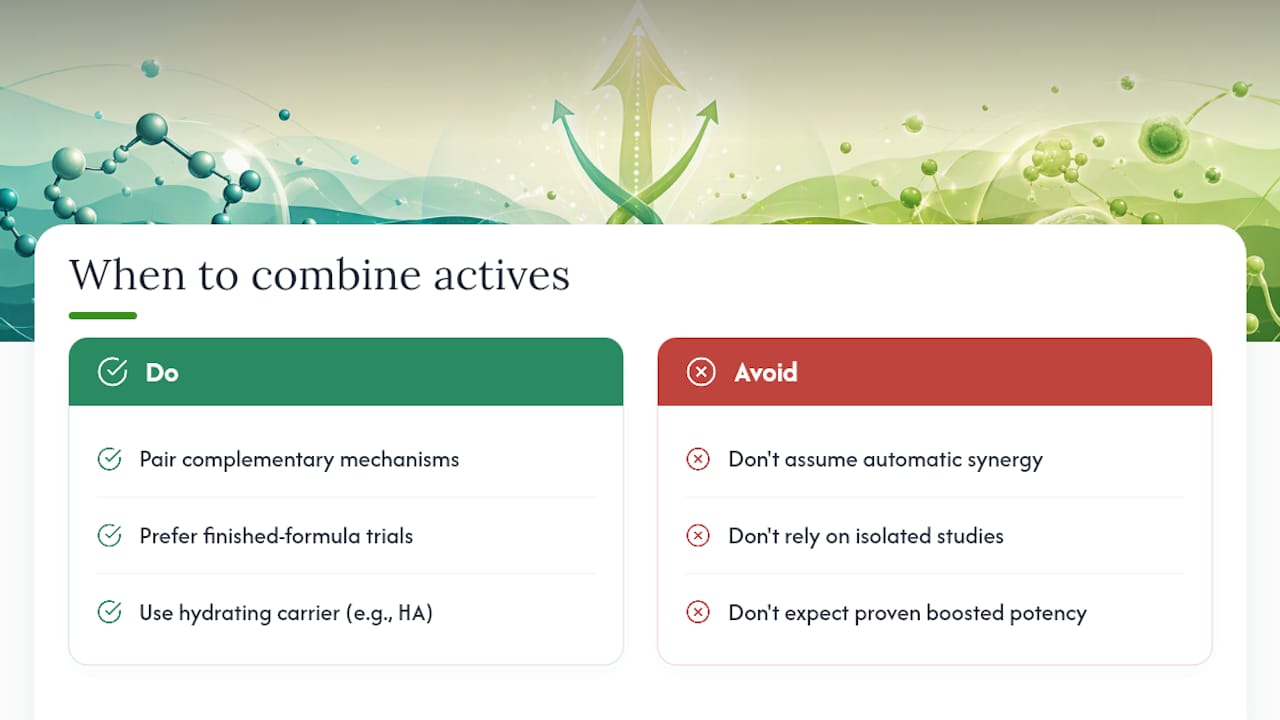
In principle, yes. Pairing a signal peptide that nudges collagen synthesis with a carrier peptide that supports the enzymatic remodeling process is a coherent strategy, since the two act on different parts of the same repair pathway rather than competing for the same cellular real estate. The same logic applies to combining a peptide with a growth factor, at least on paper.
The catch is that synergy claims are far ahead of the direct clinical evidence. Most combination-product marketing draws on studies of each ingredient in isolation rather than trials of the actual combined formula, and finished-formula human data on multi-active combinations remains thin. That gap doesn’t mean synergy is impossible. It means the honest position is that layering complementary mechanisms is biologically plausible, not that any specific combination product has been proven to outperform its individual ingredients.
The safer synergy to bank on is mechanistic complementarity rather than boosted potency. A hydrating carrier like hyaluronic acid paired with a signal peptide addresses two different skin needs (hydration and collagen support) simultaneously, and that kind of pairing has more direct trial support than protein-plus-peptide combinations aimed at amplifying a single pathway. If you’re chasing a multi-active routine, look for combination products with their own finished-formula trial data rather than assuming two good ingredients automatically add up to a better result.
Why Storage and Shelf Life Change Everything
Protein-based actives are fragile in ways that most skincare ingredients simply aren’t. Growth factors, being full-sized proteins, are vulnerable to heat, light, and oxidation, all of which can denature the protein and render it biologically inert well before the expiration date on the box. That instability is part of why one split-face trial’s authors pointed to formulation and delivery, not just biological potential, as a likely factor in disappointing topical results.
Peptides tend to be more stable than full proteins simply because they’re smaller and structurally simpler, but they’re not immune to degradation either. Copper peptides specifically can be sensitive to oxidation and light exposure, which is exactly why packaging matters as much as the ingredient list.
A few practical shelf-life rules apply across both categories:
- Opaque, airless packaging (pumps, not jars) meaningfully extends the usable life of light- and air-sensitive actives.
- Refrigeration instructions on a label aren’t a gimmick. If a brand recommends it, the ingredient probably needs it.
- Once opened, most peptide and growth-factor serums have a realistic usable window of a few months, even if the sealed shelf life is much longer.
- A product that’s been sitting open on a warm bathroom shelf for eight months is delivering a fraction of its labeled potency, regardless of what the ingredient list promises.
Myths Worth Retiring
The biggest myth is that “growth factor” automatically means stronger or more advanced than “peptide.” Biological potency and topical performance are different questions, and the evidence on split-face EGF trials makes that gap obvious. A growth factor can be extraordinarily effective injected into a wound and unremarkable in a jar on a shelf.
The second myth: bigger, more complex-sounding ingredients work better. The opposite is often true topically, since smaller matrikine peptides frequently outperform full growth-factor proteins simply because they can reach the dermis in usable concentration.
Third myth: any product mentioning “growth factor technology” contains actual recombinant growth-factor protein. Plenty of formulations use that phrase while relying almost entirely on peptide fragments, which isn’t dishonest exactly, but it does mean the ingredient list, not the marketing language, is the only reliable source of truth.
Last myth: if a little works, more works better. Concentration, delivery vehicle, and skin barrier condition all interact in ways that make “more active ingredient” a poor substitute for a well-designed, tested formula.
When Each Approach Actually Makes Sense
For daily anti-aging maintenance, a well-formulated peptide serum is the sensible starting point for most people, given the more consistent finished-formula evidence and lower irritation risk. Post-procedure repair or medically diagnosed wound situations are where clinician-directed growth-factor therapy earns its place, since that’s where the strongest trial evidence actually lives. Acne is its own case, where a topical EGF product has shown narrow but real benefit under supervision.
Start conservatively: patch-test, introduce one active at a time, and run any product against the buyer checklist above before assuming the label copy tells the whole story.
— British
A Peptide-First Option Worth Knowing About
If you’ve landed on the conclusion that a peptide serum is the more sensible starting point, Copperpeptides built its entire product around that exact logic instead of chasing growth-factor marketing language. The Copper Peptide Anti-Aging Serum is formulated around high-purity copper peptides and medical-grade hyaluronic acid, aimed squarely at firming skin texture, deep hydration, and softening fine lines rather than making broad regenerative claims it can’t back up.
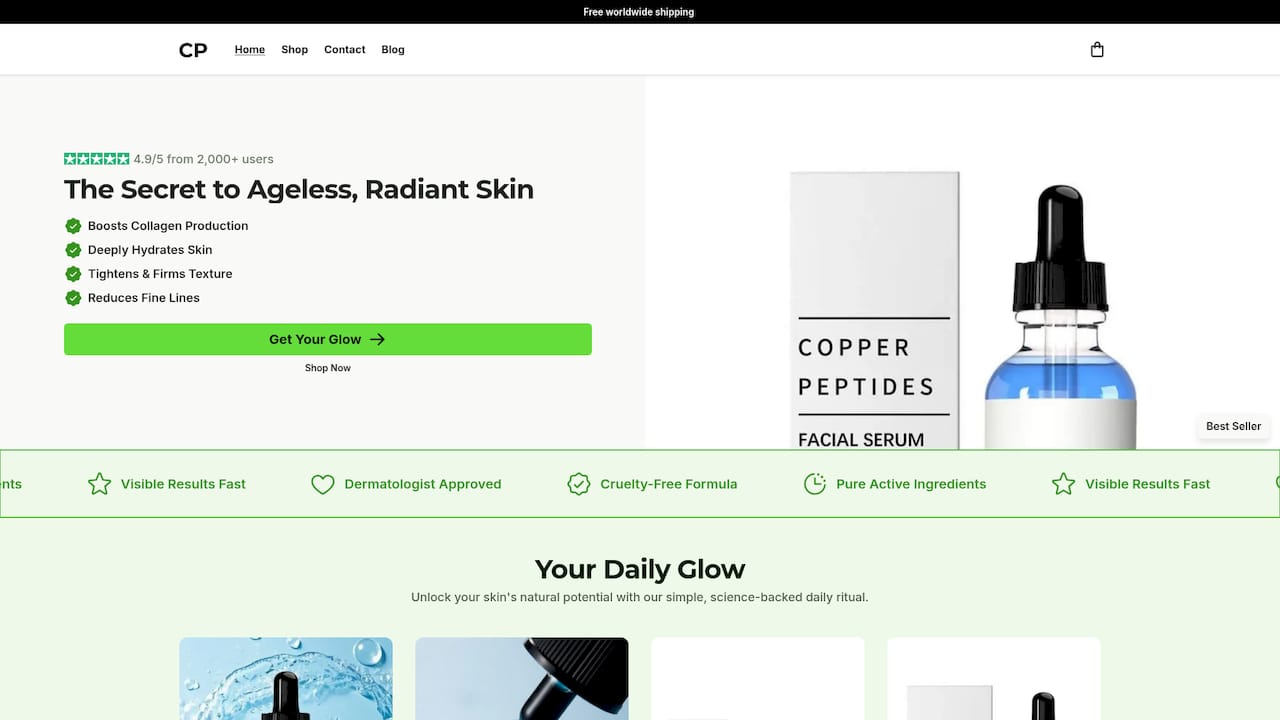
As the brand’s own claims state, the formula is dermatologist-endorsed, and customers can expect visible results within four to six weeks of consistent use. Every order carries a 30-day money-back guarantee, which gives you a real window to judge results against your own skin rather than someone else’s before and after photos. The Copper Peptide Anti-Aging Serum is priced at $20 as a one-time purchase, with no subscription required. If you want to see the full range first, browse the complete product collection and check the ingredient list against the buyer checklist covered earlier in this guide before you decide.
This article is general information, not a substitute for advice from a qualified doctor. Consult a qualified healthcare professional about your own circumstances before acting on anything here.
FAQ
Can I use peptides with growth factors?
Yes, in principle, though compatibility depends on the specific formulations, their pH, and their packaging rather than the ingredients alone. Introduce one product at a time, patch-test first, and follow manufacturer layering instructions, especially if either product is part of a post-procedure regimen supervised by a clinician.
What is better than peptides?
Nothing is universally “better,” since growth factors and peptides work through different mechanisms suited to different jobs. For daily topical anti-aging, peptides generally have more consistent finished-formula evidence; growth factors show their strongest results in clinician-supervised injectable or intralesional wound care, not over-the-counter cosmetics.
Is GHK-Cu the same as a growth factor?
No. GHK-Cu is a carrier peptide, not a growth factor. It transports copper into skin to support enzymatic processes tied to collagen remodeling, while true growth factors like EGF bind cell receptors directly to trigger a signaling cascade.
How long does it take to see results from a peptide serum?
Most peptide serums, including Copperpeptides’ copper peptide formula, show visible results within four to six weeks of consistent daily use, based on the brand’s own reported timeline. Clinical trials on peptide serums generally track outcomes over a similar 12-week window for more measurable change.
Are growth factor skincare products FDA-approved?
No topical peptide or cosmetic growth-factor product currently holds FDA approval as a drug therapeutic. They’re regulated as cosmetics, which legally limits their claims to appearance-related benefits rather than disease treatment or guaranteed regeneration.