

Topical copper peptides (GHK-Cu) produce modest, evidence-backed improvements in skin hydration, texture, and fine lines — and board-certified dermatologists confirm they support cellular repair and collagen synthesis, though they are not a replacement for prescription retinoids or in-office procedures for deep wrinkle reversal. Most people see surface changes within the first two weeks; structural improvements take 8–12 weeks of consistent use.
Here is what a realistic timeline looks like:
- Days 1–7: Skin feels more hydrated and slightly smoother. No structural change yet.
- Weeks 2–4: Surface texture refines; some people notice pores look tighter and skin tone evens slightly.
- Weeks 4–8: Fine lines begin to soften. Firmness improvements start to register, especially in thinner skin areas.
- Weeks 8–12: Measurable changes in skin thickness and elasticity, consistent with what controlled trials report. This is the window where clinical studies show the most reliable outcomes.
- 3–6 months: Continued collagen remodeling. Maintenance use sustains gains; stopping typically reverses them gradually.
Key Takeaways
Copper peptides produce real but modest improvements in skin hydration, texture, and fine lines, with structural changes requiring 8–12 weeks of consistent twice-daily use and formulation quality being the single biggest determinant of whether a product delivers on that promise.
| Point | Details |
|---|---|
| Timeline for results | Surface hydration improves in days 1–7; structural changes (firmness, fine lines) require 8–12 weeks of consistent use. |
| Evidence strength | Human trials show modest, real effects; evidence is smaller and shorter-term than for retinoids, with few large independent RCTs. |
| Formulation matters most | Choose products listing GHK-Cu by name with a stated concentration (0.05%–2%) and encapsulation or pH stability details. |
| Layering rules | Separate copper peptides from low-pH vitamin C and strong acids; alternate with retinoids on different nights. |
| Copperpeptides serum | High-purity GHK-Cu with medical-grade hyaluronic acid, dermatologist-endorsed, and formulated for all skin types including sensitive skin. |
Table of Contents
- What are copper peptides (GHK-Cu)?
- How do copper peptides work on skin?
- What do clinical studies actually show?
- What does a realistic week-by-week timeline look like?
- How do copper peptides compare to retinoids and other peptides?
- How should you use copper peptides for best results?
- Are copper peptides safe, and what side effects should you know about?
- Why do copper peptides results vary so much between people?
- How do you evaluate a copper peptide product before buying?
- What does the science not yet prove about copper peptides?
- An honest perspective on where copper peptides actually fit
- Copperpeptides fits the criteria this article describes
- Sources
What are copper peptides (GHK-Cu)?
GHK-Cu is a tripeptide made of glycine, histidine, and lysine, bound to a copper ion. It occurs naturally in human plasma, saliva, and urine, and its concentration drops with age.
Its natural roles in the body include:
- Wound repair and tissue remodeling: GHK-Cu accelerates healing by recruiting repair cells and signaling matrix remodeling.
- Collagen and elastin support: It stimulates fibroblasts to produce structural proteins that keep skin firm.
- Anti-inflammatory and antioxidant signaling: It modulates inflammatory pathways and reduces oxidative damage.
- Copper delivery to enzymes: It shuttles copper to cuproenzymes like lysyl oxidase, which cross-links collagen and elastin fibers for structural integrity.
Topical formulations aim to reproduce these actions by delivering GHK-Cu to the dermis, where fibroblasts live. Whether a product achieves that depends heavily on formulation quality — but more on that shortly.
How do copper peptides work on skin?
The core mechanism: GHK-Cu signals fibroblasts to ramp up collagen and elastin production, helps copper-dependent enzymes function, and modulates gene expression in ways that favor tissue repair over breakdown.
More specifically:
- Fibroblast activation: GHK-Cu stimulates dermal fibroblasts, the cells responsible for producing collagen type I and III, elastin, and the extracellular matrix that gives skin its structure.
- Glycosaminoglycan synthesis: It increases hyaluronic acid and other glycosaminoglycans in the dermis, which directly improves hydration and plumpness.
- Antioxidant and anti-inflammatory signaling: GHK-Cu downregulates inflammatory cytokines and neutralizes free radicals, making it particularly useful for skin barrier support and recovery.
- Cuproenzyme activation: By delivering copper to lysyl oxidase, it supports the cross-linking of newly synthesized collagen and elastin, which is what gives those fibers their mechanical strength.
The evidence supporting these mechanisms spans in vitro cell studies, animal models, gene-expression analyses, and human topical trials. That hierarchy matters. Cell and animal studies establish the mechanism clearly. Human trials are smaller and shorter, but they do exist and they show real effects. The PMC review of GHK-Cu documents all of these biological actions and notes the human clinical data, while acknowledging the evidence is more limited than for prescription actives.
What do clinical studies actually show?
The honest summary: consistent signals of modest improvements in firmness, skin thickness, and fine lines across 8–12 week topical trials, with the strongest evidence base in wound healing contexts. The cosmetic anti-aging data is real but comes with caveats.
Key findings from the clinical literature:
- Controlled trials report measurable improvements in skin thickness, firmness, and wrinkle volume after approximately 8–12 weeks of topical GHK-Cu application, though many of these trials are small or industry-sponsored.
- Wound-healing studies, including work on diabetic patients, show more robust effects, supporting the peptide’s role in repair and tissue remodeling.
- Gene-expression analyses show GHK-Cu modulates hundreds of genes related to collagen synthesis and inflammation, which gives the mechanistic case a strong foundation even where human trial data is thin.
Study limitations worth knowing:
- Most trials involve small sample sizes (often fewer than 30 participants).
- Trial windows are typically 8–12 weeks — long enough to see early structural changes, not long enough to assess durability.
- Many studies are industry-sponsored, which introduces potential bias.
- Formulations vary widely, with differences in delivery systems affecting results across products.
- There are few large, independently replicated randomized controlled trials (RCTs) isolating GHK-Cu as a single variable.
An independent deep dive into the evidence reaches the same conclusion: the mechanistic data are compelling and human trials show modest, real effects on fine lines and elasticity, but the evidence base is thinner than what exists for retinoids or vitamin C. That is not a reason to dismiss copper peptides — it is a reason to use them with calibrated expectations.
Pro Tip: When evaluating a copper peptide product’s clinical claims, check whether the cited study used the same delivery system (nanoencapsulated vs. free peptide) and concentration as the product itself. A study on a controlled delivery system does not automatically validate a standard serum.
What does a realistic week-by-week timeline look like?
Surface changes come first because hydration and barrier improvements happen faster than new collagen formation. Structural changes require fibroblast activation, protein synthesis, and matrix remodeling — a biological process that takes weeks, not days.
Day 1–7 Skin feels more hydrated within the first few applications. This is the glycosaminoglycan effect: GHK-Cu boosts hyaluronic acid production and improves water retention. Surface smoothness often improves noticeably. No visible change in lines or firmness yet.
Weeks 2–4 Texture continues to refine. Some people notice a subtle evening of skin tone and reduced redness, consistent with the anti-inflammatory signaling mechanism. Pores may appear tighter as hydration plumps the surrounding tissue. Community observations consistently report these early subjective improvements in the first two weeks, with visible firmness and line softening appearing around 6–12 weeks with consistent use.
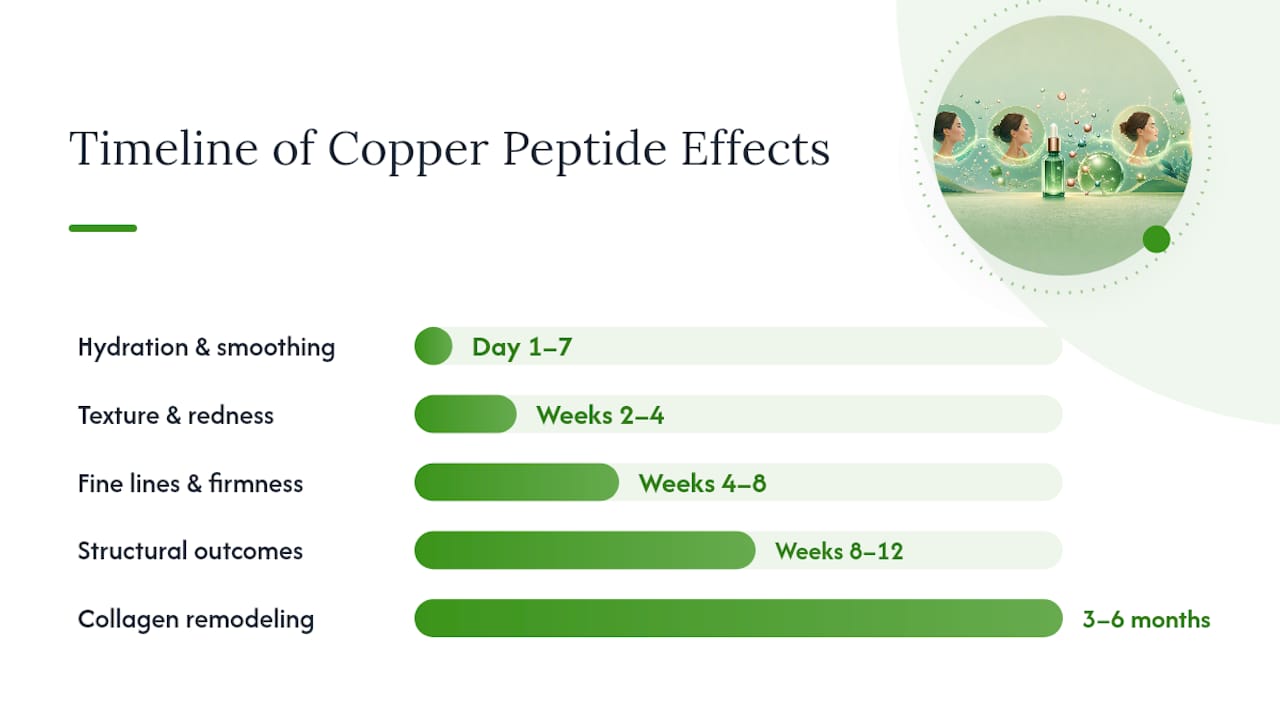
Weeks 4–8 Fine lines in thinner skin areas (around the eyes, upper lip) begin to soften. Firmness improvements start to register. This is when most people first notice a “before and after” difference in photographs.
Weeks 8–12 The window where clinical trials measure structural outcomes: skin thickness, elasticity, and wrinkle depth. Consistent twice-daily use over this period is what the evidence is based on. Skipping applications slows the process.
3–6 months Continued collagen remodeling. Gains are maintained with ongoing use; the skin does not hold improvements indefinitely once you stop. Think of it as maintenance, not a one-time fix.
Progress tracking checklist:
- Photograph in consistent lighting (same angle, same time of day) at weeks 0, 4, 8, and 12.
- Note texture under your fingertips: does skin feel smoother, less rough?
- Press gently on the cheek and release: does it spring back faster?
- Track fine-line depth in the crow’s-feet area — this tends to respond earliest.
How do copper peptides compare to retinoids and other peptides?
Copper peptides are supportive and gentler, working through matrix support and repair signaling rather than the accelerated cell turnover that retinoids drive. That distinction shapes when you should reach for each one.

| Feature | Copper peptides (GHK-Cu) | Retinoids | Other signaling peptides |
|---|---|---|---|
| Primary mechanism | Fibroblast stimulation, matrix support, copper delivery | Accelerated cell turnover, retinoic acid receptor activation | Varies: neurotransmitter inhibition, growth factor mimicry |
| Timeframe for visible change | 4–8 weeks (surface); 8–12 weeks (structural) | 3–6 months for full effect | 4–12 weeks depending on type |
| Irritation risk | Low; generally well tolerated | Moderate to high, especially at first | Low to moderate |
| Best for | Sensitive skin, barrier repair, post-procedure recovery, maintenance | Deep wrinkles, photoaging, acne, pigmentation | Complementary firming, hydration support |
| Compatibility | Avoid low-pH vitamin C and strong acids in same application | Avoid mixing with AHAs/BHAs; use SPF | Generally compatible with most actives |
Practical guidance:
- Choose retinoids when the goal is correcting deep wrinkles, significant photoaging, or acne. The evidence base is larger and the effects more dramatic, but so is the irritation risk.
- Choose copper peptides for sensitive skin, barrier recovery after procedures, or as a maintenance ingredient once you have achieved your baseline with retinoids.
- For a comparison of copper peptides versus other peptide actives like Matrixyl, the key difference is mechanism: GHK-Cu delivers copper to enzymes and modulates gene expression broadly, while Matrixyl primarily signals collagen synthesis through a different pathway.
- Layering rules: use copper peptides and retinoids on alternating nights, or apply copper peptides in the morning and retinoids at night. Never apply them simultaneously — the interaction can reduce efficacy of both. Formulation guidance from clinician sources consistently recommends separating copper peptides from low-pH vitamin C and strong acids.
How should you use copper peptides for best results?
Morning routine:
- Cleanse with a gentle, pH-balanced cleanser.
- Apply any hydrating toner or essence.
- Apply copper peptide serum to slightly damp skin — this aids absorption.
- Follow with a moisturizer that complements the serum (hyaluronic acid pairings work well; see hydrating serum pairings).
- Finish with SPF 30 or higher. Sun protection is non-negotiable: UV damage undoes collagen gains faster than any serum can rebuild them.
Evening routine:
- Double-cleanse if you wore sunscreen or makeup.
- Apply copper peptide serum.
- If using retinoids, apply them on alternating nights rather than the same night as copper peptides.
- Seal with a moisturizer.
Patch test first: Apply a small amount to the inner forearm for 24–48 hours before full-face use. Copper peptides are generally well tolerated, but individual reactions vary.
Actives to separate:
- Vitamin C (ascorbic acid at low pH): Apply at a different time of day or on different days. Low-pH vitamin C can destabilize GHK-Cu.
- AHAs and BHAs: Same rule. Strong acids disrupt the peptide’s stability and can cause irritation when combined.
- Niacinamide: Generally compatible. For specific copper peptides and niacinamide pairing guidance, both can typically be used in the same routine without conflict.
Pro Tip: Formulation stability matters more than concentration alone. Check whether the product specifies pH range or encapsulation technology.
Are copper peptides safe, and what side effects should you know about?
Topical copper peptides are generally well tolerated across skin types, including sensitive skin. Serious adverse effects are rare, but a few precautions apply.
Known side effects and precautions:
- Mild irritation or redness on first use, particularly in sensitive skin. Usually resolves within a few days.
- Allergic contact dermatitis is possible but uncommon. Patch testing before full-face use catches this early.
- Skin purging is not a typical copper peptide response (that is more characteristic of retinoids and exfoliants), but some people report a brief adjustment period.
- Avoid combining with low-pH vitamin C serums, strong AHAs/BHAs, or other highly acidic actives in the same application — this destabilizes the peptide and can cause irritation.
- Injectables and compounded formulations are a different category entirely and should only be used under direct medical supervision. Topical OTC serums are the appropriate route for self-directed use.
Red flags that warrant a dermatologist visit:
- Persistent redness, swelling, or itching that does not resolve after stopping use.
- Any reaction in skin with active inflammatory conditions (rosacea, eczema flare, open wounds from procedures) — consult a dermatologist before starting.
- If you are considering copper peptide injectables or compounded high-concentration formulations, a dermatologist’s guidance is required.
For dry or sensitive skin types, copper peptides are often better tolerated than retinoids, making them a practical starting point for people who cannot tolerate stronger actives. The Women’s Health coverage of dermatologist views consistently describes them as gentle and supportive, with a clinical signal that is promising but less extensive than for retinoids.
Why do copper peptides results vary so much between people?
Results depend on skin baseline, age, genetics, product formulation, consistency, and sun protection. No single factor dominates — they compound.
Baseline skin condition: People with moderate photoaging and early fine lines tend to see the most noticeable changes. Severely damaged skin may need more aggressive interventions alongside copper peptides; very young skin with minimal damage will show subtler improvements simply because there is less to correct.
Age and genetics: Collagen synthesis slows with age, and genetic variation in genes related to collagen production (such as COL1A1 and TGFB1 expression differences) can shift an individual’s visible response window by several weeks. This explains some of the variability you see in before-and-after comparisons online.
Formulation and delivery system: This is the factor most people underestimate. Clinical-strength effects are most often reported from nanoencapsulated or otherwise stabilized delivery systems at therapeutic concentrations. Many over-the-counter serums may be sub-therapeutic — either too low in concentration or formulated in a way that degrades the peptide before it reaches the dermis. Most dramatic trial results were achieved with controlled delivery systems and specific concentrations rather than broadly available OTC serums.
Consistency: Twice-daily use over 8–12 weeks is what the evidence is based on. Sporadic application produces sporadic results.
Sun exposure: UV radiation degrades collagen faster than copper peptides can build it. Daily SPF is not optional if you want to see the ingredient’s full effect.
Concurrent treatments: Combining copper peptides with complementary actives (hyaluronic acid, niacinamide, gentle peptides) tends to amplify results. Combining with destabilizing actives (strong acids, low-pH vitamin C) can reduce them.
Action priorities:
- Choose a product with a stable formulation and a stated concentration or encapsulation method.
- Apply consistently, twice daily, for at least 12 weeks before judging.
- Wear SPF every morning.
- Photograph progress at weeks 0, 4, 8, and 12 in consistent lighting.
How do you evaluate a copper peptide product before buying?
Prioritize formulation stability, transparent ingredient labeling, and validated concentration ranges. Marketing language about “peptide complexes” tells you almost nothing useful.
Must-have on the label:
- GHK-Cu listed by name (not buried in a vague “peptide blend”).
- Concentration guidance or a stated percentage (look for the 0.05%–2% range).
- pH range or encapsulation details, or at minimum a formulation note indicating stability.
- No incompatible actives in the same formula (strong acids, low-pH vitamin C).
Nice to have:
- Nanoencapsulation or liposomal delivery — these improve dermal penetration.
- Published in-house clinical data or third-party testing.
- Dermatologist endorsement backed by a named clinician, not a generic claim.
- Complementary ingredients like medical-grade hyaluronic acid that support hydration without destabilizing the peptide.
Red flags:
- “Peptide complex” with no named peptides or concentrations.
- Very low pH formula (below 4) with no encapsulation — this degrades GHK-Cu.
- Claims of “instant results” or “replaces Botox” — neither is supported by the evidence.
- No ingredient list transparency.
Price is not a reliable proxy for quality. A well-formulated mid-range serum with stated GHK-Cu concentration and encapsulation will outperform an expensive product with vague peptide claims. For a shopper-focused review of copper peptide serums that applies this rubric, the key differentiators are formulation transparency and delivery system, not price tier.
For additional context on how cosmetic peptide efficacy testing methods work, randomized double-blind testing is the standard that separates credible clinical claims from marketing.
What does the science not yet prove about copper peptides?
Good mechanistic and small-trial support exists, but few large, long-term, independent RCTs isolate GHK-Cu as a single variable. That gap matters when setting expectations.
Specific gaps in the current evidence:
- Small sample sizes: Most human trials involve fewer than 30–50 participants, limiting statistical power and generalizability.
- Short trial windows: The 8–12 week window captures early structural changes but says nothing about whether gains persist at 6 months, 1 year, or beyond.
- Formulation variability: Trials use different delivery systems, concentrations, and base formulas, making cross-study comparisons unreliable.
- Industry sponsorship: A significant portion of positive trials are funded by ingredient suppliers or cosmetic companies, introducing potential bias.
- Sparse long-term maintenance data: There is little evidence on what happens when you stop using copper peptides after achieving improvements.
- Weak evidence for oral or non-topical routes: The compelling mechanistic data is largely for topical application; oral supplementation and injectable routes outside clinical settings have much thinner evidence bases.
- Hair growth claims: Copper peptides are sometimes marketed for hair growth, but the evidence for topical GHK-Cu specifically driving meaningful hair regrowth in humans is preliminary and not yet well replicated in large independent trials.
The practical implication: use copper peptides as a complementary, maintenance-focused ingredient rather than a standalone solution for deep wrinkles or significant photoaging. They work best alongside a broader routine that includes SPF, barrier support, and — where tolerated — retinoids for correction.
An honest perspective on where copper peptides actually fit
The skincare industry has a habit of cycling ingredients through hype cycles that distort what they actually do. Copper peptides are genuinely interesting — the mechanistic case is stronger than for most cosmetic peptides, and the human trial data, while modest, is real. But the conversation around them often swings between two unhelpful extremes: dismissing them as marketing fluff or positioning them as a retinoid replacement.
Neither is accurate. The more useful frame is this: copper peptides are a repair and maintenance ingredient with a solid biological rationale and a growing, if still limited, clinical record. They are not a corrective tool for deep wrinkles — retinoids and procedures do that job better. What copper peptides do well is support the skin’s own repair machinery, reduce inflammatory load, and help maintain collagen density over time. For people who cannot tolerate retinoids, or who want to extend the gains from a procedure, they fill a real gap.
The formulation quality issue is the part most articles gloss over. A poorly stabilized serum at sub-therapeutic concentration will not reproduce what a controlled clinical trial achieved. That is not a reason to avoid the ingredient — it is a reason to be selective about the product. Transparency on concentration and delivery system is the single most useful filter when choosing.
The 12-week commitment is also non-negotiable. Judging a copper peptide serum at four weeks is like judging a strength training program after a month: you will see early signals, but the structural adaptation takes longer. Photograph your skin, be consistent, protect it from UV, and give the ingredient the time the biology actually requires.
Copperpeptides fits the criteria this article describes
Copperpeptides formulates its copper peptide anti-aging serum around the exact features the shopper’s rubric above identifies: high-purity GHK-Cu, medical-grade hyaluronic acid for hydration support, dermatologist endorsements, and a cruelty-free formulation safe for all skin types including sensitive skin.
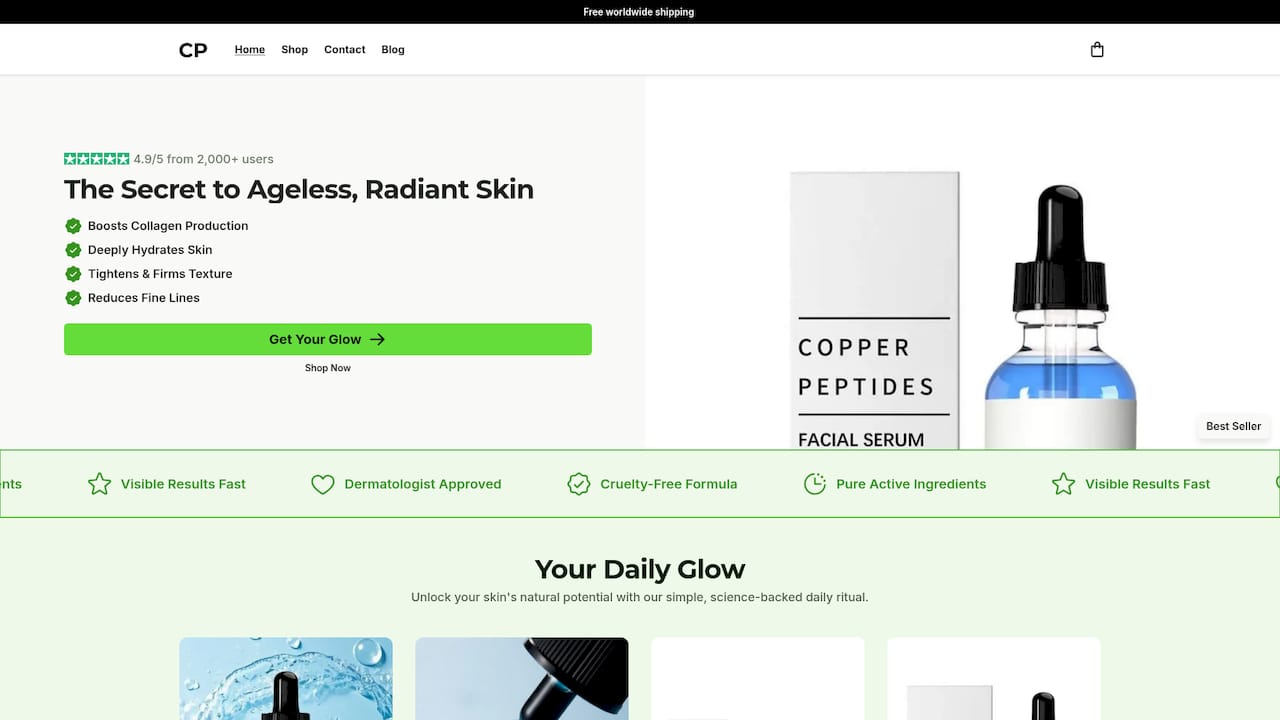
The hyaluronic acid pairing is not incidental. It addresses the early hydration phase of the timeline directly, while the GHK-Cu works on the longer structural arc. Visible results typically appear within four to six weeks, with the most meaningful changes in firmness and fine lines at the 8–12 week mark, consistent with what the clinical evidence supports.
Before starting, patch-test on your inner forearm for 24–48 hours. If you are considering copper peptide injectables or compounded formulations, those require a dermatologist’s supervision; this serum is a topical product for self-directed use. The brand backs its product with a return policy that reflects confidence in the formulation.
Ready to start the 12-week commitment? The serum is available directly at Copperpeptides.
Sources
The sources below span mechanistic reviews, clinical trials, and practice-oriented explainers. Independent RCTs carry more weight than industry-sponsored studies; mechanistic reviews establish the biological rationale but do not substitute for human trial data.
- A Dermatologist’s Take on the Copper Peptide (GHK-Cu) Skin Care Trend
- PMC article: (review) — GHK-Cu and tissue repair / skin benefits
- GHK-Cu (Copper Peptide) Deep Dive: How It Works and What Evidence Supports It
- Copper Peptides GHK-Cu: Benefits for Skin, Studies & Use 2026
This article is general information, not a substitute for advice from a qualified doctor. Consult a qualified healthcare professional about your own circumstances before acting on anything here.
Recommended
- Copper Peptides vs Matrixyl: Which One Actually Works? – Copper Peptides Store
- Copper Peptide Benefits: A Science-Backed Skin Guide – Copper Peptides Store
- Peptides for Beginners: Copper Peptide Serums Guide – Copper Peptides Store
- Copper Peptides and Niacinamide: How to Use Them Together – Copper Peptides Store