

Topical copper peptides (GHK-Cu) can improve the look of crow’s feet for some people, but only when the formulation actually gets the peptide into the skin. Expect better hydration and a firmer feel within weeks, though visible changes in fine lines vary. Results depend heavily on delivery, not on the label alone.
TL;DR:
- A randomized trial involving 13 people found higher satisfaction, but objective wrinkle measures did not differ significantly from the control group.
- Choose a serum that identifies GHK and describes liposomal, encapsulated, or palmitoyl delivery; vague copper labeling reveals little about skin penetration.
- A trial lasting 28 days found fewer and shallower crow’s feet with a small blend containing multiple peptides, not GHK copper peptide alone.
- Patch test first, apply along the outer eye bone rather than the lash line, and begin every other night before increasing use.
- Keep strong acids and exfoliants to separate nights, wear sunscreen each morning, and consult a dermatologist about deep or rapidly changing lines.
Table of Contents
- How copper peptides work and why delivery matters
- What clinical studies show for periocular wrinkles
- Is it safe to use copper peptides near your eyes?
- How to use copper peptides for crow’s feet: application and timeline
- What to look for in a copper peptide eye serum
- Our take: useful, but formulation decides
- Why our Copper Peptide Anti-Aging Serum fits crow’s feet
- FAQ
- Sources
How copper peptides work and why delivery matters
GHK-Cu is a small peptide that occurs naturally in the body and declines with age. Laboratory and animal work shows it stimulates collagen and glycosaminoglycan synthesis, which is why it gets attention for thin, crepey skin around the eyes. Reviews of cosmetic studies also describe tighter, denser skin and fewer fine lines in some human applications.
The catch is physical. GHK-Cu is highly water-loving, so it struggles to cross the stratum corneum, the skin’s outer barrier. Practitioner-level reviews note that products without delivery technology may stay largely on the surface. That is why two serums with the same ingredient name can behave very differently.
Common strategies to improve penetration include:
- Liposomes: fatty vesicles that encapsulate the peptide; one study built roughly 100 nanometer liposomes loaded with GHK-Cu and measured elastase inhibition in vitro.
- Palmitoylation: attaching a fatty acid chain so the molecule moves through skin lipids more easily.
- Nanocarriers: other tiny particle systems that shuttle the peptide deeper.
- Microneedles: a procedure-level approach that creates temporary channels in the skin.
If you want more reading on delivery science, the MyHair research hub collects clinical resources on peptide and skin research.
Pro Tip: Look for explicit delivery language and any stability information on the label. A bare “contains copper peptides” line tells you very little.
What clinical studies show for periocular wrinkles
The human evidence is encouraging but thin. In a small randomized controlled trial of 13 people using GHK-Cu on laser-resurfaced skin, patient satisfaction was higher, yet objective wrinkle measures did not differ significantly from control.
Patient-reported skin quality satisfaction improved (p = 0.04) in a 13-person trial, while objective wrinkle reduction was not statistically significant. That gap is the honest summary of the single-ingredient evidence so far.
A few points help you read the research:
- Many positive reports come from small or industry-sponsored studies, and larger independent trials are limited.
- Experts describe GHK-Cu as promising for regeneration and collagen cross-linking, but independent modern data confirming wrinkle reduction across diverse populations is still missing.
- Periocular trials of peptide formulas do show measurable gains in hydration, firmness and elasticity at 4 to 12 weeks, as in a clinical study of a peptide eye formulation.
- A 28-day multi-peptide eye serum trial reported reductions in crow’s feet number, depth and volume using instrumented analysis, though that was a blend of peptides in a small cohort, not GHK-Cu alone.
Instrumented measures such as wrinkle depth and skin density are less swayed by expectation, while subjective reports capture what you actually notice in the mirror. Both matter, and a product that moves only one of them deserves cautious interpretation. The fair conclusion: promising, formulation-dependent, and not guaranteed for everyone.
Is it safe to use copper peptides near your eyes?
Irritation is the usual worry with copper, and the data here is reassuring. In cell-based keratinocyte tests, GHK-Cu showed markedly lower irritation potential than inorganic copper salts such as copper chloride and copper acetate, and it did not raise typical irritation biomarkers. That is lab evidence rather than a guarantee for every face, so sensible habits still apply.
- Avoid stacking strong actives: high-strength acids and aggressive exfoliants on the same evening can irritate thin eye-area skin.
- Patch test first: try a small amount on the outer eye area or behind the ear for a few days, especially with sensitive skin or rosacea.
- Keep it out of the eye: apply to the bone at the outer corner, not the lash line.
- Stop and get advice: persistent redness, swelling, burning or any unexpectedly severe reaction is a reason to pause the product and see a clinician.
Pro Tip: Start every other night and watch your skin for a week before moving to daily use. For more on pacing, see our guide to starting frequency by skin type.
How to use copper peptides for crow’s feet: application and timeline
A simple routine beats an elaborate one. Here is how we suggest approaching it:
- Cleanse and pat skin lightly dry.
- Dispense a pea-sized amount and warm it between your fingertips.
- Dab gently along the outer eye area and the bone beneath it, staying clear of the eye itself.
- Start every other day for the first couple of weeks, then move to daily if your skin stays calm. Sensitive skin may want to stay at the slower pace longer.
- Follow with a moisturizer or hyaluronic acid layer; our notes on layering hyaluronic acid with peptides explain why that pairing helps visible hydration.
- Keep acids and exfoliants on separate nights, or at least well apart from your peptide step.
- Wear sunscreen every morning, since sun exposure is one of the biggest drivers of crow’s feet.
Set realistic expectations. Early hydration and a smoother, firmer feel can show up within weeks, while measurable change in lines may take time, depending on the formulation and its delivery. Dermatology discussions also stress that periocular aging is multifactorial, so combining peptides with protective agents tends to work better than relying on one ingredient. A single-ingredient serum can still be a clean starting point; our two-week rule for beginners explains how to evaluate it without overloading your routine.
Pro Tip: Take well-lit, makeup-free photos from the same angle at regular intervals. Crow’s feet change slowly, and photos beat memory.

What to look for in a copper peptide eye serum
Use this checklist when comparing products:
- Delivery language: liposomal, encapsulated or palmitoyl-derivative wording signals the formula was designed to reach the dermis.
- Clear peptide identification: the label should name GHK-Cu, not just “copper complex” or “copper extract.”
- Supportive ingredients: medical-grade hyaluronic acid and gentle antioxidants help hydration and protection without crowding the formula with irritants.
- Trust signals: dermatologist endorsement, clinical data, transparent concentrations, and a clear usage and return policy.
- Red flags: vague “copper” labeling, no peptide named, or aggressive complementary actives such as strong acids in a product meant for the eye area.
If a serum cannot answer these basics, keep looking.
Our take: useful, but formulation decides
Copper peptides are a reasonable bet for crow’s feet, not a miracle. The evidence points to real effects on firmness and hydration, with wrinkle changes that depend on whether the formula delivers the peptide. My recommendation is pragmatic: choose a targeted serum with credible delivery, patch test it, and track your skin over time before judging it. If your lines are deep or changing quickly, see a dermatologist rather than waiting on a serum.
— British
Why our Copper Peptide Anti-Aging Serum fits crow’s feet
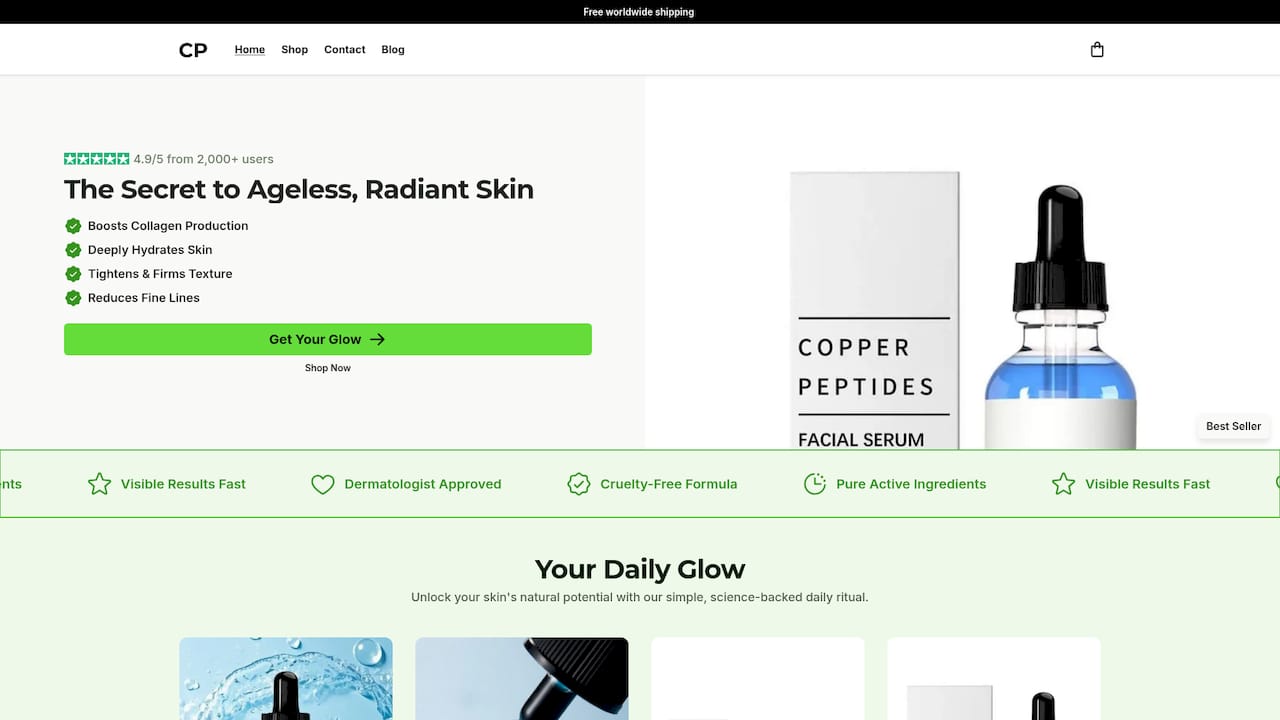
We formulated our serum with high-purity copper peptides and medical-grade hyaluronic acid, and it is dermatologist endorsed. Our own stated timeline for visible results is several weeks, so check the product terms for details of any money-back offer. Review the details of our Copper Peptide Anti-Aging Serum and see whether it matches the checklist above.
FAQ
Do copper peptides help sagging skin?
They may help skin feel firmer and denser. Reviews report that GHK stimulates collagen and glycosaminoglycan synthesis, and cosmetic studies describe improved density and firmness in some users. Results vary, and they are modest rather than lift-like.
What should you not mix copper peptides with?
Avoid layering them in the same routine with high-strength acids or aggressive exfoliants, which can irritate thin eye-area skin. Alternate nights or separate steps widely, and patch test anything new. Gentle hydrators like hyaluronic acid are a better pairing.
What are the downsides of copper peptides?
The main limits are formulation dependence and a lack of large independent trials. Experts note a gap in modern clinical data confirming wrinkle reduction in every population. Irritation potential is low compared with inorganic copper salts, but sensitive skin should still patch test.
How long do copper peptides take to work on crow’s feet?
Hydration and firmness often improve within weeks, while visible changes in lines vary and depend on the formulation and its delivery. Consistent use and daily sunscreen make results easier to see.
Sources
- Effects of Topical Copper Tripeptide Complex on CO 2 Laser–Resurfaced Skin
- Selected Biomarkers Revealed Potential Skin Toxicity Caused by Certain Copper Compounds
- Liposomes as Carriers of GHK-Cu Tripeptide for Cosmetic Application
- GHK Peptide as a Natural Modulator of Multiple Cellular Pathways in Skin Regeneration