

For most people, the safest way to start with copper peptides is every other day for the first two to four weeks, moving to once daily if your skin tolerates it well. Some people eventually build up to twice daily. This gradual pace lines up with how GHK-Cu affects skin at the cellular level, and it gives you room to watch for irritation before increasing use. Visible changes in texture and firmness commonly show up after several weeks of regular use.
TL;DR:
- Start every other day for two to four weeks, move to daily only if skin stays comfortable, and consider twice daily only after continued tolerance.
- Sensitive or reactive skin should stay at two to three applications weekly for longer, and any increase should wait until irritation has settled.
- Patch test on the inner forearm for 24 to 48 hours before facial use, and consult a dermatologist if irritation persists.
- Use copper peptides on alternate nights from retinoids and strong acids, and finish any morning routine with sunscreen because peptides do not replace sun protection.
- Visible changes in texture and firmness commonly take four to six weeks of regular use, so record progress every two weeks before judging results.
Table of Contents
- How often to use copper peptides based on your skin type
- Building tolerance: a week-by-week ramp-up plan
- When to use copper peptides and what to pair them with
- What to expect and when you’ll start seeing results
- Staying safe: patch testing and recognizing overuse
- How our serum fits the same frequency guidelines
- Does it interact with peptides, niacinamide, and other ingredients?
- How to apply copper peptides for better absorption
- A conservative approach pays off over time
- Ready to build your copper peptide routine?
- FAQ
- Sources
How often to use copper peptides based on your skin type
Frequency is not one-size-fits-all. Your starting point depends on how reactive your skin tends to be and how long you have been using active ingredients in general.
- Beginners: apply copper peptides two to three times a week, or every other day, for the first two to four weeks.
- Normal or tolerant skin: once daily, either morning or night, with a possible move to twice daily if your skin stays calm.
- Sensitive or reactive skin: stay at two to three times weekly longer, and patch test before any increase in frequency.
Dry skin types often do well moving to daily use faster, since copper peptides tend to pair naturally with hydrating steps already in the routine. Oily or acne-prone skin can usually tolerate a similar pace but should watch for any new congestion when layering with heavier creams.
Pro Tip: If you’re unsure where to start, treat the first month as a trial period: same frequency, same products, no new actives added, so you can tell what’s actually working.
Building tolerance: a week-by-week ramp-up plan
A structured ramp gives your skin time to adjust and gives you a clear record of what happened along the way.
- Weeks 1 to 2: apply every other day, ideally at night, and avoid combining with strong acids or retinoids on the same evening.
- Week 3: if there is no persistent redness or stinging, move to once daily.
- Week 5 onward: consider twice daily (morning and night) only if skin remains clear and comfortable.
- Ongoing: take a photo or jot a short note every two weeks, covering texture, redness, and any new sensitivity.
Authoritative peptide reviews note that topical protocols in consumer products commonly recommend one to two applications daily, with gradual increases rather than starting at full frequency. If you notice persistent stinging, spreading redness, or any blistering at any point in this ramp, stop increasing frequency and drop back to the last comfortable step.
When to use copper peptides and what to pair them with
Timing matters almost as much as frequency, mainly because copper peptides share routine space with other strong actives.
- Vitamin C is typically used in the morning, while copper peptides can work well in either the AM or PM slot depending on the rest of your formulation.
- Retinoids and strong acids (AHAs, BHAs) are best used on alternate nights from copper peptides, or spaced several hours apart, to reduce the chance of irritation.
- Layering order follows thinnest to thickest: serums before creams, copper peptides before heavier moisturizers.
- Sunscreen always finishes the morning routine, since copper peptides do not replace sun protection and photodamage can undo progress in skin remodeling.
If your routine already includes several actives, it is often simpler to use copper peptides at night and keep mornings focused on antioxidants and SPF.
What to expect and when you’ll start seeing results
Patience matters here. Clinical and product observations commonly point to four to six weeks of regular use before early visible changes in texture and firmness appear, which is consistent with how GHK-Cu interacts with skin remodeling pathways over time.
Positive signs include smoother texture, a gradual sense of firmness, and better hydration retention between applications. Negative signs, such as ongoing tightness, flaking, or redness that does not settle, call for scaling back frequency rather than pushing through. Tracking progress with photos, simple texture notes, and a log of how often you applied the product makes it much easier to tell a slow win from a stalled routine.

Staying safe: patch testing and recognizing overuse
A short patch test before committing to daily use is worth the extra day. Apply a small amount to your inner forearm and wait 24 to 48 hours, checking for redness, itching, or swelling before using it on your face.
- Patch test first: 24 to 48 hours on the inner forearm, checking for any reaction before facial use.
- Watch for overuse signs: redness that does not fade, stinging that lasts beyond a day or two, or a visibly compromised skin barrier.
- See a dermatologist if irritation persists, and bring details on the product used, how often you applied it, and photos of the reaction.
Pro Tip: Keep a small log of your patch test date and result alongside your skincare notes, so you have it on hand if you ever need to describe your routine to a clinician.
How our serum fits the same frequency guidelines
Our Copper Peptide Anti-Aging Serum combines high-purity copper peptides with medical-grade hyaluronic acid, formulated to support collagen production while hydrating and firming skin texture. It is dermatologist-endorsed for gentle, gradual results and formulated to suit all skin types, including sensitive skin. Our serum is used as part of a daily or every-other-day routine and comes with a return policy that reflects our confidence in its quality.
The same ramp-up logic applies here: start every other day, patch test first, and track your progress every couple of weeks before increasing to daily use.
Does it interact with peptides, niacinamide, and other ingredients?
Copper peptides generally layer well with other peptides and with niacinamide, two ingredients common in modern routines. Peptide-on-peptide layering is typically well tolerated since neither ingredient tends to disrupt the skin barrier the way acids or retinoids can.
Niacinamide pairs reasonably with copper peptides for most people, though some early anecdotal reports suggest direct mixing of copper and certain forms of vitamin C or niacinamide in the same formula can reduce ingredient stability. The simplest fix is spacing them by a few minutes within the same routine, or alternating which product goes on first, rather than avoiding the combination altogether.
If you use other peptide-based serums, such as those targeting elasticity or barrier repair, introduce them one at a time rather than all at once. This makes it far easier to trace any reaction back to a specific product, and it keeps your overall frequency plan intact, since adding multiple new actives at the same pace you are ramping up copper peptides makes tolerance harder to judge.
How to apply copper peptides for better absorption
Application technique has a real effect on how comfortably a copper peptide serum sits on skin. After cleansing, apply a few drops to slightly damp skin, which can help the product spread evenly without excess friction.
Gentle tapping with clean fingertips, rather than rubbing, helps the serum settle into skin without unnecessary pulling. A light massage in upward, outward strokes can aid even distribution, particularly around areas prone to fine lines like the eyes and mouth, though pressure should stay light given how delicate that skin is.
Avoid combining copper peptides with physical exfoliation on the same day, since freshly exfoliated skin is more prone to irritation from any active ingredient. Letting the serum absorb fully, usually a minute or two, before applying a moisturizer on top also helps it do its job rather than getting diluted or pushed aside by a heavier product layered too soon.

A conservative approach pays off over time
Slow, steady progression protects your skin barrier and makes it far easier to stick with a routine long enough to see results. Everyone’s skin responds differently, so pairing your own tracking with a dermatologist’s input when something feels off is worth more than chasing someone else’s schedule. Set realistic expectations, keep notes, and let the timeline play out.
— British
Ready to build your copper peptide routine?
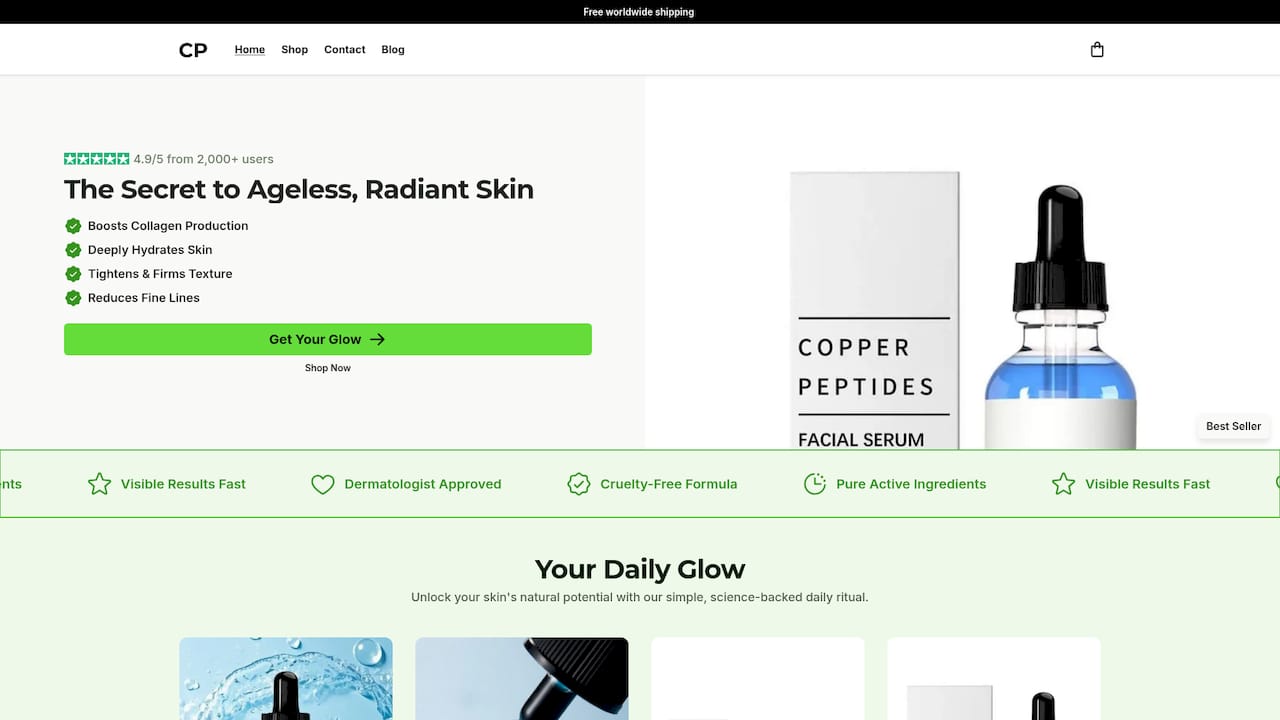
If you are ready to put this schedule into practice, our Copper Peptide Anti-Aging Serum combines high-purity copper peptides with medical-grade hyaluronic acid in one formulation, built to support the same gradual, evidence-aligned frequency outlined above.
- Dermatologist-endorsed formula suited to all skin types, including sensitive skin.
- One-off purchase at $20, with a return policy backing your purchase.
- Works with the same every-other-day-to-daily ramp described throughout this guide.
Visit our product collection to get started on your own timeline.
FAQ
Can you overuse copper peptides?
Yes, applying copper peptides too often or at too high a concentration before your skin adjusts can lead to persistent redness, stinging, or a compromised skin barrier. The fix is to scale back to your last comfortable frequency and rebuild gradually from there.
What cannot be paired with copper peptides?
Copper peptides are generally advised to be separated in time from strong acids (AHAs, BHAs) and retinoids, since combining them directly can increase irritation risk. Alternating nights or spacing applications by several hours is the common workaround rather than avoiding these ingredients entirely.
How much and how often should I apply GHK-Cu?
Topical products commonly contain roughly 1 to 3% GHK-Cu and are typically applied once or twice daily once tolerance is established. New users usually start every other day for two to four weeks before increasing frequency.
Is GHK-Cu better morning or night?
Either can work, since GHK-Cu does not require a specific time of day to be effective, though many people choose nighttime use to avoid any interaction with morning antioxidants or sunscreen. If used in the morning, finishing the routine with sunscreen is still essential for protecting skin.