

Topical peptides cannot replace Botox for deep, muscle-driven wrinkles, but they do something Botox does not: they gradually improve overall skin quality. Peptides work over weeks to months by supporting collagen and hydration, while Botox relaxes targeted muscles within days. The right choice depends on whether you want fast, dramatic smoothing of expression lines or slower, cumulative improvement in skin texture.
TL;DR:
- Consistent twice daily copper peptide use may improve wrinkle depth and barrier function after 12 weeks, though larger randomized cosmetic trials remain limited.
- Botox can smooth lines within 3 to 7 days and lasts 3 to 4 months; a licensed injector must tailor dosing to the specific brand.
- Peptides suit fine lines and texture, but cannot relax muscles; persistent deep wrinkles at rest or nerve and muscle conditions warrant professional advice.
- Choose serums with a stated active concentration and high purity, plus packaging that limits light and air exposure; patch test new formulas for 48 hours.
Table of Contents
- What Topical Peptides Do and Why Formulation Matters
- How Botox Works and Why It Acts So Much Faster
- Peptides vs Botox: A Side-by-Side Look at What Each One Does
- How Soon Will You See Results From Each Approach?
- Safety, Side Effects, and When to Get Professional Input
- What the Clinical Evidence Actually Shows
- Matching the Right Treatment to Your Goals
- A Needle-Free Option Worth Knowing About
- FAQ
- Sources
What Topical Peptides Do and Why Formulation Matters
Peptides are short chains of amino acids that signal skin cells to behave in specific ways, and the most studied cosmetic version is copper peptide GHK-Cu. This molecule occurs naturally in the body but declines with age, which is part of the rationale for applying it topically as skin matures, according to research on GHK peptide’s role in skin regeneration. Lab and clinical work tie GHK-Cu to collagen and elastin stimulation along with broader extracellular matrix remodeling, though larger randomized trials specifically measuring cosmetic outcomes remain limited.
Visible improvement in skin quality, including reduced wrinkle depth and better barrier function, is typically observed after 12 weeks of consistent twice-daily use. That timeline matters: peptides are not a quick fix, they are a cumulative one.
Formulation determines whether any of this reaches your skin in a usable form. Peptides are relatively large, water-loving molecules, which makes penetration a genuine challenge, and formulators often rely on stabilizing delivery methods such as encapsulation or pairing agents to improve absorption. When shopping for a peptide serum, look for:
- A stated, verifiable concentration of active peptide rather than a vague “peptide complex” label.
- High-purity sourcing, since impurities can blunt activity or irritate skin.
- A supporting humectant like hyaluronic acid, which helps hydration and may improve how the peptide performs.
- Packaging that protects against oxidation, since copper peptides can degrade with light and air exposure.
How Botox Works and Why It Acts So Much Faster
Botox is a brand name for a botulinum toxin type A injectable, and it works through a completely different mechanism than any topical product. It blocks the nerve signals that tell specific facial muscles to contract, which softens the wrinkles those repeated contractions create, according to the American Academy of Dermatology. Because it interrupts a nerve-muscle signal directly rather than waiting for cells to rebuild tissue, the results show up much faster than anything topical.
Most patients notice visible smoothing within 3 to 7 days, with results typically lasting around 3 to 4 months. After that window, the muscle activity gradually returns and the wrinkles reappear, so maintenance treatments are part of the deal.
A few practical points worth knowing before booking an appointment:
- Not all botulinum toxin type A products are interchangeable. Differences in manufacturing and assay methods affect dosing, onset, and duration, so a clinical review of BoNT-A products stresses that injectors should treat each brand on its own terms rather than assuming equivalence.
- The skill of the injector influences results as much as the product itself, since precise muscle targeting determines how natural the outcome looks.
- The appointment itself is brief, usually 10 to 15 minutes, with little to no downtime beyond occasional, short-lived redness at injection sites.
Peptides vs Botox: A Side-by-Side Look at What Each One Does
The two approaches work on entirely different levels of your skin, which explains why comparing them head to head is less about “better” and more about “better for what.”
- Mechanism: peptides work through cellular signaling that supports collagen and matrix repair; Botox works through neuromuscular blockade that stops a muscle from contracting.
- Speed and magnitude: peptides deliver gradual, moderate improvements in texture and fine lines; Botox delivers rapid, pronounced smoothing of dynamic wrinkles like frown lines and crow’s feet.
- Invasiveness: peptides are applied topically as part of a daily routine with no downtime; Botox involves injections that carry minor, occasional bruising or swelling.
- Maintenance: peptides require ongoing daily use to sustain gains, since stopping use allows skin to drift back toward baseline; Botox requires repeat treatments roughly every few months as muscle activity returns.
- Cost pattern: peptide serums are typically a one-time purchase used over months, while Botox is billed per treatment session and recurs indefinitely.
As a general rule, reach for peptides when your main concerns are fine lines, dullness, or overall skin texture, and when you prefer a needle-free routine. Choose Botox when deep, movement-driven wrinkles are the issue and you want a fast, visible change. Many people end up using both: peptides for daily skin maintenance, Botox for targeted muscle-driven lines.
How Soon Will You See Results From Each Approach?
Tracking progress accurately means knowing what timeline to expect and checking in at the right moments rather than daily.
- Weeks 1 to 4 with peptides: skin may feel more hydrated and look slightly more radiant, though wrinkle depth has not meaningfully changed yet.
- Weeks 8 to 12 with peptides: this is when measurable improvements in skin density and wrinkle depth are most likely to show up with consistent use.
- Days 3 to 7 with Botox: the neuromuscular effect begins, and the treated muscle starts to relax.
- Weeks 1 to 2 with Botox: results typically peak, giving the clearest sense of the final outcome.
- Around month 3 to 4 with Botox: effects gradually fade as muscle activity returns, signaling it’s time to consider a repeat session.
For peptides, standardized photos taken in the same lighting every few weeks are more reliable than daily mirror checks, which rarely capture gradual change.
Safety, Side Effects, and When to Get Professional Input
Both approaches are generally well tolerated, but each carries its own limitations worth knowing upfront.
- Topical peptides occasionally cause mild irritation or, rarely, an allergic reaction, and the risk often comes down to formulation quality and concentration rather than the peptide itself.
- Botox can cause temporary bruising at injection sites and, less commonly, transient eyelid drooping (ptosis) if the toxin migrates slightly from the target muscle.
- Product-specific dosing matters with Botox, since different BoNT-A formulations are not interchangeable, which is one reason it should only be administered by a licensed injector.
- Peptides do not relax muscle contractions, so they will not soften a deep wrinkle caused by repeated facial movement. Botox, in turn, does not rebuild collagen or improve skin texture over the long term.
Anyone with deep static wrinkles that remain visible at rest, or with a medical condition affecting nerve or muscle function, should consult a board-certified dermatologist or licensed injector before choosing a treatment path.
Pro Tip: Patch-test any new peptide serum on your inner arm for 48 hours before applying it to your face, especially if you have sensitive or reactive skin.
What the Clinical Evidence Actually Shows
The strongest human evidence for topical copper peptides comes from studies showing measurable gains in skin firmness and wrinkle depth after 12 weeks of consistent application. A smaller randomized trial on copper tripeptide after laser resurfacing found that patients reported noticeably better satisfaction at 12 weeks, even though objective imaging measures did not reach statistical significance in that particular study. Clinical guidance on long-term skin health increasingly points toward combining approaches: high-quality topicals alongside professional procedures tend to outperform either one alone for sustained results.
The serum pairs high-purity copper peptides with medical-grade hyaluronic acid, and the brand states that customers typically see visible results within 4 to 6 weeks, with dermatologist endorsement and a 30-day money-back guarantee.
These are the brand’s own stated claims rather than independent clinical validation, and they’re worth knowing as you weigh options.
Pro Tip: Layering a copper peptide serum under a medical-grade hyaluronic acid moisturizer can improve how plump and smooth skin looks day to day, even while deeper collagen changes are still building.

Matching the Right Treatment to Your Goals
In my view, the decision comes down to patience versus urgency. If you’re building a long-term skin health routine and can commit to daily consistency, peptides are a reasonable, low-risk starting point. If you need a visible change for a specific event or can’t tolerate the wait, Botox is the more predictable choice. For many people, the two aren’t competitors at all: peptides maintain skin quality between Botox sessions. Either way, a board-certified dermatologist or licensed injector can tailor a plan to your skin and goals far better than generic advice.
— British
A Needle-Free Option Worth Knowing About
If your priority is improving skin texture and fine lines without injections, we formulate a single-ingredient Copper Peptide Anti-Aging Serum that combines high-purity copper peptides with medical-grade hyaluronic acid.
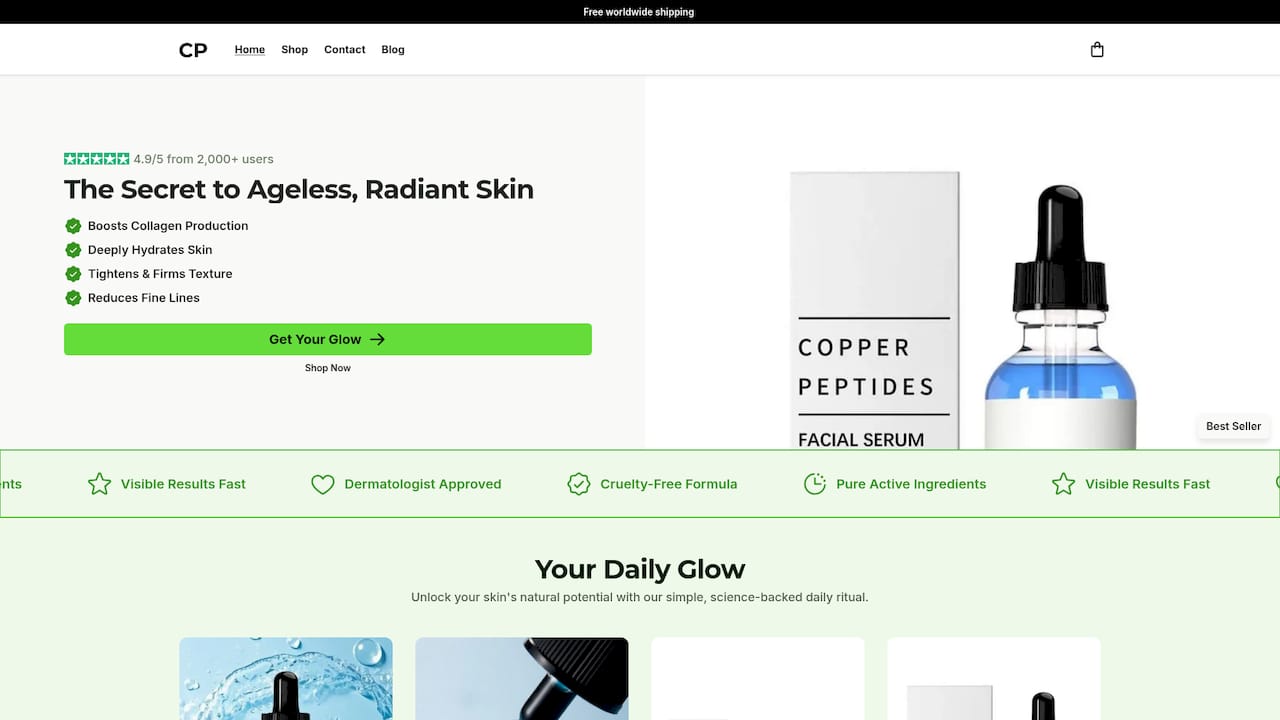
We designed it for people who want gradual, noticeable improvement in firmness and hydration rather than an injectable’s rapid muscle-relaxing effect:
- Visible results with consistent daily use.
- Dermatologist-endorsed formulation suited to sensitive skin.
- A money-back guarantee if the results don’t meet your expectations.
We see this serum as a needle-free complement to your skincare routine, not a guaranteed substitute for Botox on deep, movement-driven wrinkles. If daily skin maintenance and long-term texture improvement are what you’re after, you can explore the serum collection and see whether it fits your routine.
This article is general information, not a substitute for advice from a qualified doctor. Consult a qualified healthcare professional about your own circumstances before acting on anything here.
FAQ
Will peptides help with crepey skin?
Peptides like GHK-Cu support collagen production and hydration, which can improve skin firmness and reduce the thin, crepey appearance over time. Results build gradually, typically becoming noticeable after 8 to 12 weeks of consistent use rather than overnight.
Does GHK-Cu affect Botox?
There’s no evidence that topical GHK-Cu interferes with Botox’s neuromuscular mechanism, since the two work through entirely different pathways: one supports skin cell signaling, the other blocks nerve-to-muscle communication. Many dermatology sources describe the two as complementary rather than conflicting, with topicals supporting skin quality between injectable sessions.
How should you incorporate peptides into a skincare routine?
Apply a peptide serum to clean, dry skin, ideally before a moisturizer or medical-grade hyaluronic acid product to help lock in hydration. Consistency matters more than quantity, since visible changes in skin density and texture generally take several weeks of daily use to appear.
Do peptides really make a measurable difference?
Clinical studies on topical GHK-Cu show measurable improvements in skin density, firmness, and wrinkle depth after consistent use, though larger randomized trials remain limited compared to injectable research. Smaller studies also show patient-reported satisfaction improving even when objective imaging results vary, so expectations should stay realistic and tied to the 8 to 12 week window.
Is Botox safe, and how does it compare to dermal fillers?
Botox is widely used for aesthetic purposes and works by relaxing targeted muscles, with typical onset in 3 to 7 days, administered by a licensed injector who accounts for product-specific dosing. Dermal fillers work differently, adding volume beneath the skin rather than relaxing muscles, which makes them suited to static volume loss while Botox targets movement-driven wrinkles.
Sources
- Glycyl‑l‑histidyl‑l‑lysine‑Cu(II) (GHK‑Cu) studies — PMC
- American Academy of Dermatology: Botulinum toxin therapy overview
- GHK peptide as a natural modulator in skin regeneration — PubMed