

If you want a straight answer: the best first swap depends on what you’re actually trying to fix. For budget single-ingredient actives, look at Good Molecules, Naturium, or The Inkey List. For a cleaner, lower-irritant routine, Mad Hippie, Byoma, or Peach Slices are worth your attention. For anti-aging with peptides specifically, the Copper Peptide Anti-Aging Serum from Copperpeptides pairs high-purity copper peptides with medical-grade hyaluronic acid in a formulation that goes beyond what most budget lines offer.
Quick picks by goal:
- Hydration: Naturium or Byoma for accessible, fragrance-free hyaluronic acid options
- Acne/texture: Good Molecules Niacinamide Toner or Peach Slices Snail Rescue Serum
- Anti-aging (peptides): Copperpeptides copper peptide serum for collagen support and firming
The brands below cover every category, with specific product swaps, formulation notes, and US availability so you can make the switch without guessing.
Table of Contents
- What are the best alternatives to The Ordinary by category?
- Product-level swaps for The Ordinary’s most-searched items
- How do you choose the right alternative without wasting money?
- Is The Ordinary “clean,” and what do low-tox alternatives actually offer?
- What do Reddit threads and dermatologists say about switching?
- When peptides are your priority, consider this copper peptide serum
- Key Takeaways
- Why ingredient transparency beats chasing exact dupes
- Copperpeptides copper peptide serum: a focused anti-aging option
- Sources and further reading
What are the best alternatives to The Ordinary by category?
Not every swap is equal. The table below maps alternative categories to skin goals, typical price shapes, active types, and where to buy in the US.
| Category | Best for | Representative active(s) | Price shape | Clean/fragrance-free | Vehicle | US retailers |
|---|---|---|---|---|---|---|
| Single-ingredient budget lines | Affordability, acne, texture | Niacinamide 10%, HA 2%, glycolic 7% | Under $15 | Usually; check label | Lightweight serum, toner | Drugstore, Target, Amazon |
| Clean/low-tox artisan lines | Sensitive, reactive, fragrance-sensitive skin | Plant-derived actives, gentle AHAs | $15–$34 | Yes, typically | Emulsion, oil, balm | DTC, Whole Foods, iHerb |
| Dermatologist-backed clinical lines | Sensitive, acne-prone, barrier repair | Ceramides, niacinamide, retinol | $12–$38 | Mostly; varies by SKU | Cream, lotion, serum | Drugstore, Target, Walmart |
| Retailer house brands | Budget-first, trend actives | Retinol, HA, vitamin C | Under $12 | Variable | Serum, cream | Mass retail, drugstore |
| Specialty peptide offerings | Anti-aging, collagen support, firming | Copper peptides, GHK-Cu, HA | $30–$62 | Yes | Serum, concentrated dropper | DTC, specialty online |
Trade-offs worth knowing:
- Single-ingredient budget lines win on price but sometimes cut corners on stabilizers, which matters most for vitamin C and retinol.
- Clean/low-tox lines often skip parabens and ethoxylates but may use preservative systems with shorter shelf lives, so check the batch date.
- Retailer house brands replicate trending actives at the lowest cost by limiting SKU complexity. That works fine for a basic niacinamide or HA serum, but don’t expect a sophisticated peptide blend.
- Specialty peptide lines like Copperpeptides cost more per bottle, but the formulation complexity and dermatologist-backed positioning justify the gap for anti-aging goals.
Affordable alternatives have multiplied since The Ordinary first disrupted the market, and the category now covers nearly every active and skin type.
Product-level swaps for The Ordinary’s most-searched items
Hyaluronic acid
The Ordinary’s Hyaluronic Acid 2% + B5 is one of its most-copied products. What to match: multi-weight HA at roughly 1–2%, ideally with a humectant co-star like panthenol or glycerin.
- Naturium Hyaluronic Acid Serum 5%: — multiple molecular weights, fragrance-free, under $20 at Target
For a deeper look at how HA pairs with firming actives, the guide to hyaluronic acid serums at Copperpeptides covers concentration and pairing logic.
Red flag: some budget HA serums use high-alcohol vehicles to create a fast-dry feel. That defeats the purpose of a humectant.
Niacinamide
Match: 10% niacinamide, water-based serum, no fragrance. Zinc is a common co-ingredient for acne-prone skin.
- Minimalist 10% Niacinamide + Zinc: — nearly identical spec to The Ordinary, available on Amazon
Retinoids
The Ordinary uses granactive retinoid (hydroxypinacolone retinoate) and retinol in various concentrations. Vehicle matters here more than almost anywhere else: a retinoid in a silicone base behaves differently on skin than one in a squalane or emollient base.
- Paula’s Choice 1% Retinol Booster: well-stabilized, emollient vehicle, around $62 but highly concentrated
- Revolution Skincare 0.5% Retinol Serum: budget-friendly entry point, widely available at ULTA
- The Inkey List Retinol: 1% stabilized retinol, around $11, good for beginners
For readers comparing retinoid approaches with peptides, the wrinkle serum guide breaks down when each active makes more sense.
Azelaic acid
Match: 10% azelaic acid in a cream or gel-cream base. The Ordinary’s 10% suspension is gritty; most alternatives use a smoother emulsion.
- Paula’s Choice 10% Azelaic Acid Booster: smooth gel-cream, fragrance-free, around $38
- The Inkey List Azelaic Acid Serum: 10%, lightweight, under $15
Vitamin C
Vitamin C is the hardest active to swap correctly. L-ascorbic acid oxidizes fast without proper stabilization and packaging. The Ordinary uses suspension formats (15% and 30%) that are gritty and require specific pH.
- Naturium Vitamin C Complex Serum: stabilized L-ascorbic acid, fragrance-free, around $20
- Good Molecules Vitamin C Serum: ascorbyl glucoside (more stable derivative), gentle, under $15
- Paula’s Choice C15 Super Booster: 15% L-ascorbic acid, well-stabilized, airless packaging
Pro Tip: Vitamin C efficacy depends almost entirely on packaging. Airless pumps or opaque tubes preserve potency far better than dropper bottles exposed to air and light.
Glycolic acid and AHA toners
Match: 5–10% glycolic acid, pH around 3.5–4.0. Vehicle and pH matter more than the exact percentage.
- Peach Slices AHA/BHA Toner: gentle dual-acid formula, fragrance-free, under $15 at drugstores
- Good Molecules Glycolic Acid Toning Solution: 5% glycolic, close to The Ordinary’s 7% toner, under $12
- Paula’s Choice Skin Perfecting 8% AHA Lotion: higher-end, well-buffered, around $34
Cleansers and moisturizers
The Ordinary’s cleansers and moisturizers are functional but minimal. CeraVe is the most recommended swap across dermatologist communities for both categories.
- CeraVe Hydrating Cleanser: ceramides, hyaluronic acid, fragrance-free, under $15 at every major drugstore
- CeraVe Moisturizing Cream: barrier-repair formula, non-comedogenic, around $18 for a large tub
- Byoma Moisturizing Gel-Cream: lighter texture, ceramide complex, fragrance-free, around $15 at Target
Community dupe compilations consistently flag CeraVe and Good Molecules as the most reliable one-to-one substitutes for The Ordinary’s basic hydration and cleansing lineup.
How do you choose the right alternative without wasting money?
The biggest mistake is matching a product by name rather than by formulation. Here’s a practical checklist:
- Identify your skin goal. Hydration, acne, texture, anti-aging, or barrier repair. Each points to a different active.
- Find the active and its concentration. A niacinamide serum at 5% behaves differently than one at 10%. Know what you’re replacing.
- Check the vehicle. Water-based serums layer under moisturizer easily. Silicone-based formulas can pill under sunscreen. Oil-based products work better as the last step before SPF.
- Confirm pH for acids. AHAs and BHAs need a pH of roughly 3.0–4.5 to exfoliate effectively. A glycolic toner at pH 6 is essentially just water with a label.
- Scan for fragrance and irritants. Look for “fragrance,” “parfum,” or long botanical blend lists if you have sensitive skin. These are the most common hidden triggers.
- Review packaging. Vitamin C and retinol degrade in dropper bottles exposed to air. Airless pumps or opaque tubes are a meaningful quality signal.
- Introduce one new product at a time. Patch test before use, then introduce actives gradually.
Red flags to watch for:
- “Perfume” or “fragrance” listed without further detail
- Denatured alcohol (SD alcohol, alcohol denat.) high in the ingredient list
- Ethoxylated surfactants (ingredients ending in “-eth”) if you’re avoiding those
- Vitamin C in a clear glass dropper bottle
Pro Tip: For acids and retinoids, pH and vehicle matter more than the marketed percentage. A 5% glycolic at the right pH will outperform a 10% formula buffered to near-neutral.
Is The Ordinary “clean,” and what do low-tox alternatives actually offer?
The Ordinary is not marketed as a “clean” brand. It uses some ingredients that low-tox shoppers flag, including certain preservative systems and synthetic stabilizers. That doesn’t make it unsafe, but it does explain why consumers prioritizing clean or low-tox standards often move toward brands that explicitly avoid parabens, certain ethoxylates, and synthetic fragrance.
“Clean” in the US has no legal definition. What consumers usually mean:
- Fragrance-free or free from synthetic fragrance
- No parabens (methylparaben, propylparaben)
- Cruelty-free certification (Leaping Bunny or PETA)
- Minimal ethoxylated surfactants
- No formaldehyde-releasing preservatives
The trade-off is real. Some preservative systems flagged by low-tox shoppers are genuinely effective at extending shelf life. Brands that remove them sometimes use phenoxyethanol or natural preservatives that work, but occasionally produce formulas with shorter stability windows.
Ingredient differences that actually affect performance:
- Fragrance: the most common sensitizer in skincare, even in “natural” forms like essential oils
- Preservative systems: phenoxyethanol is generally well-tolerated; some natural alternatives (rosemary extract, vitamin E) are antioxidants, not true preservatives
- Vitamin C stabilizers: ascorbyl glucoside and sodium ascorbyl phosphate are more stable than L-ascorbic acid but convert to active form more slowly on skin
- Suspension formats: high-strength actives in anhydrous suspension (like The Ordinary’s vitamin C 30%) avoid water-related oxidation but can feel gritty and are harder to layer
US labeling rules require full ingredient disclosure under INCI naming, but third-party claims like “clean,” “non-toxic,” and “natural” are self-certified. Cruelty-free claims backed by Leaping Bunny carry more weight than a brand’s own label. Always read the ingredient list rather than the front-of-pack claim.
What do Reddit threads and dermatologists say about switching?
The Reddit megathread on The Ordinary alternatives is one of the most useful community resources available. A few consistent themes emerge from those discussions:
- Good Molecules and The Inkey List come up most often as the closest budget replacements
- Users switching for “clean” reasons frequently land on Mad Hippie or Transparent Lab
- The consensus is that one-to-one dupes rarely exist: concentrations, vehicles, and preservative systems differ even when the active is the same
- Minimalist gets strong mentions for niacinamide and retinol at near-identical specs to The Ordinary
Some consumers moved away from The Ordinary following corporate changes at parent company DECIEM, specifically seeking brands with cleaner ownership histories and more consistent cruelty-free commitments.
Dermatologists generally agree on a few points that community threads sometimes miss:
When to see a dermatologist rather than swap products:
- Persistent irritation or redness that doesn’t resolve after stopping an active
- Severe or cystic acne that hasn’t responded to OTC niacinamide or BHA
- Interest in prescription-strength retinoids (tretinoin) or professional peels
- Suspected contact dermatitis from a specific ingredient
Cruelty-free swap lists note that many candidate dupes look identical on paper but diverge in texture, finish, and how they layer, which is exactly what determines whether someone sticks with a product.
When peptides are your priority, consider this copper peptide serum
For readers focused on anti-aging, most of the brands above offer peptide products, but few center the formulation on copper peptides specifically. The Ordinary’s “Buffet + Copper Peptides” uses a multi-peptide blend with copper peptides as one component among many. The formulation vehicle is a lightweight water-based serum, which works for layering but dilutes the peptide concentration.
The Copper Peptide Anti-Aging Serum from Copperpeptides takes a different approach: high-purity copper peptides (GHK-Cu) as the primary active, paired with medical-grade hyaluronic acid for simultaneous collagen support and deep hydration. The formulation is dermatologist-endorsed, fragrance-free, and suitable for all skin types including sensitive skin.
Key features:
- High-purity copper peptides (GHK-Cu) to support collagen production and skin firmness
- Medical-grade hyaluronic acid for hydration that works alongside the peptide active
- Fragrance-free, cruelty-free, safe for sensitive skin
- Dermatologist-endorsed with visible results expected within weeks per brand claims
- Direct-to-consumer at copperpeptides.store
For a broader comparison of copper peptide options and how they stack up against other peptide actives, the best copper peptide serums guide covers the category in detail.
Pro Tip: Copper peptides and retinoids are generally not recommended for use in the same routine step. If you’re using both, apply them on alternating nights to avoid potential interaction.
*Disclosure: Copperpeptides publishes this article and sells the product featured above…
Key Takeaways
The most reliable way to find a working alternative to The Ordinary is to match the active, concentration, vehicle, and pH rather than the brand name or price point.
| Point | Details |
|---|---|
| Match formulation, not just the name | Active percentage, vehicle, and pH determine whether a swap actually performs the same way. |
| Budget lines cover most basics | Good Molecules, The Inkey List, and Naturium cover niacinamide, HA, and retinol under $15. |
| “Clean” needs a definition | Fragrance-free and Leaping Bunny certified are more meaningful than front-of-pack “clean” claims. |
| Acids require correct pH | AHAs and BHAs need roughly pH 3.0–4.5 to exfoliate; always check before switching. |
| Copperpeptides for anti-aging peptides | The copper peptide serum pairs GHK-Cu with medical-grade HA for collagen support and firming. |
Why ingredient transparency beats chasing exact dupes
The dupe hunt is understandable. The Ordinary made skincare feel like a chemistry set with price tags attached, and when you find a product that works, the instinct is to find the cheapest version of the same thing. But the search for an exact dupe often leads people in circles.
Here’s the part most dupe guides skip: two products with the same active at the same percentage can feel completely different on skin, absorb at different rates, and produce different results over time. The reason is almost never the active itself. It’s the emulsifier system, the preservative choice, the pH at which the formula was set, and whether the vitamin C or retinol was properly stabilized before it hit the bottle.
The readers who get the most out of switching from The Ordinary are the ones who stop asking “what’s the closest dupe?” and start asking “what does my skin actually need, and which formulation delivers that reliably?” That shift changes everything. You stop buying five $8 serums that don’t quite work and start buying one $20 product that does.
Texture also matters more than most people admit. If a product feels wrong, you won’t use it consistently. A retinol serum that pills under your moisturizer, or a niacinamide toner that leaves your skin feeling tight, will sit on the shelf no matter how good the ingredient list looks. Routine adherence over months is what produces results, not the theoretical efficacy of an active you use twice and abandon.
Copperpeptides copper peptide serum: a focused anti-aging option
If anti-aging is your main goal and you’ve been using The Ordinary’s peptide products, the Copper Peptide Anti-Aging Serum from Copperpeptides offers a more concentrated, single-focus approach. High-purity GHK-Cu copper peptides work to support collagen production and firm skin texture, while medical-grade hyaluronic acid handles hydration in the same step. It’s dermatologist-endorsed, fragrance-free, and formulated for all skin types, including sensitive.
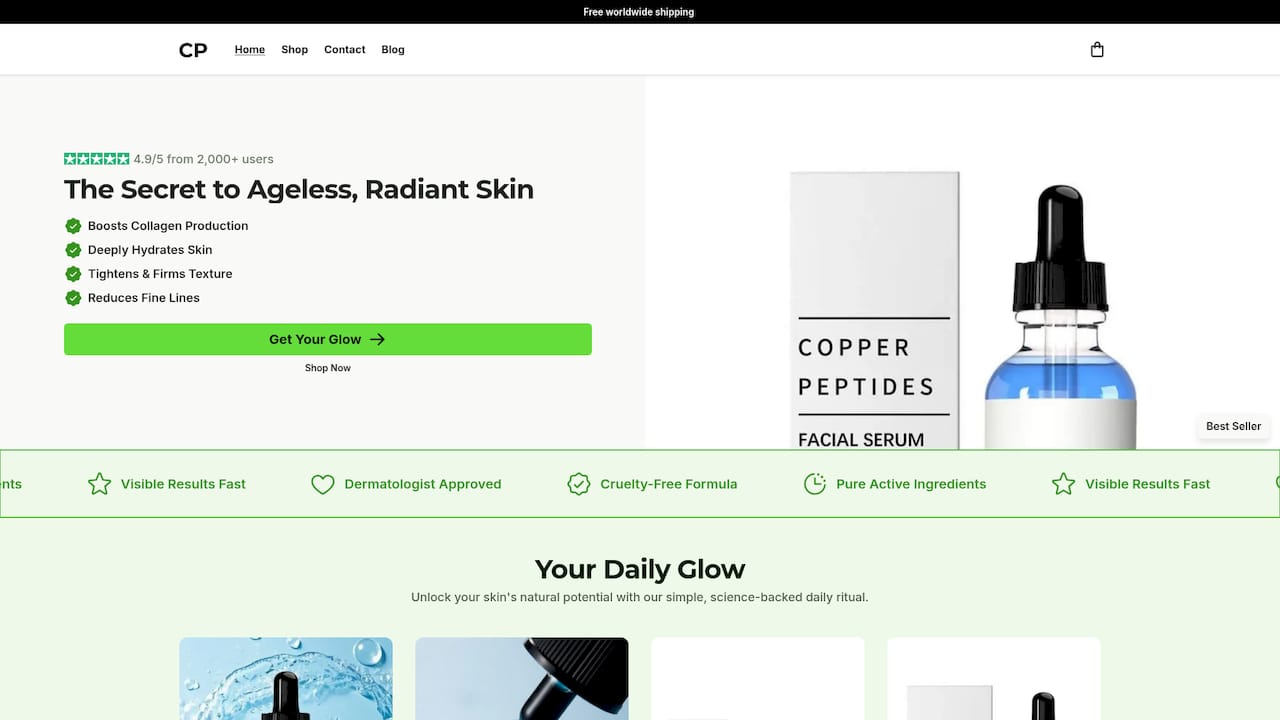
Most peptide serums treat copper peptides as a supporting ingredient. This one leads with them. The formula is cruelty-free, built for daily use, and designed to show visible results within 4–6 weeks per brand claims. Visit copperpeptides.store to review the full ingredient list and order directly.
Disclosure: this site sells the product featured above.
Sources and further reading
The recommendations in this article draw on community consensus, editorial roundups, and brand-level product information. Below are the most useful resources for going deeper.
Research and editorial sources:
- 12 Best Brands Like The Ordinary in 2026: a current roundup covering brand profiles and product comparisons across budget and mid-tier lines
- The Ordinary Alternatives Megathread: the most active community thread for peer-sourced dupe recommendations and real-world switching experiences
- Swap It Out: Clean Alternatives to The Ordinary: focused on low-tox and cruelty-free swaps with ingredient-level notes
- Brands Like The Ordinary: Alternatives and Competitors: community-compiled dupe lists with emphasis on checking percentages and ingredient order
- 5 Brands Similar to DECIEM’s The Ordinary: covers the corporate context behind why some consumers seek alternatives
- Cruelty-Free Alternatives to Popular The Ordinary Products: product-level cruelty-free swaps for HA, AHAs, retinoids, and peptides
- The Ordinary Affordable Skincare Alternatives: editorial roundup with price and ingredient simplicity comparisons
- 8 Cheap Skincare Brands That Rival The Ordinary: trend reporting on budget lines and retailer-owned alternatives
Copperpeptides resources:
- Copper Peptide Anti-Aging Serum: full ingredient list, usage instructions, and ordering
- Best Copper Peptide Serums Guide: category overview and how copper peptides compare to other anti-aging actives
- Dermatologist Approved Skincare: clinical endorsement context for readers seeking professional validation
This article is for general informational purposes only and is not a substitute for professional dermatological advice. For persistent skin concerns, consult a board-certified dermatologist.