

If fragrance has ever left your skin red, itchy, or breaking out, go fragrance-free first. It is a specific, checkable claim, and fragrance sits at the top of the list of avoidable skin allergens according to the National Eczema Association. “Hypoallergenic” sounds reassuring but carries no legal definition or testing requirement, so treat it as a bonus clue, not a guarantee. Read the ingredient list either way, and patch test anything new.
TL;DR:
- Fragrance is the top avoidable skin allergen, and products labeled fragrance-free are verified to contain no added scent materials.
- “Fragrance-free” means no added fragrance materials, but natural ingredients with scent or masking fragrances in “unscented” products can still cause reactions.
- “Hypoallergenic” is a marketing claim without standardized testing, and such products may still contain known irritants or allergens.
- Patch testing on the inner forearm is the most reliable method to detect reactions before regular use of a new skincare product.
- Choosing fragrance-free, ingredient-transparent formulas with testing seals provides the best protection for sensitive skin.
Table of Contents
- Hypoallergenic vs. Fragrance Free: What Fragrance-Free Actually Means
- What Does Hypoallergenic Mean, and Can You Trust It?
- Fragrance-Free or Hypoallergenic: Which Should You Trust More?
- How Do You Safely Test a New Skincare Product?
- Common Ingredients That Trigger Reactions on Sensitive Skin
- Practical Tips From Copperpeptides for Safer Skincare Testing
- A Straight Answer for Anyone Tired of Guessing With Their Skin
- Sources
Hypoallergenic vs. Fragrance Free: What Fragrance-Free Actually Means
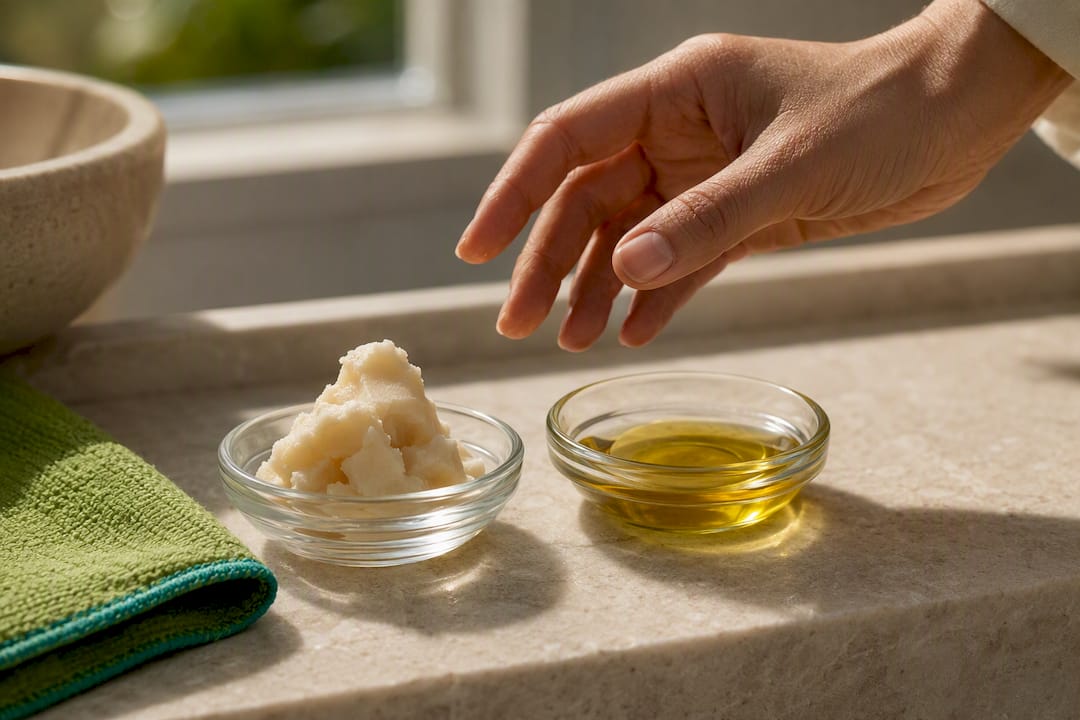
“Fragrance-free” means a product contains no added fragrance materials, whether synthetic or plant-derived, used purely to make it smell a certain way. It does not mean odorless. Raw ingredients like shea butter or certain oils carry their own natural smell, and a fragrance-free product can still have a faint scent from those base materials rather than from an added perfume compound.
This is where “fragrance-free” and “unscented” split apart, and the difference matters more than most shoppers realize. An unscented product often contains a masking fragrance, a small amount of scent added specifically to cover up the smell of the base formula, according to McGill University’s Office for Science and Society. If you react to fragrance chemicals, “unscented” does not protect you the way “fragrance-free” does.
To verify a claim, scan the ingredient list for these terms:
- Fragrance or parfum, which can legally hide dozens of unlisted chemicals in a single word.
- Essential oils by name (lavender, citrus, tea tree), which count as fragrance even when marketed as natural.
- Masking fragrance, a sign the product is unscented rather than truly fragrance-free.
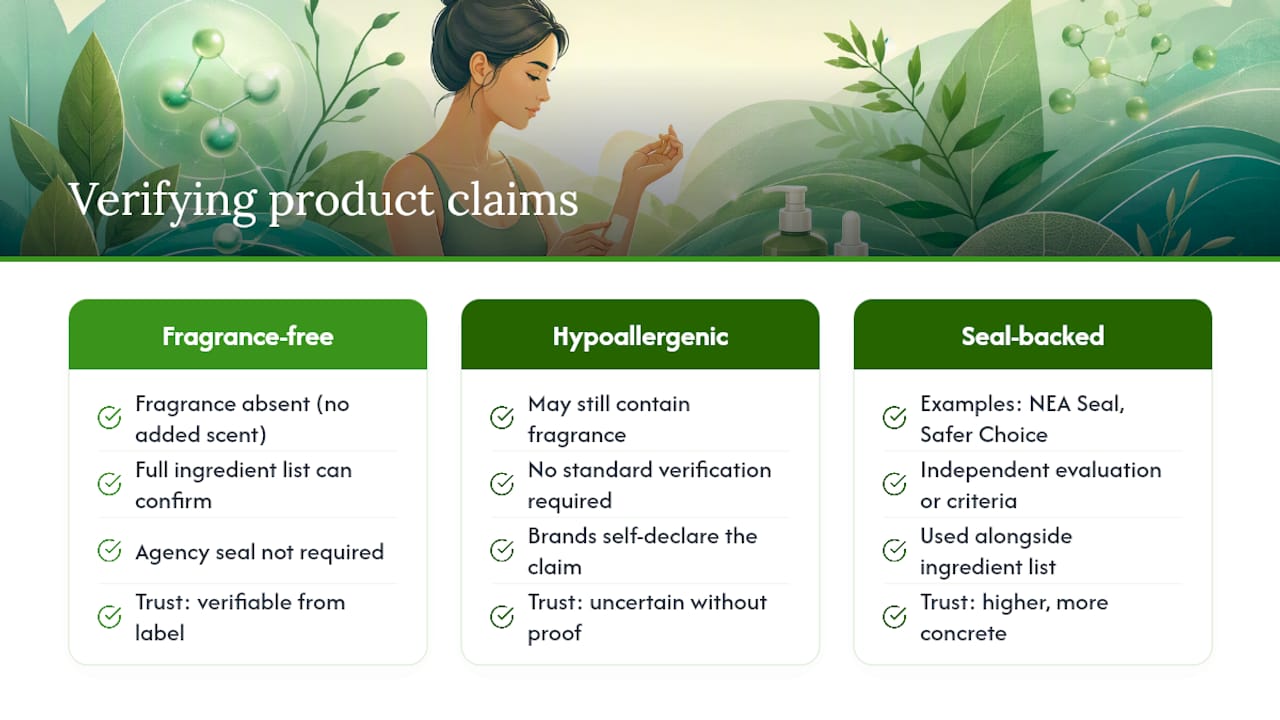
Because a single word like “fragrance” can represent a complex mixture without disclosing each component, verification gets tricky on packaging alone. The EPA’s Safer Choice program built formal fragrance-free criteria for exactly this reason, giving manufacturers a documented standard to meet before using the label, rather than leaving it to marketing discretion.
What Does Hypoallergenic Mean, and Can You Trust It?
“Hypoallergenic” implies a product is less likely to cause an allergic reaction. That is the entire concept behind it. But no agency defines the term or requires proof before a brand prints it on a bottle.
The FDA states plainly that there’s no federal standard governing hypoallergenic claims in the United States, and most other countries have no equivalent testing mandate either. A company can call a product hypoallergenic without submitting a single test result.
In practice, brands using the term often do avoid a shortlist of well-known irritants and keep formulas simpler than a standard product line. That’s a reasonable intention. The problem is what “often” leaves out.
Products marketed as “baby safe” or “free and gentle” have been found to contain known sensitizers like methylisothiazolinone, showing that a reassuring label doesn’t always match the ingredient list behind it.
That gap is why hypoallergenic works better as a secondary signal than a primary filter. If a product is both fragrance-free and labeled hypoallergenic, that’s a reasonable combination. If it’s hypoallergenic but loaded with fragrance and preservatives you’ve reacted to before, the label alone won’t save you.
A few things worth remembering about the claim:
- It’s a marketing term, not a regulatory category, in nearly every market worldwide.
- It says nothing about specific ingredients you personally react to.
- It can still coexist with fragrance, essential oils, or common preservatives.
Fragrance-Free or Hypoallergenic: Which Should You Trust More?
Fragrance-free is specific and verifiable. You can check for it on an ingredient list. Hypoallergenic is broad and unverified, resting entirely on a brand’s own judgment call. That difference in specificity is why dermatologists tend to reach for fragrance-free first when treating eczema or contact dermatitis, since fragrance is the single most common avoidable trigger they see.
Here’s how to apply that in practice, depending on your situation:
- Known fragrance allergy: Go straight to fragrance-free, verified where possible by a seal like EPA Safer Choice. Skip products labeled only “unscented.”
- Unknown or unclear reactions: Choose fragrance-free as a starting point, then scan the full ingredient list for preservatives and essential oils before buying.
- Rebuilding a routine after a flare-up: Prioritize short ingredient lists, fragrance-free formulas, and hypoallergenic as a tiebreaker between two otherwise similar products.
Run this three-step check before anything touches your skin: look at the front label claim, scan the full ingredient list for known triggers, then patch test for 24 to 48 hours before regular use.
Pro Tip: Keep a running note (your phone’s notes app works fine) of every ingredient that’s ever caused a reaction. Checking a new product against that list takes ten seconds and catches problems label claims won’t.
How Do You Safely Test a New Skincare Product?
Patch testing is the one step that catches what labels can’t. It’s simple, cheap, and it works regardless of what the packaging claims.
- Scan the ingredient list first. Flag fragrance, parfum, and named essential oils if you’ve reacted to scent before, along with methylisothiazolinone, dyes, and any preservative that’s bothered you in the past.
- Apply a small amount to your inner forearm. This skin is thinner and more reactive than most of your face, making it a reliable early-warning zone, per guidance from Medical News Today.
- Wait 24 to 48 hours without washing the area. Most contact reactions show up in this window.
- Check for redness, itching, swelling, or blistering. Mild tingling that fades quickly is usually fine; anything that worsens or spreads is not.
- Stop immediately if a reaction develops, and wash the area with mild soap and water.
A couple of extra judgment calls matter here:
- Rinse-off products (cleansers, masks) carry lower risk than leave-on products (serums, moisturizers), since contact time is shorter.
- If you get recurrent or severe reactions across multiple products, a dermatologist can run formal patch testing with a standardized allergen panel, something you can’t replicate at home.
Common Ingredients That Trigger Reactions on Sensitive Skin
Fragrance allergens rarely show up as one obvious word. Limonene, linalool, and geraniol are all fragrance components, and clinical reviews consistently flag them as common contact allergens in cosmetics. They can appear buried in a broader “fragrance” listing or named individually, depending on the brand’s disclosure practices.
Non-fragrance triggers deserve equal attention:
- Methylisothiazolinone, a widely used preservative linked to rising rates of contact allergy.
- Formaldehyde releasers, another preservative category that can irritate sensitized skin over repeated use.
- Essential oils and botanical extracts, which are frequently marketed as gentle or natural but are chemically active enough to sensitize skin just as synthetic fragrance can.
“Natural” is not a safety guarantee. A lavender or citrus extract carries the same allergen risk profile as a synthetic version of the same compound, sometimes higher, because “natural” products often skip the purification steps that reduce allergen load.
Practical Tips From Copperpeptides for Safer Skincare Testing
Some brands build products around a short, transparent ingredient list, which makes the checks above faster to run. A formula with fewer ingredients gives you fewer variables to test.
Before adding anything new to your routine, including a serum:
- Read the full ingredient list, not just the front-of-package claims.
- Patch test on your inner forearm using the step-by-step method for 24 to 48 hours.
- Introduce one new product at a time so you know exactly what caused a reaction if one happens.
- Follow a layering protocol that spaces out active ingredients rather than stacking them all at once.
The safest approach still combines all three tools: fragrance-free formulation, a careful ingredient scan, and a real patch test. No single label replaces that process.
A Straight Answer for Anyone Tired of Guessing With Their Skin
Fragrance-free earns your trust first because you can verify it. Hypoallergenic earns a maybe, because nobody’s checking the brand’s homework. If a product gives you a full ingredient list, skips fragrance entirely, and carries a seal like the National Eczema Association’s Seal of Acceptance or EPA Safer Choice, that’s about as much confidence as label-reading alone can offer.
When reactions persist despite doing everything right, that’s not a signal to try more products faster. It’s a signal to see a dermatologist, who can patch test with a standardized panel and catch what’s chemically impossible to guess from a bottle. If cosmetic allergy claims still confuse you even after label-reading, a closer look at how allergy misdiagnosis happens is worth your time before you write off an entire product category.
Buy from brands that give you the full ingredient list upfront, skip the fragrance, and back their formula with something more concrete than a marketing word.
— British
This article is general information, not a substitute for advice from a qualified doctor. Consult a qualified healthcare professional about your own circumstances before acting on anything here.
Sources
- Fragrances, Perfumes, Eczema & Allergy — National Eczema Association
- Hypoallergenic cosmetics — FDA
- Fragrance-free criteria — U.S. Environmental Protection Agency (Safer Choice)
- How to patch-test skincare — Medical News Today
- Review of contact allergens in cosmetics — PMC (peer-reviewed article)