

Yes, always patch test new skincare before applying it to your face or body. Pick a discreet spot, apply the product as you normally would, and set a reminder to check the site over the following days.
Do this right now:
- Choose a test site (inner forearm works for most products; behind the ear or along the jawline for face formulas)
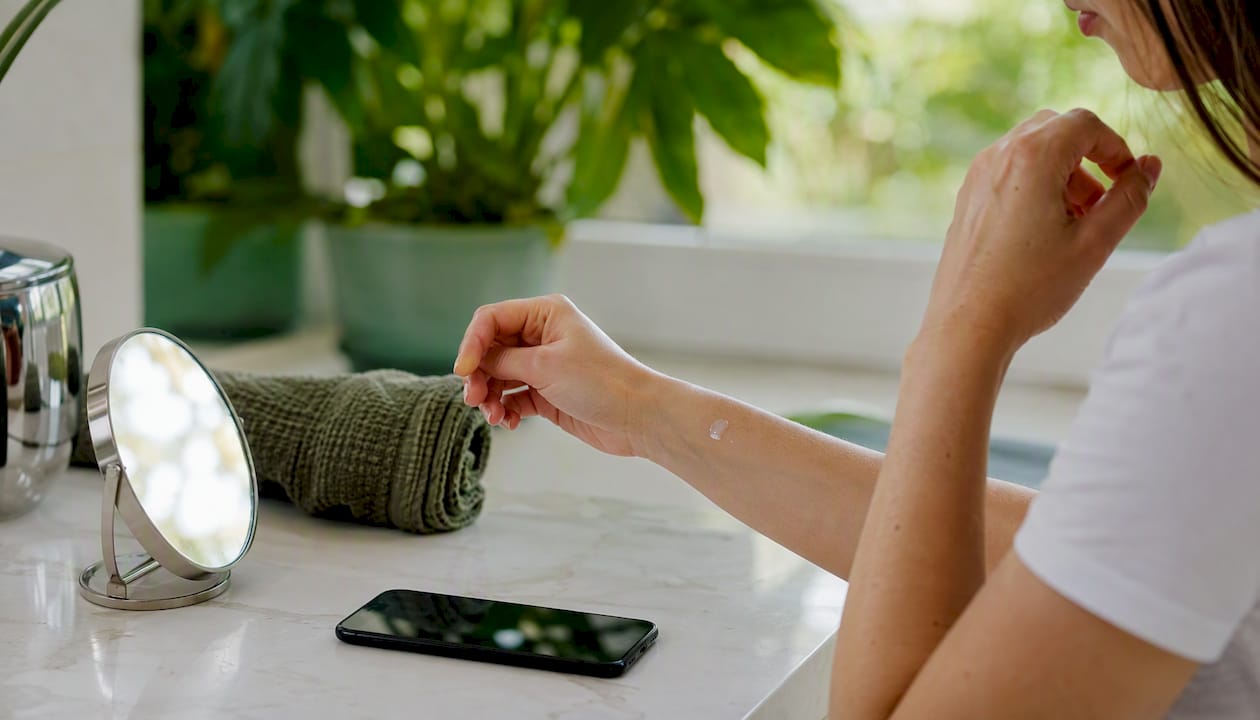
- Apply a small amount, the same quantity you’d use in your regular routine
- Set calendar reminders for 24 hours, 48 hours, and day 7–10
If a reaction occurs:
- Wash the product off immediately with cool water
- Stop using the product entirely
- Seek emergency care if you experience throat tightening, difficulty breathing, or widespread hives
Key Takeaways
Patch testing skincare for 7–10 days, twice daily, on a discreet site is the most reliable at-home method to screen for irritant and allergic reactions before full-area use.
| Point | Details |
|---|---|
| Choose the right site | Use the inner forearm for most products; behind the ear or jawline for face formulas. |
| Apply and observe for 7–10 days | Apply twice daily as you normally would; check at 24h, 48h, and day 10. |
| Stop at the first severe sign | Wash off immediately for blistering, spreading redness, or burning; call 911 for breathing difficulty. |
| At-home tests have limits | They confirm product tolerance, not which ingredient caused a reaction. |
| Escalate persistent reactions | See a board-certified dermatologist for recurrent, severe, or unexplained skin reactions. |
Table of Contents
- What is a patch test, and what can it actually tell you?
- Who should patch test, and when does it matter most?
- How to patch test skincare: the step-by-step method
- How long should you watch for a reaction?
- What signs should you watch for, and what do you do if the site reacts?
- Which ingredients are most likely to cause a reaction?
- When should you see a dermatologist for professional patch testing?
- What dermatologists and evidence say about patch testing
- A practical reminder before you open that new product
- Sources
What is a patch test, and what can it actually tell you?
An at-home patch test is straightforward: apply a small amount of a product to a discreet skin area, leave it as directed, and watch for a reaction over several days. That’s the whole method. What it tells you is whether this product, on your skin, causes a visible reaction under normal use conditions.
What it cannot tell you is which specific ingredient triggered the response. If your skin flares, you know to avoid the product, but you won’t know whether it was the fragrance, the preservative, or the active acid. That distinction matters if you’re managing a known allergy.
Professional in-office patch testing is a different procedure entirely. A dermatologist or allergist applies concentrated single allergens to adhesive patches placed on your back, then reads results at 48 hours and again at 72–96 hours. This diagnostic precision, explained by the Cleveland Clinic, is what identifies the exact culprit. At-home tests are a useful preliminary safety screen, not a diagnostic tool.
Who should patch test, and when does it matter most?
Everyone benefits from patch testing a new product, but some people genuinely need to make it non-negotiable.
Always test if you:
- Have sensitive skin, eczema, rosacea, or a history of contact dermatitis
- Are introducing a retinol, AHA, BHA, or other chemical exfoliant for the first time
- Are trying a product containing essential oils, hair dye, or fragrance
- Have reacted to a skincare product before, even mildly
- Are using a DIY or small-batch formulation without a full ingredient list
Testing is especially critical with:
- Concentrated active serums (vitamin C, glycolic acid, copper peptides)
- Fragranced formulas and products labeled only “unscented” (which may still contain masking fragrance)
- Preservative-heavy products or those with long ingredient lists
- Sunscreens, which contain UV filters that are common sensitizers
Skip the patch test when:
- Your skin is broken, sunburned, or actively flaring
- You have open wounds or an acute eczema flare at the intended test site
- You are in the middle of a severe allergic reaction to another product
For people with sensitive or dry skin, the stakes of skipping this step are higher. A full-face reaction from an untested product can take weeks to resolve.
How to patch test skincare: the step-by-step method
Prepare your skin
Clean the test site with a gentle, fragrance-free cleanser and let it dry completely. Avoid applying any other products to that spot. If you’re taking oral antihistamines or using topical corticosteroids, note that these can suppress a reaction and make the test less reliable.
Choose the right spot
For most body and face products, the inner forearm is the standard choice: easy to monitor, relatively thin skin, and low sun exposure. For products specifically designed for the face, test behind the ear or along the jawline instead, since facial skin behaves differently from arm skin. Healthline’s summary of AAD guidance specifically recommends these face-adjacent sites for serums and moisturizers.
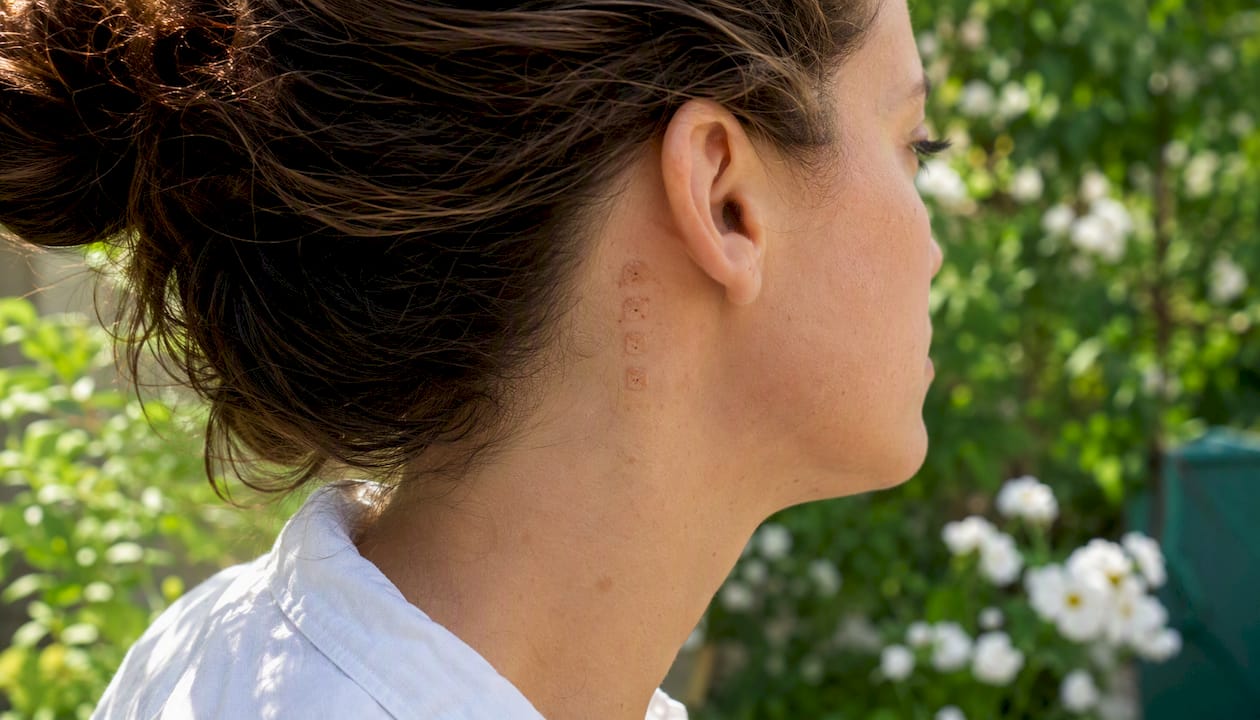
For hair products, test along the hairline or the nape of the neck.
How much to apply
- Face products: a dime- to pea-sized amount spread over a quarter-sized area
- Body products: a quarter-sized application
- Essential oils: always dilute with a carrier oil first (a 1–2% dilution is standard) before applying to the test site
Leave the product on exactly as you would in your normal routine. Don’t cover the site with a bandage unless the product is a leave-on treatment you’d normally cover.
Duration and frequency
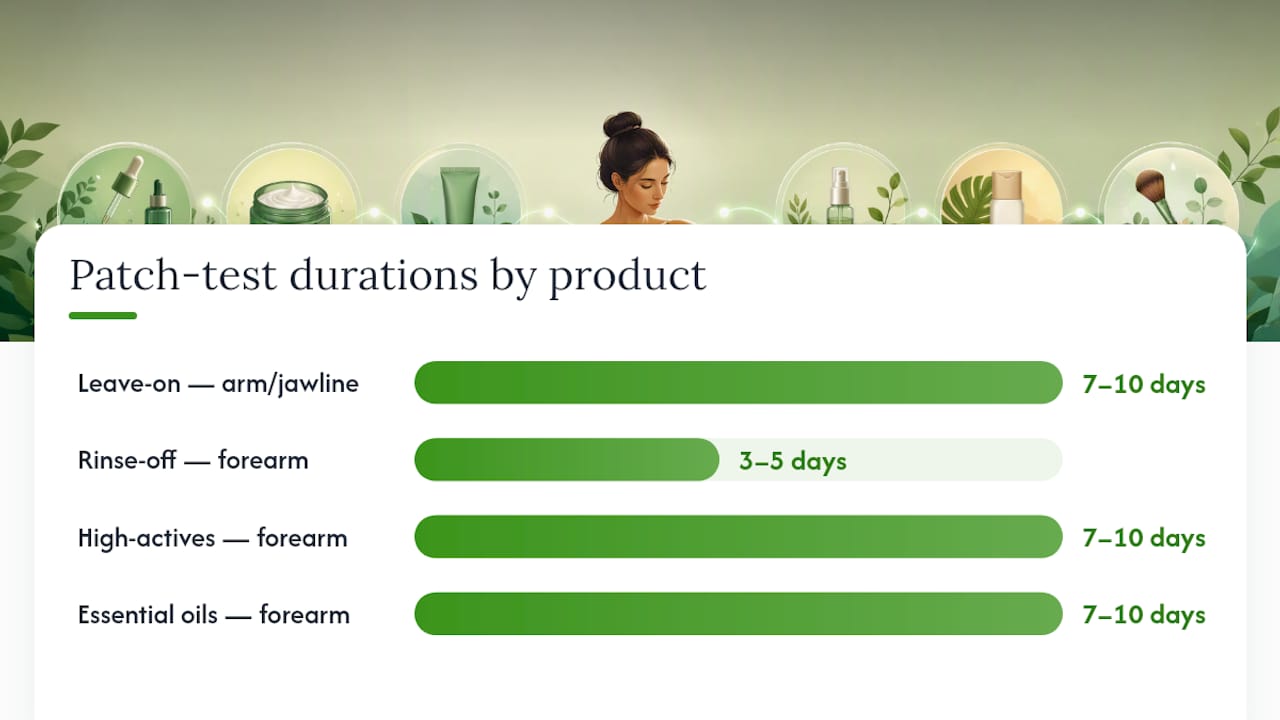
The American Academy of Dermatology recommends applying the product to the test area twice daily for 7–10 days. Wash it off and stop use immediately if a negative reaction occurs.
| Product category | Suggested test duration | Recommended test site |
|---|---|---|
| Leave-on moisturizers and serums | 7–10 days, twice daily | Inner forearm or jawline |
| Rinse-off cleansers and masks | 3–5 days, once daily (short contact) | Inner forearm |
| High-actives (AHAs, retinol, vitamin C) | 7–10 days, start once daily | Inner forearm |
| Essential oils (diluted) | 7–10 days, once daily | Inner forearm |
Track what you see
Take a photo of the test site on day one, then again at 48 hours and at day 7–10. A simple note in your phone with the product name, date started, and any observations is enough. If you’re testing multiple products, space each new test at least 48 hours apart so you can isolate which product caused a reaction.
Pro Tip: Even after a clear patch test, introduce potent actives like retinol or glycolic acid slowly. Start with two or three applications per week before moving to daily use. A clear patch test means no acute reaction, not that your skin is ready for daily high-frequency use from day one.
How long should you watch for a reaction?
Timing is where most people get it wrong. They apply a product once, see nothing, and assume they’re fine.
Reactions fall into two categories. Irritant reactions, caused by a product that’s simply too harsh for your skin, often appear within minutes to a few hours of application. These show up as immediate stinging, redness, or burning at the test site.
Allergic contact dermatitis is slower. The immune system needs time to mount a response, which is why the Medical News Today guidance recommends repeating the application twice daily for 7–10 days. A reaction can appear anywhere from 48 to 96 hours after first contact, or even later.
A clear test at day 10 is meaningful. If you’ve applied the product twice daily for 10 days with no redness, itching, swelling, or burning, that’s a strong signal the product is tolerable for your skin under normal use conditions. It doesn’t guarantee zero future reaction, but it substantially reduces your risk of a full-face flare.
Set three reminders: 24 hours, 48 hours, and day 7–10. Check the site in good lighting each time.
What signs should you watch for, and what do you do if the site reacts?
Watch for these at the test site:
- Redness or pink discoloration
- Itching or burning that doesn’t fade within a few minutes
- Swelling or puffiness
- Blistering or weeping skin
- Spreading redness beyond the test area
- Small raised bumps or vesicles
Mild reaction (slight redness, minor itching that fades quickly): Rinse the area with cool water, apply a fragrance-free moisturizer or a thin layer of petroleum jelly, and discontinue the product. Monitor the site for 24–48 hours.
Moderate reaction (persistent redness, itching, swelling, or blistering): Wash off the product immediately, apply a cool compress, and stop use. If symptoms don’t improve within 48 hours, see a dermatologist. The AAD advises consulting a board-certified dermatologist for severe or persistent symptoms.
Severe or systemic reaction: Call 911 immediately if you experience throat tightening, difficulty breathing, widespread hives, dizziness, or swelling of the face and lips. These are signs of anaphylaxis, a medical emergency requiring epinephrine.
Dermatology guidance draws a clear line between mild tingling from an active ingredient (normal with acids and retinoids) and true irritant or allergic reactions. Severe burning, spreading redness, or vesicles means remove the product now.
Which ingredients are most likely to cause a reaction?
Clinical reviews on contact dermatitis consistently identify fragrances and preservatives as the leading causes of allergic and irritant reactions from personal care products.
High-risk ingredient groups:
- Fragrances: listed as “fragrance,” “parfum,” or hidden in “masking fragrance” entries; present even in some “unscented” products
- Preservatives: formaldehyde-releasing preservatives (DMDM hydantoin, quaternium-15), methylisothiazolinone, and parabens in high concentrations
- Solvents and emulsifiers: propylene glycol is a frequent sensitizer, especially in leave-on products
- Dyes and colorants: synthetic dyes in tinted moisturizers and color cosmetics
- Botanicals and essential oils: tea tree, lavender, peppermint, and citrus oils are common triggers
- Metals: nickel in tools and some cosmetic pigments
Product types that warrant extra caution:
- Hair dyes (especially those containing PPD, or para-phenylenediamine)
- Concentrated active serums and exfoliants
- Sunscreens (UV filters like benzophenones are known sensitizers)
- DIY or small-batch formulations without standardized testing
Label-reading tip: “Fragrance-free” means no added fragrance compounds. “Unscented” may still contain masking fragrance to neutralize odor. When a product’s ingredient list runs past 20 entries, the probability of a hidden sensitizer rises. Scan for “parfum,” “fragrance,” and any ingredient ending in “-paraben” or containing “formaldehyde” in its name.
When should you see a dermatologist for professional patch testing?
At-home testing is a useful first filter, but it has real limits. If you’re dealing with any of the following, professional patch testing is the right next step.
- Recurrent unexplained rashes that appear and disappear without a clear product trigger
- Severe or spreading reactions that don’t resolve within 48–72 hours of stopping the product
- Multiple suspected triggers where you can’t isolate the cause through home testing
- Occupational exposures (healthcare workers, hairdressers, construction workers) where contact with allergens is ongoing
- Reactions to products you’ve used for years without prior issues, which can signal new sensitization
At a dermatologist or allergist’s office, the process looks like this:
- The clinician applies adhesive patches containing individual allergens to your upper back
- You return at approximately 48 hours for the first reading
- A second reading occurs at 72–96 hours to catch delayed responses
- Results identify which specific allergens triggered a response
Before the appointment, avoid applying topical corticosteroids or taking oral antihistamines to the test area, as these suppress immune responses and can produce false negatives. Avoid sun exposure on your back in the days before testing. The Cleveland Clinic’s overview of the procedure covers pre-test preparation in detail.
What dermatologists and evidence say about patch testing
The AAD’s guidance on how to test skincare products is built around a 7–10 day observation window with twice-daily application, immediate wash-off for any negative reaction, and dermatologist consultation for anything severe or persistent. The Cleveland Clinic echoes this, adding that professional testing is the appropriate escalation when broader allergic contact dermatitis is suspected.
Board-certified dermatologist Dr. Dendy Engelman frames the at-home patch test as a fundamental safety practice: genuinely useful as a home screen, but less precise than in-office tests that use single allergens at diagnostic concentrations. That framing is accurate. Home testing tells you whether a product is tolerable; clinical testing tells you which ingredient is the problem.
The practical takeaway from the evidence: patch testing before widespread use reduces your risk of a full-face or full-body reaction. It doesn’t eliminate risk entirely, but it catches the most acute responses before they become a larger problem. For anyone introducing active ingredients, including retinoids, acids, or peptide serums, this preliminary screen is worth the 10 days.
For readers considering a dermatologist-approved active serum, patch testing is the responsible first step before committing to daily use.
A practical reminder before you open that new product
The most common mistake isn’t skipping the patch test entirely. It’s doing it once, seeing nothing, and immediately applying a new active to your whole face. Even a clear patch test result is a starting point, not a green light for aggressive daily use.
Keep a simple log: product name, date started, test site, and a photo at day one and day 10. If you ever react to something months later, that record tells you exactly what changed in your routine. Log ingredients too, not just product names, because the same sensitizer can appear across multiple products under different names.
Sources
The following sources informed this guide and are worth bookmarking for ongoing reference:
- How to test skin care products
- How to perform a patch test for skincare products
- How to Patch Test Skincare | PillowtalkDerm / Byrdie
- Patch Testing for Skin Allergies: Procedure & Results
This article is general information, not a substitute for advice from a qualified doctor. Consult a qualified healthcare professional about your own circumstances before acting on anything here.