

Combining copper peptides microneedling protocols is safe and effective for most skin types, provided you wait until the initial inflammatory phase passes before applying them. GHK-Cu, the copper peptide most studied for this purpose, is small enough and biologically active enough to make good use of the micro-channels microneedling creates.
That’s the short version. Here’s what matters if you’re actually planning to do this:
- Primary benefit: GHK-Cu supports collagen cross-linking and brings antioxidant activity right when your skin is rebuilding tissue, which is the whole point of microneedling in the first place.
- Main caveat: timing is everything. Apply copper peptides too early, and you risk irritation or, in some skin types, post-inflammatory hyperpigmentation. Apply them at the right window, and the data suggests faster early gains.
If you want the actual research behind that verdict, including a JCAS 2026 trial that found both a benefit and a risk worth knowing about, skip ahead to the evidence section below.
Key Takeaways
Copper peptides microneedling protocols work best when GHK-Cu is introduced after the inflammatory phase settles, timed to skin depth and tone rather than a single fixed rule.
| Point | Details |
|---|---|
| Mechanism checks out | GHK-Cu’s small size and copper-driven role in collagen cross-linking make it a strong match for microneedling’s delivery channels. |
| Evidence is real but modest | Clinical data shows faster early gains with copper peptides but no significant long-term advantage over microneedling alone. |
| Timing prevents most problems | Wait 24 to 72 hours for light treatments, longer for deep sessions, before applying copper peptides. |
| Hyperpigmentation is the key risk | It occurred more often in copper-peptide groups in clinical study data, especially relevant for medium to deep skin tones. |
| Copperpeptides fits the protocol | Its high-purity, dermatologist-endorsed serum pairs medical-grade hyaluronic acid with copper peptides for post-procedure use. |
Table of Contents
- How Does Copper Peptide Delivery Work After Microneedling?
- What Do Clinical Studies Say About Copper Peptides and Microneedling?
- When Should You Start Copper Peptides After Microneedling?
- What’s the Best Protocol for Using Copper Peptides After Microneedling?
- What Are the Risks of Combining Copper Peptides With Microneedling?
- How Copperpeptides Approaches Post-Microneedling Skincare
- Why the Timing Debate Misses the Bigger Point
- Get Started With a Post-Microneedling Copper Peptide Routine
- Frequently Asked Questions
- Sources
How Does Copper Peptide Delivery Work After Microneedling?
Microneedling works by puncturing the stratum corneum, the skin’s outermost barrier, with dozens to hundreds of tiny needles. Those punctures close within hours to a day or two depending on depth, but while they’re open, they function as temporary conduits. Anything applied topically during that window has a real shot at reaching the dermis instead of sitting uselessly on the surface, which is the entire reason “what to put on after microneedling” is such a loaded question.
That’s where GHK-Cu comes in. GHK-Cu is a tripeptide bound to a copper ion, weighing in at roughly 340 daltons. That’s a genuinely small molecule by peptide standards, and size matters here: smaller peptides under 500 daltons are far more likely to actually pass through those micro-channels than larger, bulkier compounds that just sit at the surface no matter how many holes you poke in the skin. Copper itself isn’t a passive passenger. It acts as a cofactor for lysyl oxidase, an enzyme your skin needs to cross-link collagen fibers into stable, load-bearing structures. Without adequate copper availability, new collagen stays looser and weaker.
The permeation numbers back this up in a concrete way. A widely cited lab study on microneedle-mediated copper peptide delivery measured 134 ± 12 nanomoles of peptide and 705 ± 84 nanomoles of copper permeating through microneedle-treated human skin over nine hours. Through intact, unbroken skin, permeation was close to zero. That’s not a marginal improvement. It’s the difference between a serum that mostly evaporates off your face and one that actually reaches the tissue doing the repair work.
Why GHK-Cu specifically fits this mechanism better than most other active ingredients people reach for post-procedure:
- Its low molecular weight lets it travel through micro-channels that would block larger peptides or protein complexes.
- The copper ion it carries has a direct enzymatic role in collagen maturation, not just a vague “anti-aging” association.
- It has decades of use in wound-healing research, unlike many trendier peptides with thinner evidence bases.
- It doesn’t require a carrier system or enhancer to cross the barrier once microneedling opens the door.
None of this means copper peptides are the only compatible option after microneedling, but the size and mechanism line up unusually well with what microneedling is mechanically built to deliver.
What Do Clinical Studies Say About Copper Peptides and Microneedling?
The lab-level evidence is solid. The clinical picture is more nuanced, and worth understanding before you assume more is automatically better.
The foundational permeation study mentioned above established that microneedling dramatically increases dermal exposure to GHK-Cu compared to topical application on intact skin. That’s a pharmacokinetic finding, not a clinical outcomes study. It tells you the peptide gets in. It doesn’t, by itself, tell you how much visible improvement that translates to on a real face over months.
For that, the more relevant reference is a JCAS 2026 study comparing dermaroller alone against dermaroller plus copper peptide for acne scar management. The combination group showed faster early improvement, meaning texture and scar indices moved in the right direction sooner than with microneedling alone. But by the later follow-up points, the two groups had largely converged. No statistically significant long-term difference between them.
The copper-peptide group also showed a higher rate of hyperpigmentation than the microneedling-only group, a detail that matters more than the headline efficacy finding for anyone with medium to deep skin tones.
That single line is arguably the most important piece of evidence in this entire discussion, and it’s frequently left out of enthusiastic skincare content that treats copper peptides as a strictly upside proposition.
A few protocol variables explain why results differ so much from one study or one person’s routine to the next:
- Needle depth changes how deep the channels reach and how long they stay open, which changes total peptide exposure.
- Peptide concentration in the formulation used varies widely across studies and commercial products, with no industry-standard dose.
- Contact time, meaning whether the peptide is left on for minutes or hours before rinsing, appears to affect both benefit and hyperpigmentation risk, since longer contact windows push more copper into tissue that’s still actively inflamed.
- Skin type and baseline pigmentation heavily modify hyperpigmentation risk independent of the product itself.
The honest read: mechanistically, copper peptides are a strong fit for microneedling. Clinically, they show a real but modest edge in the early weeks, not a guaranteed long-term transformation, and that edge comes with a pigmentation trade-off that hasn’t been fully resolved by protocol standardization across studies. Anyone promising dramatic, universal results is overstating what the current research supports.
When Should You Start Copper Peptides After Microneedling?
Timing is the single biggest variable separating a good outcome from an irritated, blotchy one. The skin moves through overlapping phases after microneedling: an inflammatory phase in the first day or so, followed by a proliferation phase where new tissue and collagen actually start forming. Copper ions interact with matrix metalloproteinases and growth-factor signaling, both of which are especially active and easily disrupted during that early inflammatory window.
- Immediately after treatment (0 to 24 hours): stick to sterile hyaluronic acid only. Skip peptides entirely during this stretch.
- 24 to 72 hours after light, at-home microneedling: this is the window practitioner guidance generally points to for introducing GHK-Cu, once the skin barrier has begun re-forming.
- Longer after deeper, in-clinic procedures: wait closer to the higher end of that range, or follow your provider’s specific instructions, since deeper needle penetration means a longer inflammatory window.
During that early window, avoid retinoids (they accelerate cell turnover on tissue that’s already turning over rapidly), AHAs and BHAs (chemical exfoliation on open channels is a recipe for irritation), strong vitamin C formulations (low pH can sting compromised skin), and anything containing alcohol or added fragrance (both are common irritants with zero benefit to healing tissue).
Pro Tip: If you have a darker Fitzpatrick skin type, extend your waiting period past the standard 72 hours and patch-test any copper peptide product on a small area first. Hyperpigmentation risk isn’t evenly distributed across skin tones, and caution here costs you nothing but a couple of extra days.

Some clinician sources specifically caution against rushing copper peptides into the earliest hours post-treatment, precisely because copper’s interaction with MMP activity can influence remodeling before the skin has even started that process properly. If you’re unsure how deep your last session went, treat it as deep and wait longer rather than shorter.
What’s the Best Protocol for Using Copper Peptides After Microneedling?
Here’s a practical sequence that lines up with both the timing research and the delivery mechanics covered above.
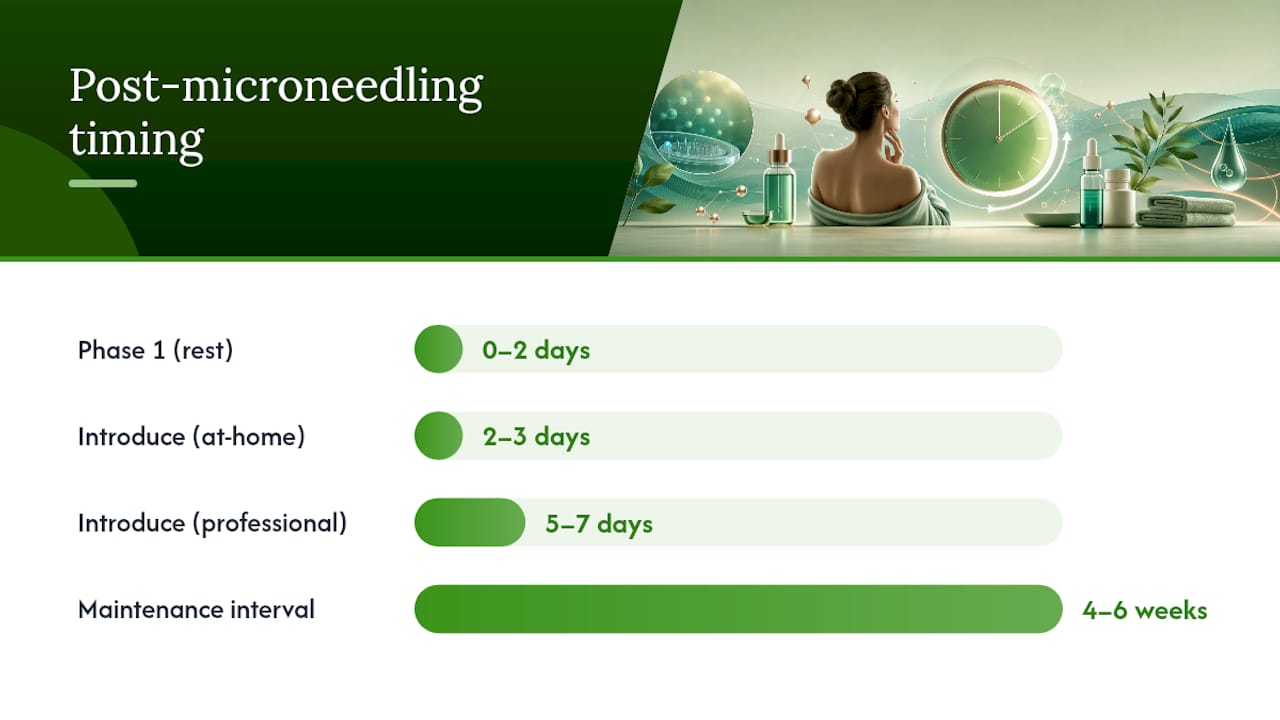
Phase one: 0 to 48 hours.
- Cleanse gently with a fragrance-free cleanser, patting rather than rubbing the skin dry.
- Apply sterile hyaluronic acid as your only active. Nothing else goes on the skin during this phase.
- Use a mineral (physical) sunscreen if you’re heading outdoors, since chemical filters can sting freshly treated skin.
- Avoid makeup, sweating, and swimming for at least the first 24 hours.
Phase two: introducing copper peptides.
- For light, at-home microneedling (shorter needles, shallower depth), day 2 or 3 is a reasonable point to introduce a copper peptide serum, assuming no active irritation.
- For deeper, professional-grade sessions, wait until day 5 to 7, or follow your provider’s specific timeline.
- Apply as a light mist or a few drops of serum, patted in rather than rubbed, since rubbing compromised skin invites unnecessary friction and irritation.
- Patch-test on the inner arm first if this is your first time using a copper peptide product, especially if you have a history of sensitivity or hyperpigmentation.
Phase three: maintenance between sessions.
Professional microneedling is typically spaced 4 to 6 weeks apart, giving the skin enough time to complete a full remodeling cycle before the next round of channels opens things up again. Deeper clinical work often needs longer gaps, and darker skin tones benefit from a more conservative interval to reduce cumulative pigmentation risk. Between sessions, a copper peptide serum applied once or twice daily supports ongoing collagen synthesis without the acute permeation spike that follows a fresh microneedling pass. Micro-channels stay open anywhere from several hours to a day or two, so the day-of-treatment window is where contact time matters most; regular daily use afterward is a maintenance habit, not a re-creation of that initial absorption spike.
If you’re using an at-home derma roller or stamping device, sterility isn’t optional.
Pro Tip: Keep your copper peptide serum in its own dedicated bottle with a clean dropper or pump, never a jar you dip fingers into repeatedly. Contamination risk goes up considerably once broken skin is involved, and an infected micro-channel is a far bigger problem than a slightly less potent serum.
Watch for anything that looks like it’s escalating rather than resolving. Redness that fades within a day or two is normal. Redness that spreads, deepens, or comes with pain that’s getting worse instead of better is not.
What Are the Risks of Combining Copper Peptides With Microneedling?
The main documented risk is hyperpigmentation. The JCAS 2026 trial found it occurred more frequently in the copper-peptide group than in the microneedling-only group. It typically shows up as darker patches at treatment sites weeks after the procedure and usually fades over months, though it can persist longer in medium to deep skin tones without proper aftercare.
Beyond pigmentation, watch for:
- Immediate stinging or burning that doesn’t settle within minutes, which often signals the product isn’t suited to freshly opened skin.
- Signs of infection from non-sterile needling technique, including spreading redness, warmth, or pus.
- Reactions to impurities in low-quality copper peptide formulations, which is one reason formulation purity matters more here than in a standard daily serum.
Certain people should avoid this combination entirely or only pursue it under direct clinician oversight: anyone with an active skin infection, anyone who has recently taken oral isotretinoin, pregnant or breastfeeding individuals, people with autoimmune or inflammatory skin conditions, and anyone with a medium to deep Fitzpatrick skin type attempting anything beyond very superficial at-home microneedling.
Contact a clinician if pain worsens rather than improves, redness spreads beyond the treated area, you develop a fever, or you notice pus at any puncture site.
How Copperpeptides Approaches Post-Microneedling Skincare
Copperpeptides formulates a single-ingredient-focused serum built around high-purity copper peptides paired with medical-grade hyaluronic acid, designed with sensitive and post-procedure skin in mind. The formulation is dermatologist-endorsed, and purity matters more than most people realize when a product is going into freshly opened skin rather than sitting on an intact barrier.
What that means practically:
- Most users see visible improvements in texture and firmness within 4 to 6 weeks of consistent use, in line with the timelines the research above suggests for copper peptide activity.
- The hyaluronic acid component addresses the immediate hydration need that comes first, before copper peptides are introduced.
- Patch-testing is still recommended, and anyone recovering from a deeper clinical procedure should confirm timing with their provider before adding any new active.
| Consideration | Detail |
|---|---|
| Formulation focus | High-purity copper peptides with medical-grade hyaluronic acid, positioned for sensitive and post-procedure skin. |
| Expected timeline | Visible results generally reported within 4 to 6 weeks of consistent use. |
| Recommended practice | Patch-test first and confirm timing with a clinician after deeper procedures. |
Why the Timing Debate Misses the Bigger Point
Most discussion around copper peptides and microneedling gets stuck arguing over exact hour counts. Twenty four hours versus forty eight, day two versus day three. That precision is useful, but it’s not where most people actually go wrong.
The bigger failure point is treating every microneedling session as identical. A 0.25 millimeter at-home roller and a 1.5 millimeter professional session put skin in genuinely different physiological states, and the JCAS 2026 hyperpigmentation signal almost certainly reflects protocol variation as much as the ingredient itself. Depth, concentration, and contact time move together, and most consumer advice flattens all three into one generic waiting period.
What should you actually prioritize? Match your caution to your treatment depth and your skin tone, not to a number you read somewhere. If you’re doing light at-home rolling, the standard windows above serve you well. If you’ve had deeper professional work, or you have a skin tone with elevated hyperpigmentation risk, err longer and choose a high-purity formulation rather than whatever’s cheapest. That single decision, purity and timing calibrated to your actual situation, does more for your results than any debate over the exact hour to start.
Get Started With a Post-Microneedling Copper Peptide Routine
If you’ve made it this far, you already know the ingredient matters as much as the timing. A copper peptide serum with unclear purity or a vague concentration undermines everything covered above about why GHK-Cu works. Copperpeptides built its copper peptide anti-aging serum specifically around the purity issue: a high-purity, single-focus formulation combined with medical-grade hyaluronic acid, meant for skin that needs both hydration and active support rather than a crowded ingredient list of unknown strength.
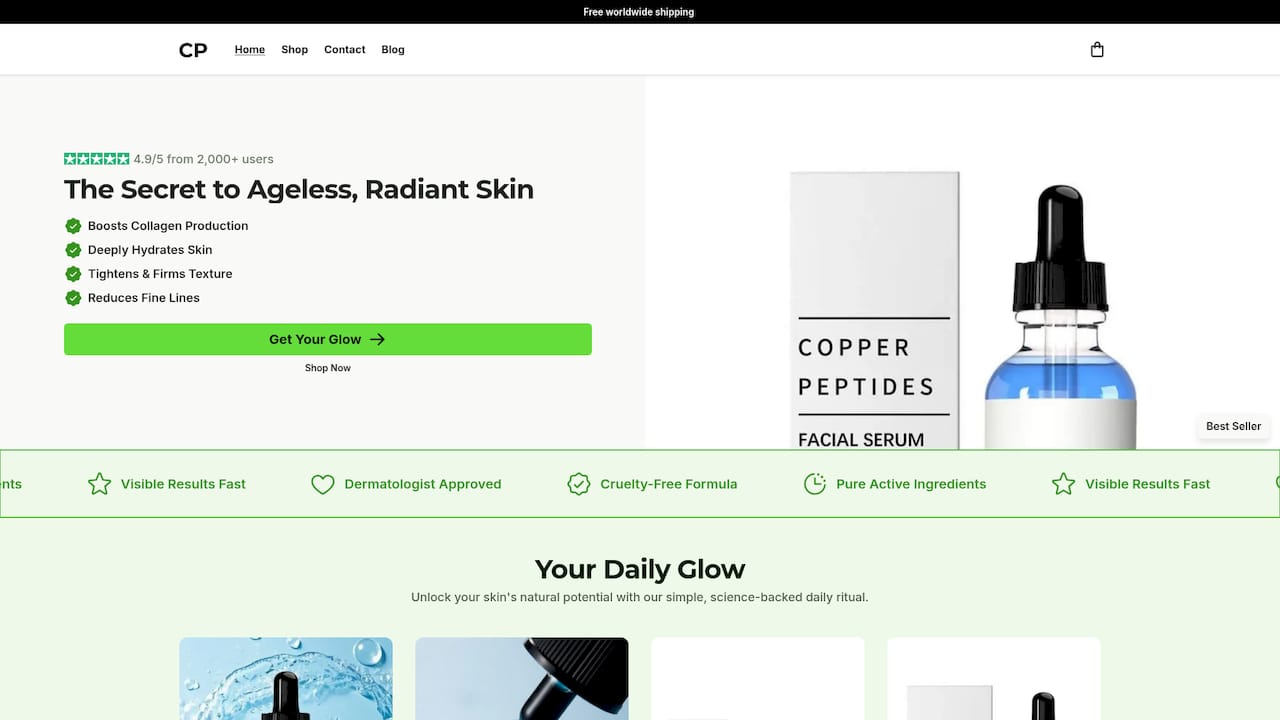
It’s formulated to be gentle enough for sensitive skin and post-procedure use, with dermatologists behind its endorsement rather than just marketing copy. Most people using it consistently see visible firming and texture improvement within 4 to 6 weeks, a timeline consistent with how collagen remodeling actually progresses. If you’re planning your next microneedling session and want a copper peptide option built with post-procedure skin in mind, check the product page and see whether the concentration and formulation match what your skin and your provider’s timing guidance call for.
Frequently Asked Questions
Can you use copper peptides after microneedling right away? No. Most practitioner guidance recommends waiting at least 24 hours, often up to 72 hours, before applying copper peptides after microneedling. Immediately after treatment, sterile hyaluronic acid alone is the safer choice.
What are the main benefits of copper peptides for skin? Copper peptides support collagen cross-linking through their role as a cofactor for lysyl oxidase, help with antioxidant defense during tissue repair, and are frequently used to support firmness and texture in aging skin over consistent use.
Do copper peptides cause hyperpigmentation? Clinical data from a JCAS 2026 study found a higher rate of hyperpigmentation in a copper-peptide group compared to microneedling alone, particularly relevant for medium to deep skin tones. Timing and patch-testing reduce this risk but don’t eliminate it entirely.
How often should you microneedle when using copper peptides? Professional microneedling sessions are typically spaced 4 to 6 weeks apart, with copper peptides used as a daily or twice-daily maintenance step between sessions rather than only on treatment days.
What should you avoid mixing with copper peptides after microneedling? Avoid retinoids, AHAs and BHAs, strong vitamin C formulations, and anything with alcohol or added fragrance in the days immediately following a microneedling session, since all of these can irritate skin that’s still in an active healing phase.
This article is general information, not a substitute for advice from a qualified doctor. Consult a qualified healthcare professional about your own circumstances before acting on anything here.
Sources
- Microneedle-mediated delivery of copper peptide (GHK-Cu) — Springer
- A study comparing the effect of dermaroller versus dermaroller with copper peptide in the management of acne scars - JCAS
- Copper peptides after microneedling: Boost collagen and heal - MDPen
Recommended
- Copper Peptides and Niacinamide: How to Use Them Together – Copper Peptides Store
- Copper Peptides vs Matrixyl: Which One Actually Works? – Copper Peptides Store
- Copper Peptide Benefits: A Science-Backed Skin Guide – Copper Peptides Store
- Peptides for Beginners: Copper Peptide Serums Guide – Copper Peptides Store