

Yes. Topical copper peptides, specifically GHK-Cu (copper tripeptide-1), are safe for most people when used in standard cosmetic concentrations, and the Expert Panel safety assessment on cosmetic peptides has found no evidence of genotoxicity or meaningful sensitization at typical use levels. That verdict comes with real conditions attached.
- Concentration matters. Products formulated within standard cosmetic ranges carry a very different risk profile than compounded or high-strength versions.
- Topical is not injectable. Everything in this safety picture applies to skin application, not injections, which follow an entirely different (and far less studied) risk pathway.
- Some groups need a check-in first. Pregnant or breastfeeding people, anyone with a copper metabolism disorder, and those with known metal allergies should talk to a clinician before starting.
Patch test any new copper peptide product on your inner arm for 48 hours before applying it to your face. If you fall into a higher-risk group, get a green light from your dermatologist first.
Key Takeaways
Topical copper peptides are safe for most adults at standard cosmetic concentrations, but formulation quality, patch testing, and awareness of higher-risk groups determine the real-world outcome.
| Point | Details |
|---|---|
| Topical safety is well-supported | Safety panels found no genotoxicity or meaningful sensitization at typical cosmetic concentrations. |
| Topical differs from injectable | Injectable GHK-Cu lacks controlled human safety data; only topical use has the strong track record. |
| Patch test before full use | Apply to your inner arm, wait 48 hours, and check for redness or irritation first. |
| Avoid layering with strong acids | Low-pH vitamin C and strong exfoliants can weaken the copper-peptide bond and raise irritation risk. |
| High-risk groups should consult a doctor | Pregnancy, copper metabolism disorders, and metal allergies all warrant a clinician check-in first. |
| Formulation quality drives real results | Copperpeptides’ high-purity serum with medical-grade hyaluronic acid is built for stability and tolerability. |
Table of Contents
- What Copper Peptides Are and How They Work in Skin
- Is GHK-Cu Safe? What the Research and Safety Panels Say
- Common Side Effects and Warning Signs to Watch For
- Using Copper Peptides Safely: What Not to Mix Them With
- Who Should Talk to a Doctor Before Using Copper Peptides
- How to Add Copper Peptides to Your Routine Safely
- Copper Peptide Myths, Facts, and Alternatives Worth Knowing
- What I’d Tell a Friend Asking About Copper Peptides
- Where to Find a Vetted Copper Peptide Serum
- Frequently Asked Questions
- Sources
What Copper Peptides Are and How They Work in Skin
GHK-Cu is a naturally occurring copper-binding tripeptide, listed on ingredient labels as “copper tripeptide-1.” Your body actually produces small amounts of it, and levels decline with age, which is part of why the compound draws so much attention in anti-aging formulas.
In skin, GHK-Cu appears to support the signaling pathways involved in collagen production and wound-repair, and it acts as part of the skin’s antioxidant defense system. That is the mechanism behind most of the marketing claims you have seen: firmer texture, better hydration retention, and support for skin that looks tired or thin.
Cosmetic brands lean on three main selling points:
- Anti-aging support through collagen and elastin signaling.
- Barrier and healing support, since copper peptides were first studied for their role in wound recovery.
- Hydration and firmness, often paired with humectants like hyaluronic acid to round out a serum.
Here is the distinction that gets lost in most online discussions: everything above describes topical use. Applying GHK-Cu to the skin’s surface is a fundamentally different exposure than injecting it, which bypasses the skin barrier entirely and introduces risks that topical formulas simply do not carry. When people ask whether copper peptides are safe, they are almost always asking about the topical version, and that is the version with decades of use behind it.
Is GHK-Cu Safe? What the Research and Safety Panels Say
The strongest evidence here does not come from marketing copy. It comes from independent safety reviews built specifically to stress-test cosmetic ingredients before they reach store shelves.
The Expert Panel safety assessment on cosmetic peptides concluded that peptide ingredients, evaluated at their present practices of use and concentration, showed no evidence of irritation, sensitization, or genotoxicity. A separate CIR final report on pentapeptides reached a similar conclusion for related peptide compounds, backed by tolerability data from randomized human trials at the low concentrations typically used in finished products.
Safety snapshot: Cosmetic safety panels consistently find peptides, including copper-binding peptides, safe at the concentrations actually used in commercial formulas. Not compounded, not concentrated, not injected. Just the standard cosmetic dose.
The peer-reviewed literature backs this up on the topical side specifically. A GHK-Cu review covering cell, tissue, animal, and human data describes an extensive research record with a generally favorable topical safety profile, and notes that most human exposure data comes from topical, not systemic, use. Separately, a review on copper’s role in skin health found that topical copper formulations tested in clinical studies were largely non-irritating and non-sensitizing, classifying copper as a weak sensitizer at most.
A few things worth flagging honestly:
- Much of the mechanistic research (how GHK-Cu actually triggers collagen signaling) is preclinical, meaning it comes from cell and animal studies rather than large human trials.
- Human topical safety data is real and reassuring, but it is not the same volume of evidence you’d find for, say, sunscreen.
- Formulation quality changes the equation entirely. A poorly stabilized peptide can degrade, oxidize, or destabilize, which affects both how well it works and how your skin tolerates it.
None of this undercuts the safety verdict. It just means “safe” here refers to a well-supported, real conclusion, not an ironclad guarantee that applies to every product regardless of how it’s made.
Common Side Effects and Warning Signs to Watch For
Most people tolerate copper peptides without issue, but “most” is not “all,” and knowing what a normal reaction looks like versus a red flag matters.
Typical, usually temporary side effects include:
- Mild redness or flushing in the first week or two of use.
- Slight tingling on application, especially on freshly cleansed skin.
- Increased sensitivity if you’re also using other active ingredients.
- Occasional acne flares in oily or acne-prone skin, since some formulations can feel heavier than a simple moisturizer.
Rarer but worth knowing about: allergic contact dermatitis. It’s uncommon given copper’s status as a weak sensitizer in tested topical formulations, but it happens. Concerns about cumulative systemic copper load are largely theoretical at typical over-the-counter concentrations, since your body tightly regulates systemic copper levels and topical cosmetic exposure sits well below the threshold that causes systemic issues.
Stop use and see a doctor if you notice spreading redness, blistering, hives, or any systemic symptom like swelling or difficulty breathing.
Pro Tip: A mild reaction typically shows up within 24 to 48 hours of first use as light pinkness or a faint tingling sensation that fades on its own. If it’s still there or getting worse after 72 hours, that’s your cue to stop and reassess, not push through.
Using Copper Peptides Safely: What Not to Mix Them With
Copper peptides don’t play well with every active ingredient, and getting the order wrong can quietly cancel out the benefit you’re paying for.
The main culprits are low-pH vitamin C (L-ascorbic acid) and strong exfoliating acids like glycolic or salicylic acid. Layering these directly with copper peptides can weaken the copper-peptide bond and oxidize the copper itself, which reduces effectiveness and can also raise irritation risk when actives stack on top of each other.
A workable routine looks like this:
- AM: antioxidant serum (if not vitamin C heavy) plus sunscreen.
- PM, night one: retinoid.
- PM, night two: copper peptide serum, applied as its own dedicated step.
- Wait at least 20 to 30 minutes between other actives if you’re not alternating nights entirely.
Think of copper peptides as needing their own lane rather than sharing a step with acids or retinoids. If you’re pairing copper peptides with something gentler, like niacinamide, compatibility is generally much less of a concern.
Pro Tip: When introducing a new combination, whether that’s copper peptides with a new moisturizer or a new acid elsewhere in your routine, add one new product at a time and give it a full week before judging how your skin responds.
Who Should Talk to a Doctor Before Using Copper Peptides
Most healthy adults can start using a copper peptide serum without a medical consultation. A few groups should check in with a clinician first, though, because their individual risk calculus is different.
- Pregnant or breastfeeding individuals, since topical peptide safety data during pregnancy specifically is limited.
- Anyone with a known copper or metal allergy, even if it’s mild.
- People with Wilson’s disease or other copper-handling disorders, where the body’s copper regulation is already impaired.
- Anyone considering injectable GHK-Cu, which carries unresolved safety and immunogenicity questions that topical use simply doesn’t share.
- Anyone recovering from a recent invasive skin procedure, like laser resurfacing or a deep chemical peel, unless their provider has specifically cleared it.
Immunocompromised individuals and people on medications that alter systemic copper levels should also loop in their doctor before adding a new active. And if irritation persists past a couple of weeks, or you suspect an allergic reaction, that’s a dermatologist visit, not a wait-and-see situation.
How to Add Copper Peptides to Your Routine Safely
Here’s a straightforward way to introduce copper peptides without guessing:
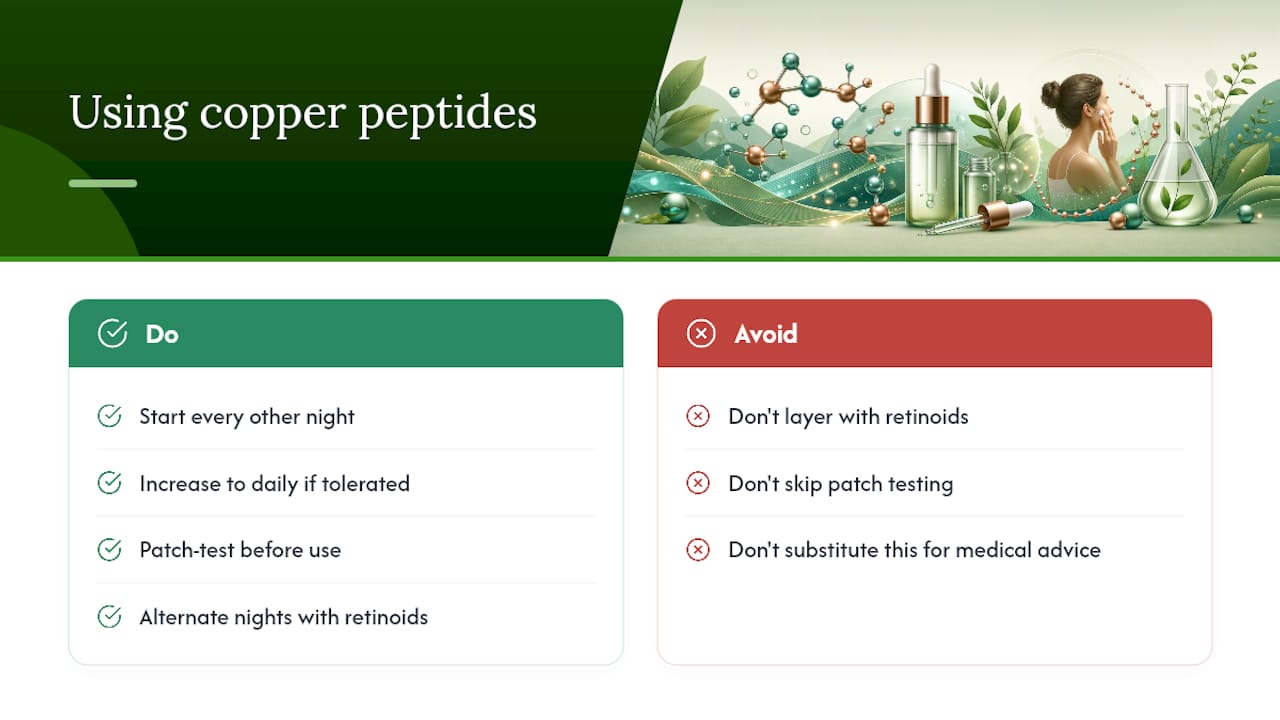
- Patch test first. Apply a small amount to your inner forearm or behind your ear, then wait 48 hours and check for redness, itching, or swelling before using it on your face.
- Start slow. Apply every other night for the first two weeks, then move to nightly use if your skin tolerates it well.
- Give it a real trial period. Most people need four to six weeks of consistent use before judging whether it’s working, since collagen remodeling isn’t instant.
- Track how your skin responds. Keep a quick note (a phone photo works) of texture and tone changes so you’re not relying on memory alone.
A few things beyond the schedule that affect real-world safety:
- Concentration and formulation quality both matter. Products built around the concentrations reviewed by safety panels behave predictably; unregulated or compounded versions do not carry the same track record.
- Store your serum away from heat and direct sunlight, since instability can degrade the peptide and change how your skin reacts to it.
- Check the expiration date. An oxidized, expired copper peptide product is more likely to irritate than an ineffective one.
Copper Peptide Myths, Facts, and Alternatives Worth Knowing
Myth: Topical copper peptides cause systemic copper poisoning. Fact: Your body tightly regulates systemic copper, and the concentrations used in cosmetic products are far below the threshold linked to toxicity. That risk applies to a completely different exposure route, like high-dose oral supplementation or injectables, not a standard serum.
Myth: All peptides work the same way, so it doesn’t matter which one you pick. Fact: Copper peptides, Matrixyl-style peptides, and retinoids all signal skin cells differently, and picking the wrong one for your skin type can mean paying for results you won’t see.
If you’re in a restricted group or just prefer to avoid copper peptides, niacinamide is a gentler option worth considering, and retinoids used with proper timing rules remain a well-studied alternative for collagen support.
What I’d Tell a Friend Asking About Copper Peptides
Copper peptides deserve their reputation more than most trending skincare ingredients do. The safety data is real, the mechanism has decades of research behind it, and the caveats are manageable rather than disqualifying. What actually determines your experience isn’t the ingredient name on the label. It’s whether the formulation behind it is stable, well-made, and used the way the evidence supports: patch tested, dosed sensibly, and kept away from ingredients that fight it. Skip the compounded or injectable versions circulating online, stick with a well-formulated topical product, and follow the routine rules. That’s the whole difference between a good outcome and a disappointing one.
Where to Find a Vetted Copper Peptide Serum
If you’ve read this far, you already know the real risk with copper peptides isn’t the ingredient itself. It’s ending up with a poorly stabilized, low-purity version that oxidizes in the bottle before it ever touches your skin. Copperpeptides built its copper peptide anti-aging serum around that exact problem: a high-purity, single-ingredient formula paired with medical-grade hyaluronic acid, designed for stability and safety across skin types, including sensitive skin.
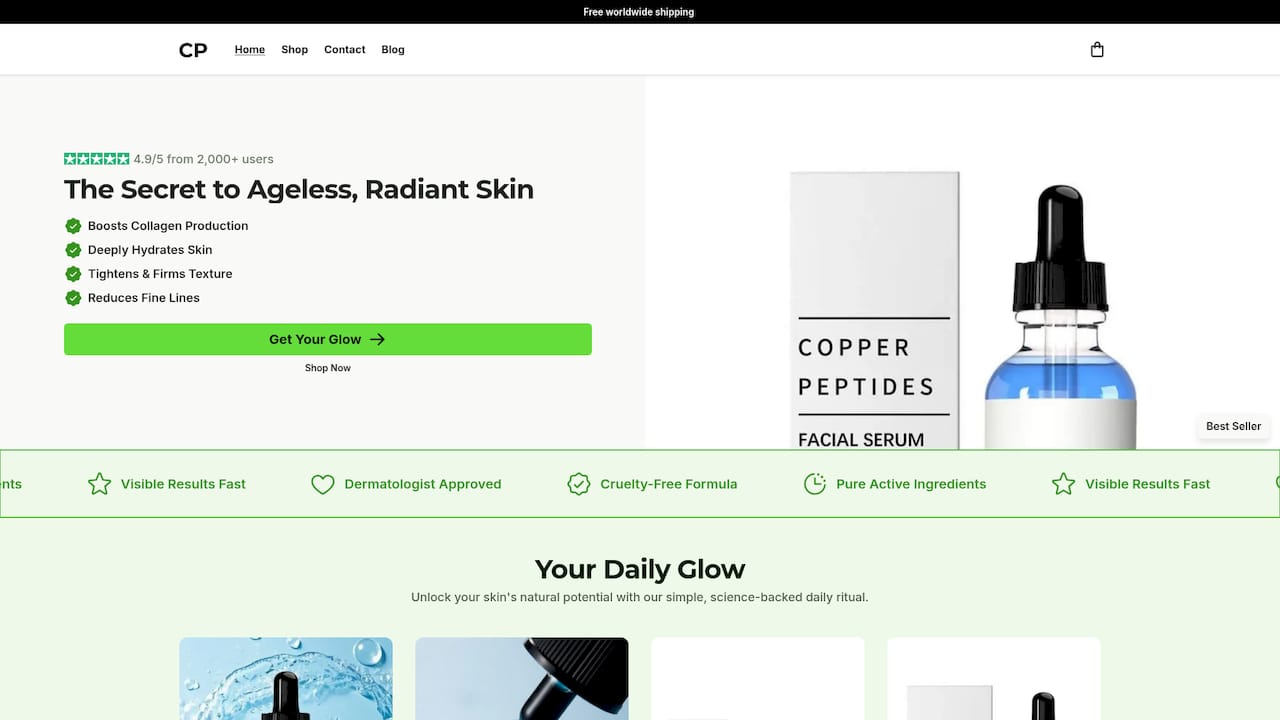
Dermatologists have endorsed its gentle, transformative effect on fine lines and firmness, with most people seeing visible changes within four to six weeks of consistent use, in line with the trial period safety experts recommend for judging any peptide product. If you’re ready to start, patch test it this week and see how your skin responds before committing to a nightly routine. You can check the full product details and ingredient breakdown to decide if it fits what your skin needs right now.
Frequently Asked Questions
Are copper peptides safe for daily use? Yes, for most people. Many dermatologists recommend starting every other night and building up to daily use once your skin shows it tolerates the product well.
Is GHK-Cu safe for sensitive skin? Generally yes, since topical copper has been classified as a weak sensitizer in clinical reviews. A patch test still matters more for sensitive skin than for any other skin type.
Are copper peptides irritating when combined with retinol? They can be more irritating when combined directly. Most guidance recommends alternating nights between retinoids and copper peptides rather than layering both at once.
Are copper peptides harmful if used long-term? No credible evidence points to long-term harm from standard topical, cosmetic-concentration use. The research record spans decades of topical application without widespread adverse reports.
Are copper peptides effective enough to justify the caution? For most users, yes. The combination of a documented safety profile and a genuine mechanism for supporting collagen and hydration is why copper peptides remain a staple recommendation among dermatologist-vetted formulations.
This article is general information, not a substitute for advice from a qualified doctor. Consult a qualified healthcare professional about your own circumstances before acting on anything here.
Sources
- Expert Panel safety assessment on cosmetic peptides (SAGE Journals)
- CIR final report on pentapeptides (FR_Pentapeptides_092024.pdf)
- GHK-Cu review (PMC6073405)
- Lpi
Recommended
- Dermatologist Approved Skincare: Best Copper Peptide Serum – Copper Peptides Store
- Copper Peptide Benefits: A Science-Backed Skin Guide – Copper Peptides Store
- Copper Peptides vs Matrixyl: Which One Actually Works? – Copper Peptides Store
- Peptides for Beginners: Copper Peptide Serums Guide – Copper Peptides Store