

Transepidermal water loss (TEWL) is the rate at which water evaporates through your skin’s outer layer into the air, measured in grams per square meter per hour. A high reading signals a compromised barrier, not just “dry skin,” and the fastest fix is layering a humectant, an occlusive, and an emollient rather than reaching for any single product.
TL;DR:
- TEWL varies greatly depending on body site, with healthy values ranging from about 2.3 to 44.0 g/m²/h, making interpretation site-specific.
- Factors such as low humidity, airflow, hot water, harsh cleansers, and over-exfoliation can increase TEWL by damaging the skin’s lipid barrier.
- Proper repair involves layering a humectant on damp skin, sealing with a ceramide-rich moisturizer, and avoiding skin irritants over a period of two to six weeks.
- Elevated TEWL manifests through visible signs like flaking, tightness, cracking, and dullness, especially when barrier disruption persists despite routine care.
- Copper peptides support barrier health when used after proper cleansing and as part of a comprehensive routine, but they are not primary repair agents.
Table of Contents
- What Is Transepidermal Water Loss, Really?
- How TEWL Is Measured and What Counts as Normal
- What Raises or Lowers TEWL
- How Elevated TEWL Shows Up in Real Skin Problems
- Ingredients and Strategies That Actually Reduce Water Loss
- A Simple Daily Routine to Repair the Barrier
- Why TEWL Numbers Don’t Tell the Whole Story
- Do TEWL Levels Differ by Skin Type or Ethnicity?
- Why Dermatologists and Researchers Rely on TEWL
- How TEWL Shapes Skincare Product Testing
- Barrier Repair Takes Weeks, Not Miracles
- Where Copper Peptides Fit Into a Barrier Repair Routine
- Sources
- FAQ
What Is Transepidermal Water Loss, Really?
TEWL is a passive process. Water diffuses upward from the deeper, wetter layers of your skin, passes through the stratum corneum, and evaporates off the surface, driven purely by the humidity gradient between your skin and the surrounding air. No sweat glands are involved. No active pumping. It’s the same physics that dries a puddle on a sidewalk, just happening constantly across every square inch of your skin.
What controls the rate is the stratum corneum’s structure, often described as a brick-and-mortar wall. The “bricks” are corneocytes, flattened dead skin cells packed with keratin. The “mortar” is a mix of lipids, mainly ceramides, cholesterol, and free fatty acids, arranged in tightly stacked layers between the cells. When that lipid mortar is intact, it slows water’s escape to a crawl. When it’s disrupted by harsh cleansing, over-exfoliation, or genetic conditions like eczema, water moves through far more freely and TEWL climbs.
Inside the corneocytes themselves sits another piece of the puzzle: natural moisturizing factor (NMF), a blend of amino acids, urea, lactic acid, and other small hygroscopic molecules that hold water inside the cells. Comprehensive reviews on skin hydration’s molecular mechanisms tie both NMF levels and lipid composition directly to how well the barrier resists water loss and how normally skin cells shed at the surface.
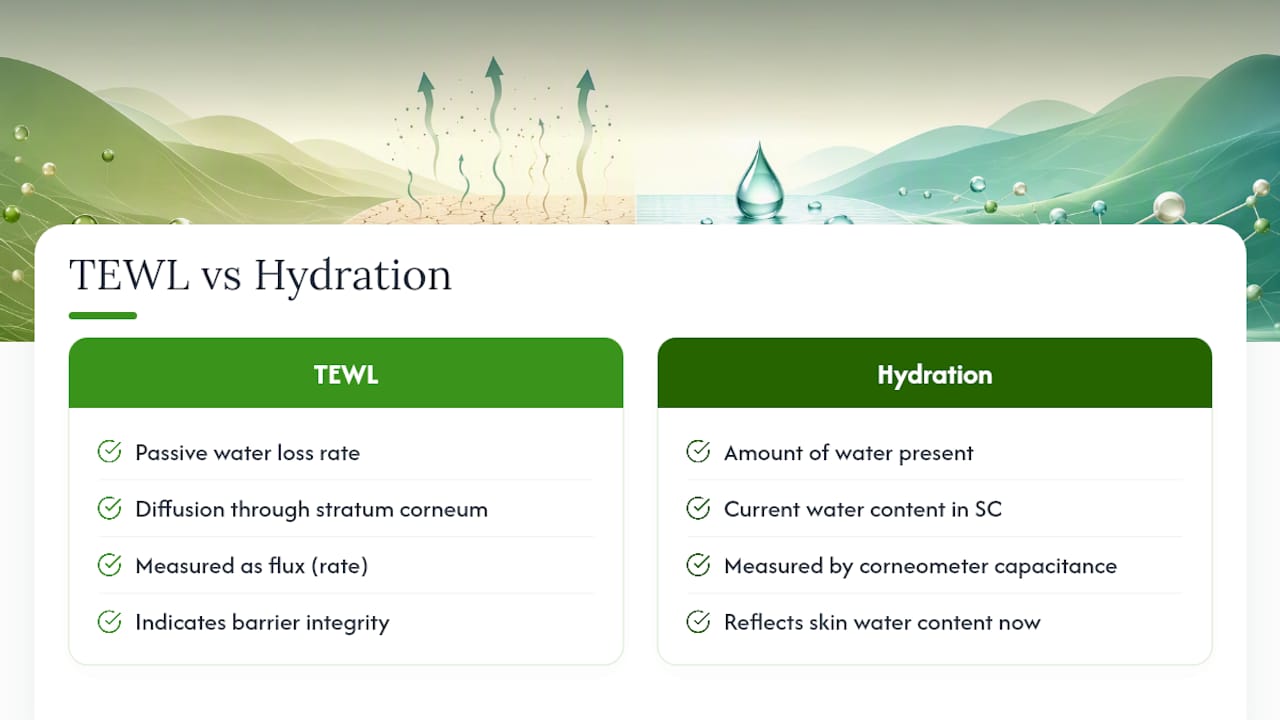
Here’s where most people get confused: TEWL is not the same thing as skin hydration. Hydration refers to how much water is actually present in the stratum corneum right now, usually measured with a corneometer that reads electrical capacitance. TEWL measures the rate water is leaving, which reflects barrier integrity more than current water content. You can have skin that feels plump and hydrated in the morning but still shows elevated TEWL because the barrier itself is thin or damaged. That distinction matters if you’re trying to figure out whether your skin is “dry” (lacking oil, structurally impaired) or “dehydrated” (lacking water, often temporary), and it’s worth reading further on how dry skin differs from dehydrated skin if you’re still sorting that out.
TEWL functions best as an indicator of barrier condition, not a standalone hydration score. A dermatologist or researcher reads it the way a mechanic reads a pressure gauge, as one signal among several, not the entire diagnosis.
How TEWL Is Measured and What Counts as Normal
Two instrument types dominate TEWL measurement. Open-chamber evaporimeters use a probe with sensors positioned at different heights above the skin, calculating the vapor pressure gradient between them. Closed-chamber devices seal a small chamber against the skin and track humidity rise inside it over a few seconds. Closed-chamber systems tend to be less sensitive to ambient air currents, which matters more than it sounds like it should.
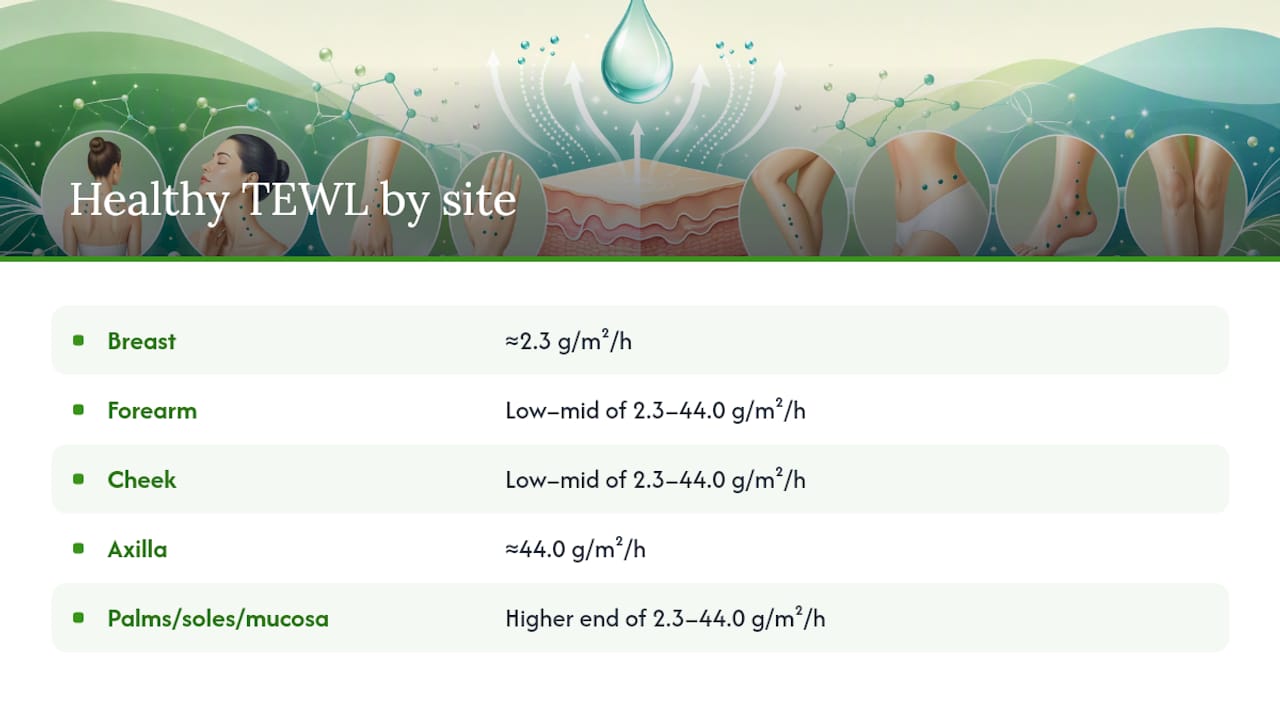
Reference values swing enormously by body site, which is exactly why a single “normal” number doesn’t exist for skin in general.
A systematic review and meta-analysis pooling healthy adult data found TEWL values ranging from around 2.3 g/m²/h on the breast to as high as 44.0 g/m²/h in the axilla. Forearm and cheek skin typically sit somewhere in the low-to-mid range of that spread, while palms, soles, and skin near mucous membranes run on the higher end due to thinner or more permeable stratum corneum. This is why interpreting a raw TEWL number without knowing the anatomical site is close to meaningless. A reading that looks alarming on the forearm might be completely unremarkable on the axilla.
Clinical severity sits at the other extreme entirely. Reviews of barrier disruption in burn injuries describe TEWL climbing past 50 to 100 g/m²/h in severely damaged skin, several times higher than even the most permeable healthy site. That gap illustrates the practical range TEWL covers: from routine site-to-site variation in healthy skin up to numbers that signal a medical emergency involving massive fluid loss.
Measurement itself is fussier than most people assume. Published guidelines call for standardized ambient temperature, humidity, and a stabilization period before recording, plus consistent probe pressure and shielding from drafts. A poorly shielded probe or a room with fluctuating humidity can shift readings enough to change a clinical interpretation, which is one reason TEWL numbers from a spa device and a hospital dermatology lab shouldn’t be compared directly.
What Raises or Lowers TEWL
Some factors you can change today. Others are just biology. Knowing which is which keeps you from chasing fixes for things that aren’t fixable, and from ignoring the ones that are.
Environmental factors:
- Low ambient humidity pulls water out of skin faster, which is why TEWL tends to run higher in winter and in air-conditioned or heated indoor air.
- Airflow across the skin surface, even a mild draft, disrupts the local humidity gradient and accelerates evaporation.
- Higher ambient temperature increases evaporation rate independent of humidity.
Behavioral and chemical factors:
- Harsh surfactants in cleansers strip lipids from the stratum corneum, thinning the barrier.
- Over-exfoliation, whether from acids, physical scrubs, or frequent retinoid use without adequate support, removes corneocytes faster than the skin can rebuild them.
- Hot water showers and baths dissolve surface lipids more aggressively than lukewarm water.
Biological factors:
- Age changes barrier function; both very young infant skin and aged skin tend to show higher TEWL than skin in the middle decades of life.
- Anatomical site is a built-in variable, as the reference-range data above shows.
- Skin conditions such as atopic dermatitis and psoriasis involve genetic or inflammatory disruption of lipid and NMF production.
- Active sweating temporarily confounds readings, since sweat itself adds moisture the instrument can misread as reduced barrier loss.
Measurement confounders deserve their own mention here. Recent skin cleansing, recent sun exposure, and even the time since a patient last applied a product can all skew a single TEWL reading, which is why clinical studies typically require an acclimation period in a controlled room before measuring anything.
How Elevated TEWL Shows Up in Real Skin Problems
Elevated TEWL doesn’t just show up as a number on a screen. It shows up as flaking, tightness, a rough texture that catches on fabric, and skin that looks dull instead of reflecting light evenly. That’s not a coincidence. Water loss and desquamation, the process of shedding dead skin cells at the surface, are mechanically linked. Corneocytes need adequate hydration to detach cleanly from each other. When TEWL is high and the stratum corneum runs dry, the enzymes responsible for breaking down the connections between cells slow down, cells pile up unevenly, and you get visible flaking instead of the invisible, continuous shedding healthy skin does.
Atopic dermatitis is the clearest clinical example of TEWL gone wrong at a structural level. People with this condition often carry mutations affecting filaggrin, a protein that breaks down into several NMF components. Less filaggrin means less NMF, which means a compromised ability to hold water and a stratum corneum that’s inherently leakier. TEWL in affected skin, even outside visible flare-ups, tends to run measurably higher than in unaffected skin nearby, and this baseline elevation is part of why atopic skin reacts more readily to irritants and allergens that would otherwise stay superficial.
Burns represent the extreme end of that same mechanism. When a significant portion of the skin barrier is destroyed, TEWL doesn’t just rise, it becomes a fluid management crisis, which is part of why burn units track it as a genuine physiological parameter and not a cosmetic one.
For everyday skin, the practical threshold for concern is behavioral: if moisturizer stops helping within a couple of hours, if skin feels tight immediately after cleansing, or if visible cracking or fissuring appears, that’s elevated TEWL crossing from a cosmetic nuisance into something worth a clinician’s attention, particularly if it’s paired with persistent redness or itching that disrupts sleep.
Ingredients and Strategies That Actually Reduce Water Loss
Effective barrier care rests on three distinct ingredient categories, and confusing them is the single most common reason people feel like “nothing works.”
Humectants pull water toward themselves and hold it, either from deeper skin layers or, in humid air, from the environment. Hyaluronic acid, glycerin, and urea fall here. Urea does double duty as a mild keratolytic, helping loosen the excess corneocyte buildup that comes with impaired desquamation.
Occlusives form a physical film on the skin surface that slows evaporation directly. Petrolatum sits at the top of this category; clinical reviews on moisturizer formulation note it’s one of the most effective occlusive ingredients available, cutting water loss substantially when applied in adequate amounts. Dimethicone and other silicones offer a lighter-feeling occlusive effect, useful for people who dislike the heaviness of petrolatum-based products.
Emollients are usually lipid-based ingredients, think ceramides, fatty acids, and cholesterol analogs, that integrate into the spaces between corneocytes and help rebuild the lipid mortar itself rather than just sitting on top of it. This is the category doing the actual structural repair work, while humectants and occlusives manage water in the meantime.
Here’s the part that trips up a lot of skincare routines: a humectant used alone, especially in a low-humidity room, can occasionally pull water toward the skin surface and lose it there rather than holding it in the deeper layers, subtly worsening TEWL instead of helping it. This isn’t a reason to avoid humectants. It’s a reason to never use one without sealing it in.
Pro Tip: Apply hyaluronic acid or a glycerin-based serum to slightly damp skin, right after cleansing, then follow immediately with a ceramide cream or occlusive layer. The humectant needs something to trap the water it’s attracting, and this two-step order is what makes it work rather than backfire. You can find a fuller breakdown of this exact layering logic in this guide to applying hyaluronic acid before moisturizer.
A few behavioral changes compound these ingredient choices:
- Swap hot showers for lukewarm water, and keep them under ten minutes when skin is already compromised.
- Use a gentle, low-surfactant cleanser instead of anything that leaves skin feeling squeaky or tight.
- Run a humidifier in bedrooms during dry winter months or in consistently air-conditioned spaces.
- Pat skin dry rather than rubbing, and apply moisturizer within a couple of minutes of stepping out of the shower.
None of this requires an elaborate routine. It requires the right three categories, used in the right order, consistently.
A Simple Daily Routine to Repair the Barrier
Barrier repair is less about finding a magic ingredient and more about sequencing the ordinary ones correctly, morning and night, and giving the process weeks rather than days to show up in the mirror.
- Cleanse gently in the morning. Use a low-surfactant, fragrance-light cleanser with lukewarm water. Skip anything that leaves skin feeling tight afterward.
- Apply a humectant to damp skin. Hyaluronic acid or a glycerin serum goes on within a minute or two of cleansing, while skin still holds surface moisture.
- Seal with a ceramide-rich moisturizer. This is the emollient and occlusive step combined, locking in the humectant and supplying lipids the barrier needs to rebuild.
- Finish with sunscreen. UV exposure itself degrades barrier lipids over time, so daytime protection is part of TEWL management, not a separate concern.
- Cleanse again at night, using the same gentle approach.
- Introduce actives carefully, if at all, during active repair. Retinoids, acids, and strong exfoliants can wait until TEWL and comfort have stabilized; add them back slowly, one at a time.
- Apply a richer occlusive overnight if skin still feels tight by bedtime, since overnight is when transdermal water loss runs highest relative to daytime, with no clothing friction or humidity control helping offset it.
- Give it two to six weeks before judging results. Structural lipid repair happens on a cellular turnover timeline, not overnight, a point this guide to a three-step barrier repair routine covers in more detail.
If skin doesn’t respond within that window, if cracking, weeping, or persistent inflammation shows up, or if you suspect an underlying condition like eczema or a fungal issue, that’s the point to bring in a dermatologist rather than adding another product to the routine.
Why TEWL Numbers Don’t Tell the Whole Story
TEWL is genuinely useful, but treating it as the single source of truth about skin health overstates what one number can do. Ambient humidity, room temperature, recent activity, and even a slightly drafty testing room can shift a reading enough to change its interpretation, which is exactly why standardized conditions matter so much in any serious measurement setting.
Researchers increasingly combine TEWL with other measurements, including stratum corneum hydration via corneometry, surface pH, and imaging techniques, to build a fuller picture of barrier status rather than relying on one metric in isolation. A single TEWL value without that context is a snapshot, not a diagnosis.
Newer imaging and spectroscopic tools are starting to complement rather than replace evaporimetry, offering structural detail about lipid organization that TEWL alone can’t provide. The research gap that remains is standardization across studies. Different labs use different devices, different acclimation periods, and different site selections, which makes cross-study comparison harder than it should be and is part of why published reference ranges carry such wide spreads.
Do TEWL Levels Differ by Skin Type or Ethnicity?
Baseline TEWL isn’t identical across every skin type, though the differences are more nuanced than “one group has drier skin than another.” Skin thickness, lipid composition, and corneocyte cohesion all vary somewhat by skin type and can influence how quickly water escapes and how visibly that shows up as dryness or flaking.
Darker skin types have sometimes shown differences in stratum corneum structure, including corneocyte size and lipid layering, that can affect barrier resilience under stress, though researchers caution that study populations and methods vary enough that broad generalizations risk oversimplifying real individual variation. Skin type also interacts with visible signs differently. Flaking and ashiness tend to show up more visibly on darker skin tones even at TEWL levels that might look unremarkable on lighter skin, simply because the contrast between healthy and dry skin is more visually apparent.
Oily and combination skin types add another layer of complexity. More sebum on the surface can partially offset water loss by adding its own barrier against evaporation, which is part of why oilier skin types sometimes report feeling “less dry” even when an instrument might show comparable TEWL to a drier skin type nearby. None of this changes the underlying management strategy. Humectant, occlusive, emollient logic applies across skin types; what shifts is the texture and weight of the products used, not the principle behind them.
Why Dermatologists and Researchers Rely on TEWL
TEWL earned its place in dermatology because it offers something rare: a numeric, repeatable way to assess barrier function without a biopsy. Clinical researchers use it to track disease severity in atopic dermatitis over time, to evaluate how quickly a wound or surgical site is re-establishing barrier integrity, and to compare treatment responses in ways that a visual assessment alone can’t quantify.
In diagnostic contexts, TEWL helps distinguish barrier-driven dryness from other causes of skin irritation. A patient with persistently elevated TEWL despite adequate moisturizing points a clinician toward investigating an underlying inflammatory or genetic cause rather than assuming a simple product mismatch. It also plays a role in monitoring recovery after procedures that disrupt the barrier, including certain resurfacing treatments, where tracking TEWL over days to weeks helps gauge how well the skin is rebuilding.
Researchers studying environmental skin stress, from occupational irritant exposure to climate-related dryness, use TEWL as a standardized outcome measure precisely because it’s objective and comparable across a study population in a way subjective dryness ratings aren’t. That said, its clinical value depends entirely on consistent measurement conditions. A single TEWL reading taken casually tells you far less than a series of readings taken under controlled conditions over time, which is why serious research protocols invest so heavily in the acclimation and shielding steps mentioned earlier.
How TEWL Shapes Skincare Product Testing
Cosmetic chemists lean on TEWL heavily during product development, and it’s one of the more honest metrics available to them precisely because it’s hard to fake. A moisturizer claiming “24 hour hydration” gets tested by measuring TEWL before application, then at intervals afterward, to see whether the barrier’s evaporation rate actually stays suppressed or simply feels that way subjectively for an hour before reverting.
This is also how formulators catch the humectant-without-occlusive problem before a product ever reaches shelves. A prototype moisturizer heavy on glycerin but light on lipids might test beautifully on immediate skin feel, then show TEWL creeping back up within a few hours during evaporimetry testing, a signal that the formula needs more occlusive backup before it’s ready.
Regulatory and efficacy claims in some markets require this kind of objective backing rather than relying solely on user perception surveys, which tend to be more susceptible to placebo effect and immediate sensory bias than an evaporimeter reading taken under controlled lab conditions. It’s part of why ingredient lists on serious barrier repair products so often lean on the same core categories, ceramides, cholesterol, fatty acids, glycerin, hyaluronic acid, rather than exotic-sounding proprietary blends. Those ingredients have decades of TEWL-backed formulation data behind them, and that track record is genuinely hard to compete with on novelty alone.
Barrier Repair Takes Weeks, Not Miracles
The instinct when skin feels tight or flaky is to add something new to the routine. The better instinct, based on how barrier lipids actually rebuild, is to stop stripping what’s already there and give the humectant, occlusive, emollient sequence time to work.
Chasing a single trending ingredient, whatever it happens to be this year, misses the point. TEWL improves because lipid structure rebuilds, and that happens on a cellular turnover timeline measured in weeks, not days. Expect subjective comfort, less tightness, less visible flaking, to improve before an actual TEWL measurement would show a meaningful change, since how skin feels and what an evaporimeter reads don’t always move in perfect lockstep.
Persistent redness, cracking that doesn’t respond to two to three weeks of consistent barrier care, or dryness that seems to worsen despite doing everything right are the signals worth taking to a dermatologist rather than solving with another product purchase.
— British
Where Copper Peptides Fit Into a Barrier Repair Routine
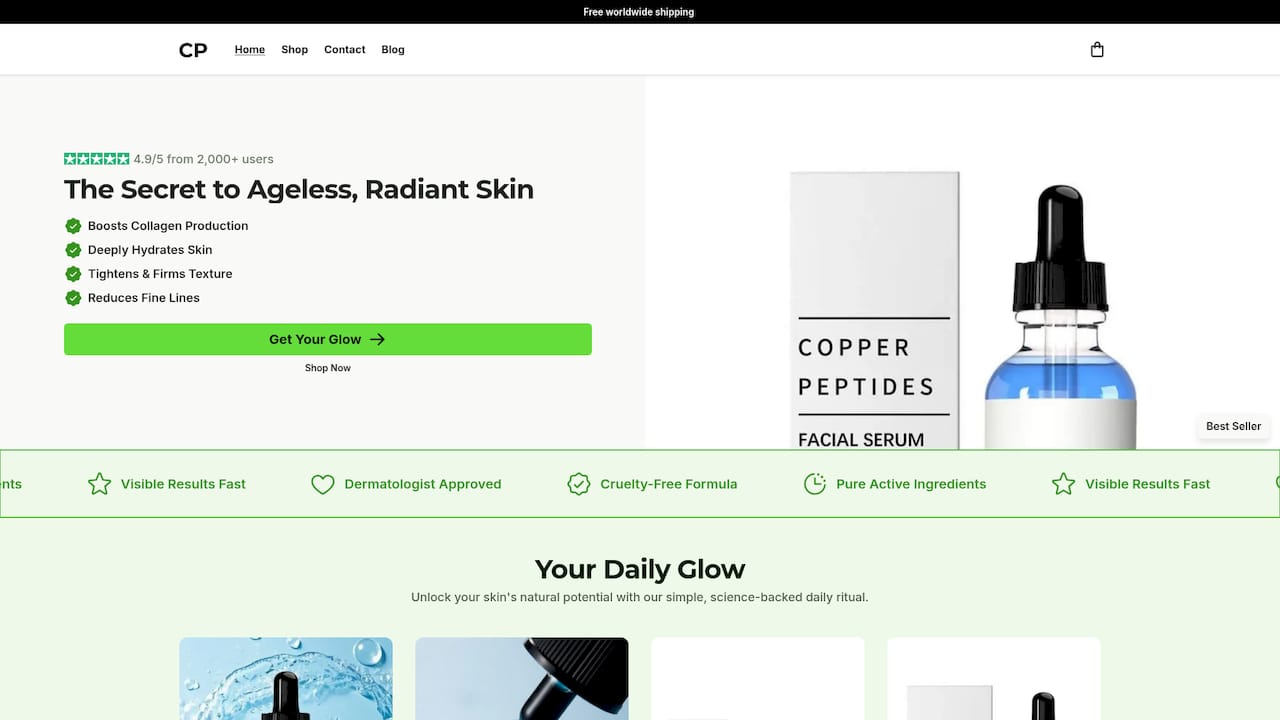
Copper peptides aren’t a barrier-repair primary. Think of them as reinforcement for skin that’s already getting the humectant, occlusive, emollient basics right and is ready to work on firmness and texture at the same time. Copperpeptides formulates its serum with high-purity copper peptides paired with medical-grade hyaluronic acid, aiming to support collagen production and hydration in the same step rather than asking you to layer two separate products for two separate goals.
The practical placement matters here. Apply it to slightly damp, freshly cleansed skin, then follow with your ceramide moisturizer, the same sequencing logic that makes any humectant work rather than backfire, covered in more depth in this piece on barrier repair peptides. Because skin with a compromised barrier is more reactive to begin with, patch test on the inner forearm for a couple of days before applying to the face, especially if you’re managing sensitive or currently irritated skin, and pair any new active with sound general irritation avoidance habits while your barrier stabilizes. Most people see visible changes in texture and hydration within four to six weeks of consistent use. If you’re ready to add it to your routine, the Copper Peptide Anti-Aging Serum is available for $20 with a straightforward return policy behind it.
Sources
- Transepidermal water loss in healthy adults: a systematic review and meta-analysis update
- Severe barrier disruption and TEWL in burns (clinical review)
- Moisturizers (NCBI Bookshelf clinical review)
FAQ
What Causes Transepidermal Water Loss to Increase?
Damage or thinning of the stratum corneum’s lipid barrier is the core cause, whether from harsh cleansers, over-exfoliation, low humidity, aging, or conditions like atopic dermatitis. Environmental factors such as dry air, heat, and airflow speed up the evaporation itself once the barrier is compromised, as research on environmental effects on TEWL confirms.
How Do You Fix Elevated Transepidermal Water Loss?
Pair a humectant like hyaluronic acid or glycerin with an occlusive and a ceramide-rich emollient, applied to damp skin right after cleansing. Cutting back on hot showers, harsh surfactants, and over-exfoliation gives the barrier room to rebuild over roughly two to six weeks.
Is Transepidermal Water Loss a Real, Measurable Thing?
Yes. It’s measured with evaporimeter devices in dermatology research and clinical settings, and published reference values show it varies from about 2.3 to 44.0 g/m²/h across different body sites in healthy adults. It’s a recognized parameter, not a marketing term.
Can Transepidermal Water Loss Actually Be Prevented?
Consistent barrier care, gentle cleansing, humectant-plus-occlusive layering, and avoiding known irritants meaningfully reduce excess TEWL, though some baseline variation by age and anatomical site is unavoidable. Products like a copper peptide serum layered under a ceramide moisturizer can support this process as part of a broader routine, not as a standalone fix.
Does Copperpeptides Help With Barrier-Related Water Loss?
The Copperpeptides serum pairs copper peptides with medical-grade hyaluronic acid and is designed to be layered under an occlusive moisturizer, fitting the same humectant-then-seal logic that supports barrier repair. It’s positioned as a complement to a barrier routine, not a replacement for the ceramides and occlusives doing the primary structural work.