

Apply serum before sunscreen in your morning routine, never after. Serums are built to sink into skin and deliver active ingredients where they work; sunscreen is built to sit on top and form a protective shield. Reverse that order and you weaken both the treatment and the protection. The sections below cover exact timing, how much sunscreen to use, and the handful of exceptions worth knowing.
TL;DR:
- Applying serum before sunscreen ensures active ingredients reach the skin and are not blocked by the protective film of sunscreen, which sits on top.
- It is recommended to wait 30 to 60 seconds for water-based serums and 1 to 3 minutes for thicker or pH-sensitive serums before applying sunscreen.
- Vitamin C serums should still go before sunscreen but require a 1 to 2-minute wait, while acids and retinoids are best used at night to avoid increased sun sensitivity.
- Most people apply too little sunscreen, typically a nickel-sized amount for the face and neck, and need to reapply every two hours during sun exposure.
- Using a lightweight, fast-absorbing serum like copper peptides facilitates proper layering and can eliminate the need for an additional moisturizer on busy mornings.
Table of Contents
- Do You Apply Serum Before Sunscreen? The Morning Layering Order
- Why Serum Goes Before Sunscreen, Not After
- How Long Should You Wait Between Serum and Sunscreen?
- Do Vitamin C, Acids, and Retinoids Change the Rule?
- How Much Sunscreen Should You Actually Use?
- What I’ve Learned About Fitting Serum Into a Sunscreen Routine
- A Morning Serum Built to Layer Cleanly Under Sunscreen
- Where This Guidance Comes From
- Sources
Do You Apply Serum Before Sunscreen? The Morning Layering Order
The full sequence, thinnest product to thickest, looks like this:
- Cleanser
- Toner (optional)
- Serum
- Moisturizer, if your skin needs it
- Sunscreen, always last
That order follows a simple texture rule: watery, low-viscosity products go on first so they can reach the skin, and heavier, film-forming products go on last so they can sit where they belong. Skipping steps is fine. If your skin is oily, you might drop the moisturizer entirely and go straight from serum to sunscreen. If you’re using a minimal routine, cleanser, serum, and sunscreen covers the essentials without adding products your skin doesn’t need.
- Oily or acne-prone skin: skip the heavy moisturizer, use a lightweight serum, and let sunscreen double as your final layer.
- Dry skin: don’t skip moisturizer. A dry base makes sunscreen sit unevenly and can cause pilling.
- Minimalist routine: cleanser, serum, sunscreen is a complete, dermatologist-reasonable routine on its own.
Why Serum Goes Before Sunscreen, Not After
Serums carry small, concentrated molecules designed to move into the epidermis and act on it, whether the goal is hydration, brightening, or collagen support. Sunscreen works the opposite way. Mineral filters like zinc oxide sit on the skin’s surface and physically deflect UV rays, while chemical filters form a thin film that absorbs UV energy before it reaches living skin cells. Both types need to stay on top to do their job.
Put sunscreen on first, and you create a barrier that blocks your serum from reaching skin at all. According to practitioner guidance from Joanna Vargas, serum should go before sunscreen precisely because sunscreen’s protective film has to remain undisturbed on top, not buried under a treatment product trying to work through it.
Serums are formulated to penetrate the skin, while sunscreen is formulated to sit on top of it. Reversing that order compromises both.
There’s a public-health angle here too. A University of Liverpool analysis found that misapplying sunscreen, including layering it incorrectly, measurably reduces the protection it provides. Getting the order wrong isn’t a cosmetic nitpick. It’s a real gap in your sun defense.
How Long Should You Wait Between Serum and Sunscreen?
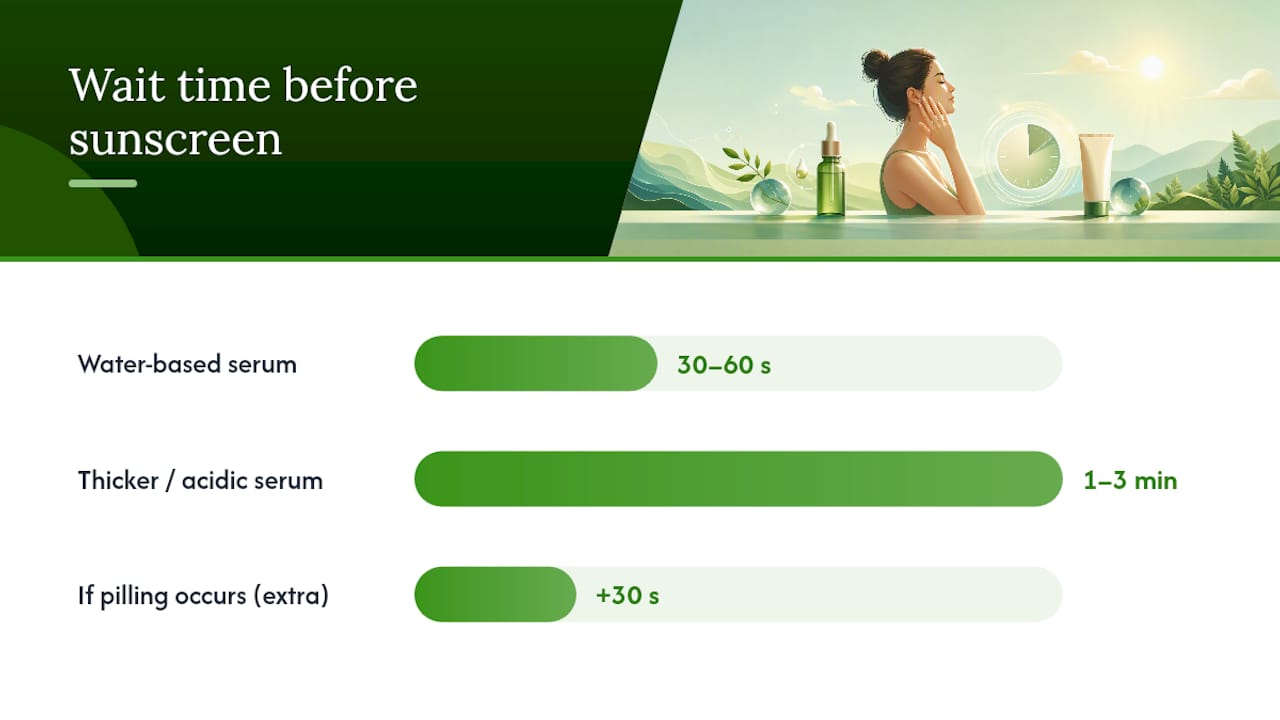
Most serums need less time to settle than people assume. For a standard water-based serum, 30 to 60 seconds is usually enough before you move on to sunscreen. Thicker or more acidic formulas, particularly L-ascorbic acid vitamin C serums, can need 1 to 3 minutes to stabilize on the skin before the next layer goes on.
You don’t need a stopwatch. A few quick checks tell you when skin is ready:
- Touch test: press two fingers lightly on your skin. If it feels tacky or sticky, wait longer.
- Look test: the serum should have absorbed into skin, not sitting as a visible wet film.
- Press test: gently pat your skin. If nothing transfers to your fingers, you’re clear to move on.
If your sunscreen keeps pilling into little white flakes or rolling off in beads, the fix usually isn’t a different sunscreen. It’s technique. Use a smaller amount of serum, pat products in rather than rubbing them, extend your wait time by 30 seconds, or simplify your routine to fewer layers.
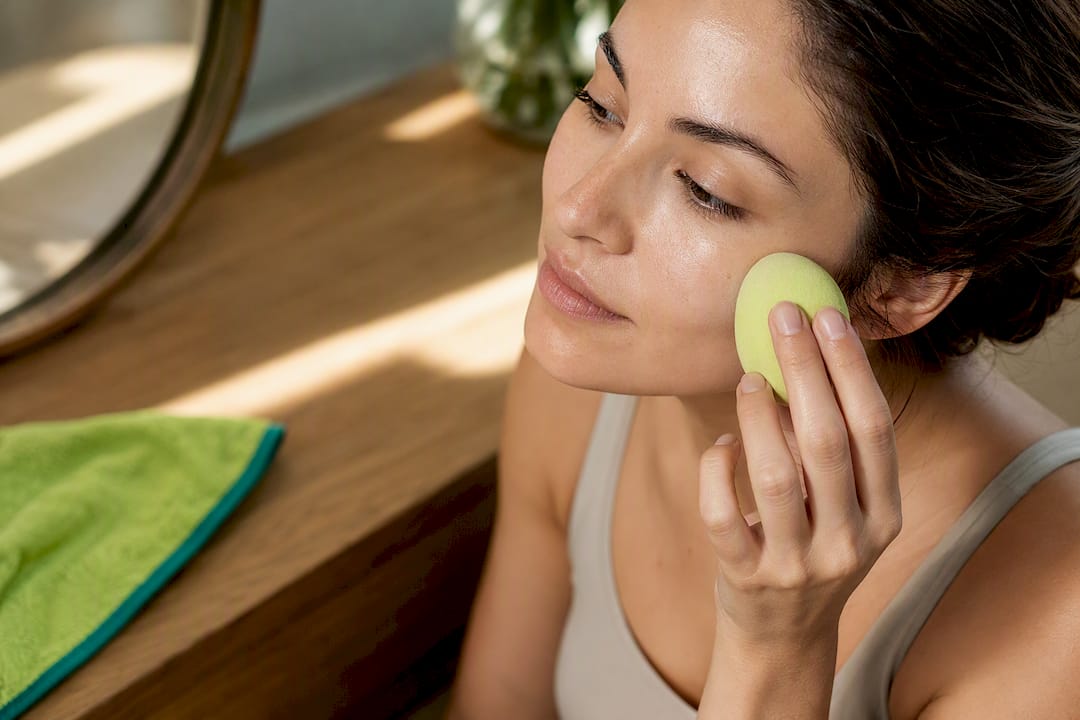
Pro Tip: If pilling keeps happening no matter what you try, apply sunscreen with a slightly damp beauty sponge instead of your fingers. It presses the product into skin more evenly and disturbs fewer of the layers underneath.
Do Vitamin C, Acids, and Retinoids Change the Rule?
The core order holds for almost every active ingredient, but a few deserve specific handling.
- Vitamin C serums still go before sunscreen. Give the formula 1 to 2 minutes to settle since it’s more pH-sensitive than most serums, then apply SPF right away to protect the antioxidant work you just layered on.
- Exfoliating acids (glycolic, salicylic, lactic) work best at night. If you use one in the morning, understand that it temporarily increases sun sensitivity, and treat strict sunscreen application as non-optional that day.
- Retinoids belong in a nighttime routine for the same reason. Morning retinoid use without disciplined sunscreen habits is a common way people end up with irritation and sunburn.
- Mineral versus chemical sunscreen changes how a formula feels going on, mineral options tend to sit heavier, but the layering order never changes. Sunscreen is always the outermost product regardless of filter type.
- Hybrid “sunscreen serums” on the market are formulated primarily as sun protection, not treatment serums, so they belong in the sunscreen slot, not as a replacement for your actual serum step.
If you’re using prescription-strength actives or have reactive, sensitized skin, loop in a dermatologist before adding new acids or retinoids to a morning routine.
How Much Sunscreen Should You Actually Use?
Most people apply far too little sunscreen to get the SPF number printed on the bottle. The American Academy of Dermatology recommends enough sunscreen to cover all exposed skin, and dermatology guidance commonly translates that to roughly a nickel-sized amount for the face and neck alone.
- Apply chemical sunscreens about 15 to 20 minutes before heading outside, giving the filters time to bind properly.
- Mineral sunscreens work as a physical barrier immediately, so they can go on right before you leave.
- Reapply every 2 hours during sun exposure, and more often if you’re sweating or swimming.
- Layering makeup on top? Use a light patting motion instead of swiping, and consider a mineral powder SPF for touch-ups rather than disturbing your base layer completely.
The Skin Cancer Foundation is direct about one thing: SPF-infused moisturizers and makeup are not reliable substitutes for a dedicated sunscreen, because almost nobody applies enough of those products to hit their labeled protection level.
What I’ve Learned About Fitting Serum Into a Sunscreen Routine
Watching how people actually build their morning routines, the layering mistake that comes up again and again isn’t ignorance of the rule. It’s impatience. People know serum goes before sunscreen; they just don’t wait long enough between steps, so products pill, and then they blame the serum instead of the timing.
A lightweight, water-based formula like a copper peptide serum fits this routine cleanly because it absorbs fast and doesn’t leave the tacky residue that causes sunscreen to ball up. In practice, that means cleansing, applying the copper peptide serum, giving it roughly a minute to settle, and then moving straight to sunscreen. No moisturizer step needed if the serum itself is hydrating enough. A formula around medical-grade hyaluronic acid can serve as both treatment and hydration in one layer.
One caveat worth repeating: patch-test any new serum before working it into a daily routine, and talk to a dermatologist if you’re combining it with prescription actives.
— British
A Morning Serum Built to Layer Cleanly Under Sunscreen
If you’re looking for a serum that actually fits the routine described above instead of fighting it, Copperpeptides is worth a look. Its formula pairs high-purity copper peptides with medical-grade hyaluronic acid, so it hydrates and supports collagen without leaving the sticky film that causes sunscreen to pill or slide.
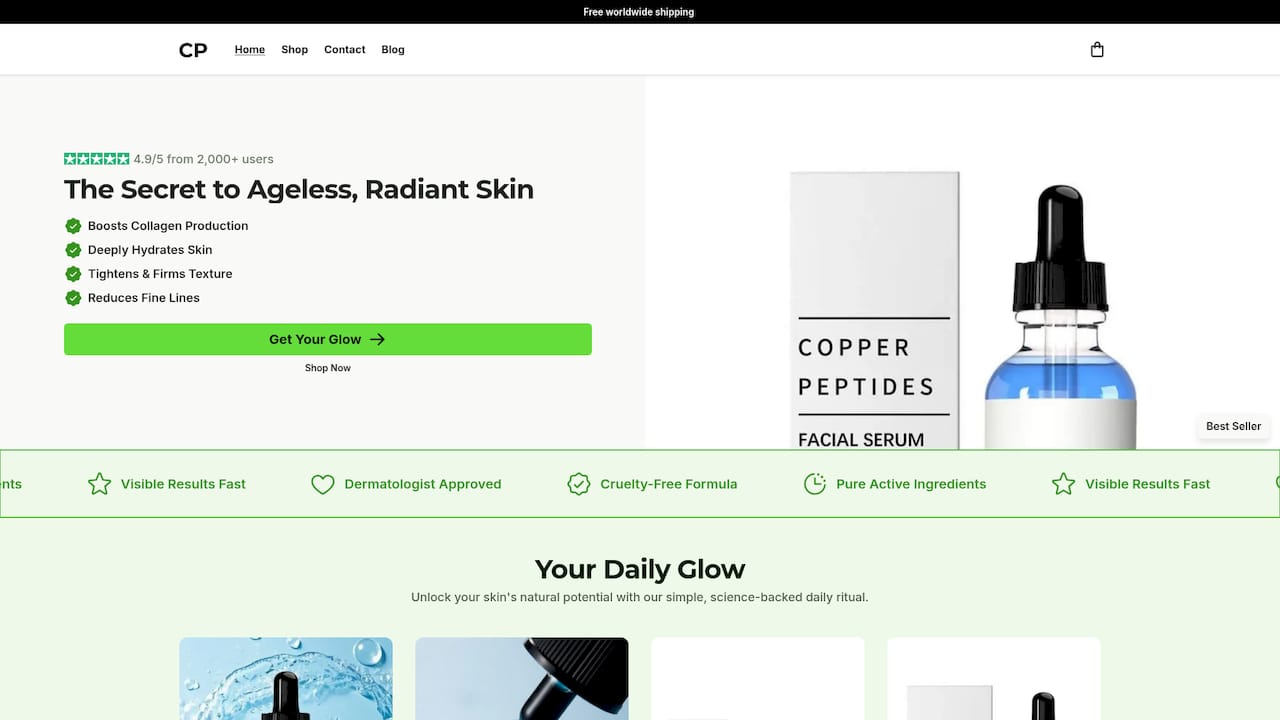
Using it is simple: cleanse, apply the Copper Peptide Anti-Aging Serum, give it about a minute to absorb, then move straight to sunscreen. Because the formula is lightweight, most people can skip a separate moisturizer step entirely on busy mornings. Some dermatologists endorse gentle profiles, and some companies back their orders with return policies if products are not the right fit for your skin. Visit Copperpeptides to see the full product details and start your order.
Where This Guidance Comes From
The layering order and application guidance in this article draw on established dermatology sources, including the American Academy of Dermatology, Johns Hopkins Medicine, the Skin Cancer Foundation, and peer-reviewed research on sunscreen and photoprotection. For broader context on daytime skin health, Moja-lekarna’s skin care resources offer additional background on supporting skin from the inside out.
Sources
- How to apply sunscreen - American Academy of Dermatology (AAD)
- Peer-reviewed article on sunscreen and photoprotection - NCBI
- Sunscreen and your morning routine - Johns Hopkins Medicine
- Recommended products - Skin Cancer Foundation