

If you’re searching for Paula’s Choice alternatives that genuinely address collagen loss, dehydration, and fine lines, the answer is a dermatologist-backed copper-peptide serum formulated with high-purity GHK-Cu and medical-grade hyaluronic acid. That combination targets the structural causes of aging skin, not just the surface.
- GHK-Cu mechanism: A signal peptide that tells fibroblasts to rebuild the extracellular matrix, producing more collagen and elastin at the cellular level.
- No photosensitivity: Dermatologists confirm copper peptides are safe morning or night, unlike retinoids or vitamin C, which require more careful timing.
- Realistic timeline: Expect early healing and reduced inflammation within a few weeks; structural texture improvements typically appear after 1–2 months of consistent use.
TL;DR: Try a dermatologist-endorsed copper-peptide serum available in the U.S., such as the one from Copperpeptides, and give it at least four to six weeks.
Table of Contents
- What benefits do copper-peptide serums deliver for your skin?
- How does GHK-Cu actually signal your skin to repair itself?
- When will you actually see results from copper peptides?
- How to add a copper-peptide serum to your daily routine
- How do you choose the best dermatologist-backed copper-peptide serum?
- Copperpeptides: does this serum actually check every box?
- Key Takeaways
- Why dermatologists trust copper peptides as long-term skin allies
- Copperpeptides delivers what the checklist demands
- Sources and further reading
What benefits do copper-peptide serums deliver for your skin?
Copper-peptide serums work on several fronts at once, which is part of why dermatologists recommend them as a long-term maintenance tool rather than a quick fix.
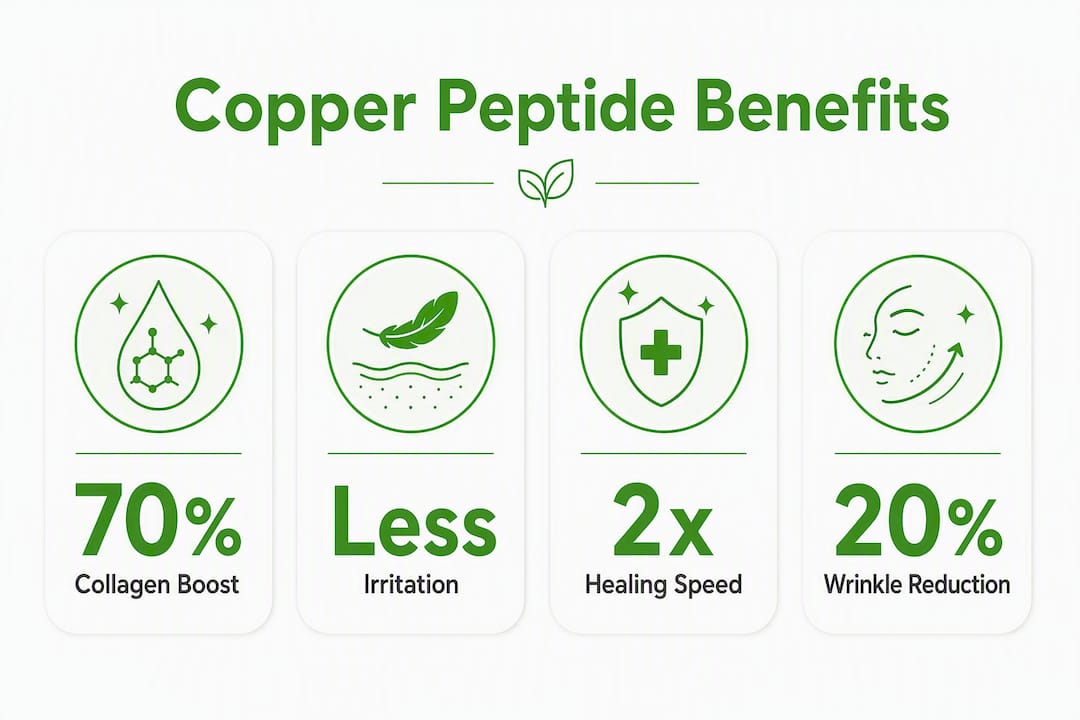
- Collagen stimulation: GHK-Cu signals fibroblasts to produce more collagen, improving skin firmness and reducing the depth of fine lines over time.
- Improved elasticity: Regular use supports the extracellular matrix, which gives skin its bounce and resilience.
- Barrier repair: Copper peptides pair well with barrier-supportive ingredients like hyaluronic acid, squalane, and ceramides, helping compromised skin recover.
- Deep hydration: When formulated with medical-grade hyaluronic acid, the serum draws moisture into the dermis and holds it there.
- Reduced fine lines and improved texture: Users consistently report smoother, plumper skin after consistent use, particularly around the eyes and forehead.
- Sensitive-skin friendly: Because copper peptides are not photosensitive and generally well-tolerated, they suit people who react badly to retinoids or strong acids.
Skincare guides increasingly position copper peptides as gentler alternatives to retinoids for anyone seeking repair without the irritation risk. That’s a meaningful distinction if your skin flares easily.
Pro Tip: Pair your copper-peptide serum with a fragrance-free hyaluronic acid moisturizer to maximize barrier repair and hydration. Clinicians recommend adding squalane or a ceramide-rich cream on top for best tolerability, especially if your skin runs dry or reactive.
How does GHK-Cu actually signal your skin to repair itself?
GHK-Cu is a signal peptide, not a surface moisturizer. It binds to receptors on fibroblasts and instructs them to repair and rebuild the extracellular matrix, the structural scaffolding beneath your skin’s surface. That’s a fundamentally different mechanism from a cream that simply softens the top layer.
A 1998 clinical study from Reims found that topical GHK-Cu increased collagen production more than tretinoin after one month, which was a striking result given tretinoin’s reputation as the gold standard for collagen stimulation. The Reims data established copper peptides as a serious anti-aging active, not a cosmetic afterthought.
Clinical observations reported in 2026 confirm that healing and inflammation improvements appear within a few weeks, with deeper structural changes becoming visible after one to two months of consistent use. That timeline aligns with how long fibroblast activity takes to produce measurable new collagen.
Where copper peptides differ from retinoids and vitamin C is in their approach. Retinoids accelerate cell turnover; vitamin C is an antioxidant that supports collagen synthesis. Copper peptides work as cellular repair signals. They complement those actives rather than replace them, and they’re generally gentler on the skin barrier. Dermatologists describe them as supportive rather than aggressive, which makes them a smart addition to almost any anti-aging routine.
When will you actually see results from copper peptides?
Expect a two-phase timeline. The first phase is healing and inflammation reduction; the second is structural improvement.
- Weeks 1–4: Skin often looks calmer and more even. Redness and minor irritation tend to settle. This reflects GHK-Cu’s anti-inflammatory and wound-healing properties.
- Weeks 4–8: Texture improvements become noticeable. Users in product roundups report improved bounciness and smoother skin at roughly the one-month mark.
- 8+ weeks: Structural changes in firmness and fine-line depth become more apparent with continued use. This is when the collagen-building effects from the Reims study become perceptible.
The 1998 Reims study showed greater collagen production with GHK-Cu than with tretinoin after just one month of topical application.
Consistency matters more than frequency here. Using a copper-peptide serum twice daily for six weeks will outperform sporadic use over three months. Set a realistic expectation of four to eight weeks before judging whether a product is working.
How to add a copper-peptide serum to your daily routine
Copper peptides are not photosensitive, so morning or night application both work. Most people use them once or twice daily depending on their skin’s tolerance.
- Apply the copper-peptide serum — to damp skin while the barrier is receptive.
Layering guide: what to combine and what to separate
| Ingredient | Combine with copper peptides? | Notes |
|---|---|---|
| Medical-grade hyaluronic acid | Yes | Enhances hydration and tolerability |
| Ceramides / squalane | Yes | Supports barrier repair |
| Niacinamide | Yes | Compatible; use together for barrier and tone benefits |
| High-strength L-ascorbic acid (vitamin C) | Separate | Acidic pH can destabilize the copper molecule |
| Strong AHA/BHA acids | Separate | Alternate morning/night or on different days |
| Retinoids | Alternate | Use retinoids at night; copper peptides in the AM or on off-nights |
Pro Tip: If your routine includes a potent vitamin C serum or a strong acid exfoliant, experts advise using copper peptides in the morning and those actives at night, or alternating nights entirely. Acidic environments destabilize the copper molecule and reduce efficacy.
How do you choose the best dermatologist-backed copper-peptide serum?
Prioritize formulas that list GHK-Cu early in the INCI ingredient list, pair it with medical-grade hyaluronic acid, carry a dermatologist endorsement, and come with a transparent return policy.
| Evaluation dimension | What to look for |
|---|---|
| Active ingredient (GHK-Cu) | Listed in the first half of the INCI list; concentration notes a plus |
| Supporting humectants | Medical-grade hyaluronic acid; ceramides or squalane as bonus |
| Dermatologist endorsement | Named clinician or third-party clinical testing noted |
| Clinical evidence | Reference to peer-reviewed studies or clinical observations |
| Visible results timeline | Brand states 4–8 weeks; aligns with published research |
| Price and U.S. availability | Ships to U.S.; clear pricing with no hidden subscription |
| Skin-type suitability | Fragrance-free; tested for sensitive skin |
| Cruelty-free and return policy | Cruelty-free certification; fair return window stated |
“Look for GHK-Cu positioned early in the ingredient list and paired with humectants like medical-grade hyaluronic acid — those are the two clearest formulation signals that a product will actually deliver.”
Checklist before you buy:
- GHK-Cu appears in the first half of the ingredient list
- Fragrance-free or very low fragrance (critical for sensitive skin)
- Medical-grade hyaluronic acid is present
- Dermatologist endorsement or third-party clinical signal
- Ships within the U.S. with a clear return or satisfaction policy
- No proprietary blend hiding the active concentration
Clinicians recommend looking for these formulation cues as the most reliable proxy for efficacy when full clinical trial data isn’t publicly available.
Copperpeptides: does this serum actually check every box?
The Copper Peptide Anti-Aging Serum from Copperpeptides hits every point on the buyer checklist above.
- High-purity GHK-Cu: Listed prominently in the formula; not buried at the bottom of a long INCI list.
- Medical-grade hyaluronic acid: Paired directly with GHK-Cu for deep hydration and improved barrier function.
- Dermatologist-endorsed: Clinicians back its gentle, regenerative approach for all skin types including sensitive.
- Visible results timeline: Brand states four to six weeks, consistent with published clinical observations.
- Cruelty-free: No animal testing.
- U.S. availability: Ships directly to customers across the United States.
- Return policy: Backed by a satisfaction guarantee that reflects confidence in the formula.
| Dimension | Copperpeptides serum |
|---|---|
| Active ingredient | High-purity GHK-Cu, listed early in INCI |
| Humectant support | Medical-grade hyaluronic acid |
| Dermatologist endorsement | Yes |
| Results timeline | 4–8 weeks (visible); structural at 8+ weeks |
| Skin-type suitability | All types, including sensitive |
| Cruelty-free | Yes |
| U.S. availability | Yes, direct-to-consumer |
| Return policy | Satisfaction guarantee |
Pro Tip: For a deeper look at the science behind copper peptide benefits, the Copperpeptides blog covers the clinical evidence in detail — useful if you want to compare ingredient profiles before buying.
Key Takeaways
A dermatologist-backed copper-peptide serum with high-purity GHK-Cu and medical-grade hyaluronic acid is the most evidence-grounded Paula’s Choice alternative for collagen support, deep hydration, and gentle wrinkle reduction.
| Point | Details |
|---|---|
| GHK-Cu is a repair signal | It instructs fibroblasts to rebuild collagen, not just moisturize the surface. |
| Results take 4–8 weeks | Expect inflammation improvements first, then texture and firmness changes. |
| Layering matters | Separate copper peptides from strong acids and high-strength vitamin C to protect efficacy. |
| Choose by formulation cues | GHK-Cu early in the INCI list plus medical-grade HA are the two strongest quality signals. |
| Copperpeptides serum | High-purity GHK-Cu, medical-grade HA, dermatologist-endorsed, cruelty-free, ships to the U.S. |
Why dermatologists trust copper peptides as long-term skin allies
Dermatologists value copper peptides because they work with the skin’s own repair systems rather than forcing rapid turnover. That makes them genuinely useful for sensitive skin types who can’t tolerate retinoids at full strength, and for anyone who wants a maintenance active that builds structural integrity over time.
The clinical case is solid. The Reims study showed GHK-Cu outperforming tretinoin for collagen production at one month. The 2026 clinical observations confirm that healing improvements appear within weeks and structural changes follow at one to two months. Those two data points, separated by nearly three decades, tell a consistent story.
What gets underestimated is the complementary role. Copper peptides don’t compete with retinoids or vitamin C; they fill the gap those actives leave. Retinoids drive turnover. Vitamin C protects against oxidative damage. Copper peptides rebuild the matrix underneath. A routine that includes all three, properly timed, is more complete than one that relies on any single active.
The practical takeaway for shoppers: copper peptides are not a trend. They’re a well-researched, dermatologist-endorsed category with a track record that stretches back to the late 1990s. The best ones pair GHK-Cu with medical-grade hyaluronic acid, carry a dermatologist endorsement, and come from a brand transparent enough to stand behind a return policy.
Copperpeptides delivers what the checklist demands
Shoppers who want collagen support, deep hydration, and gentle wrinkle reduction without the irritation risk of retinoids or acids have a clear option. The Copperpeptides serum is formulated with high-purity GHK-Cu and medical-grade hyaluronic acid, dermatologist-endorsed, cruelty-free, and available directly in the U.S. with a satisfaction guarantee. It’s built for all skin types, including sensitive, and the results timeline of several weeks aligns with what the published clinical evidence actually supports.
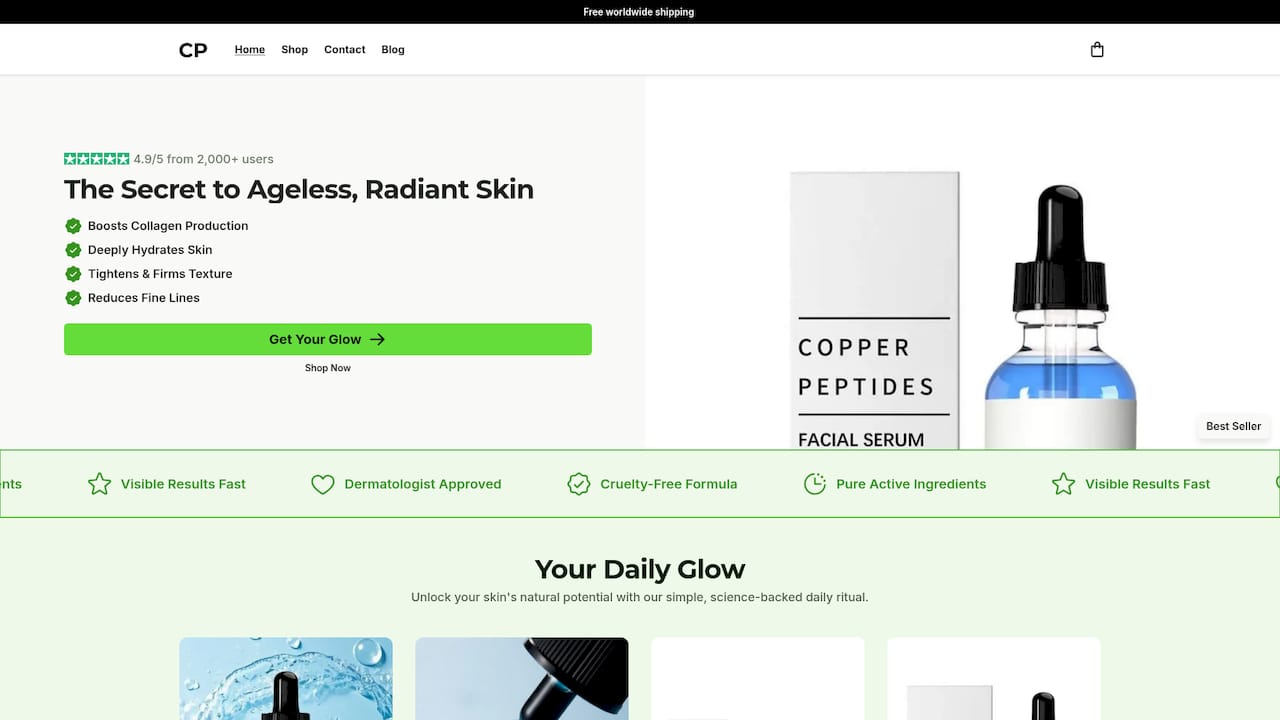
No subscription required. No proprietary blend hiding the active. Just a transparent formula backed by clinical science and a return policy that means the brand stands behind it. Visit the Copper Peptide Anti-Aging Serum page to check availability and order directly.
Sources and further reading
The claims in this article draw on peer-reviewed research, clinical observations, and editorial reporting from dermatologists and skincare specialists.
- The Benefits of Copper Peptides For Anti-Aging, Explained | Vogue — covers the 1998 Reims clinical study and clinician pairing recommendations.
- Should We All Be Using Copper Peptides for Our Skin: Reviews | The Cut — 2026 clinical observations on timeline; layering cautions for acids and vitamin C.
- Copper peptides for skin, benefits, side effects, and how to use | Women’s Health — dermatologist notes on photosensitivity, timing, and formulation cues.
- What are copper peptides? Benefits and uses explained by dermatologists | Women’s Health — complementary role of copper peptides; barrier-supportive ingredient pairings.
- Copper Peptides in Skincare: Benefits, Science, Clinical Evidence | TheSkincareLady — positioning copper peptides as gentler alternatives to retinoids.
- Copper peptides: these powerful molecules are worth the skincare hype | The Conversation — mechanism overview and natural production decline with age.
- Copper Peptides: Benefits for Skin and Hair Care, and How to Use Them | Healthline — practical application guidance for serums.
These sources collectively support the mechanism claims (GHK-Cu as a fibroblast signal), the results timeline (weeks to months), the layering guidance (separate from strong acids and high-strength vitamin C), and the dermatologist endorsements cited throughout this article.
Recommended
- Peptides for Beginners: Copper Peptide Serums Guide – Copper Peptides Store
- Best Hydrating Serums for Firming and Anti-Aging Skin – Copper Peptides Store
- Best Hyaluronic Acid Serums for Firming Skin: Copper Peptide Pairings – Copper Peptides Store
- Copper Peptide Benefits: A Science-Backed Skin Guide – Copper Peptides Store