

The right marionette lines treatment depends on what’s driving them, not on whatever your friend or an influencer tried last year. Isolated volume loss along the jaw and chin responds best to HA dermal filler. A downturned mouth caused by an overactive depressor anguli oris muscle responds better to micro-dosed Botox in that muscle. True skin laxity, the kind where the lower face is sagging rather than just hollow, needs threads, energy devices, or a facelift to see real change.
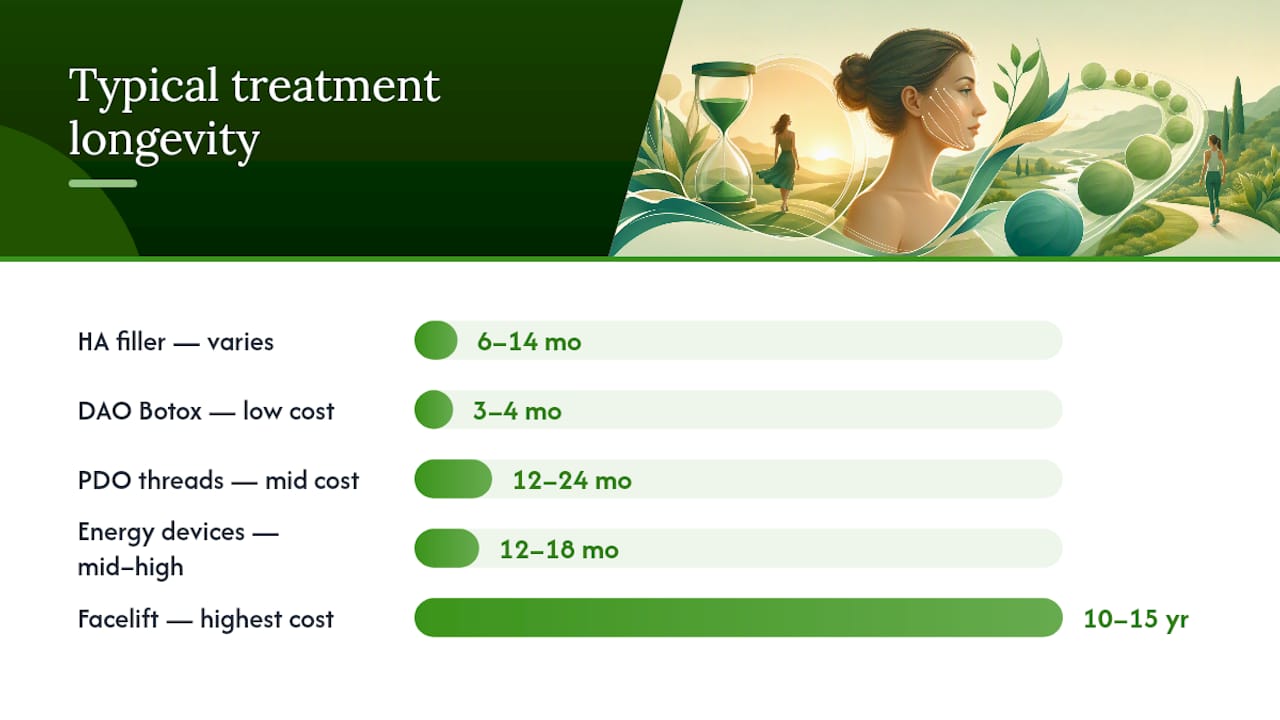
Expect results to last anywhere from a few months to over a decade depending on the modality. HA filler typically holds for 6 to 14 months, thread lifts and biostimulators run 12 to 24 months, and a surgical facelift can last 10 to 15 years.
Before you book anything, evaluate three things:
- Whether the lines deepen mainly when you smile or talk (muscle pull)
- Whether your cheeks and chin look flatter or hollow at rest (volume loss)
- Whether the skin along your jawline sags or folds even when your face is still (laxity)
Key Takeaways
Matching the treatment to the actual cause, muscle pull, volume loss, or skin laxity, produces more durable, natural-looking results than treating the crease alone.
| Point | Details |
|---|---|
| Identify the dominant cause | Determine whether muscle pull, volume loss, or laxity drives your lines before choosing a treatment. |
| HA filler for volume loss | Expect 1.0 to 2.0 mL split between sides, lasting 6 to 14 months. |
| DAO Botox for muscle pull | Micro-dosing at 2 to 4 units per side softens downward pull for 3 to 4 months. |
| Surgery is the only long-term fix | A facelift offers 10 to 15 years of correction for significant laxity that injectables can’t match. |
| Support results with a serum | Copperpeptides’ copper peptide serum helps maintain skin quality between procedures, showing visible change in 4 to 6 weeks. |
Table of Contents
- What Are Marionette Lines and How Do Dermatologists Evaluate Them?
- What Causes Marionette Lines to Deepen With Age?
- What Treatment Options Actually Treat Marionette Lines?
- Can You Combine Treatments for Better Marionette Line Results?
- Can Skincare Actually Prevent or Reduce Marionette Lines?
- When Should You See a Dermatologist or Plastic Surgeon?
- What Are the Risks and Realistic Results for Marionette Line Treatments?
- A Copper Peptide Serum as Your Daily Support Step
- Sources
What Are Marionette Lines and How Do Dermatologists Evaluate Them?
Marionette lines run from the corners of your mouth down toward the chin, tracing the path of old-fashioned puppet strings. They’re distinct from nasolabial folds, which run from the nose to the mouth corners. Clinicians typically assess them with a three-part exam: watching the smile in motion to gauge muscle activity, mapping volume loss in the prejowl and chin area, and grading skin laxity by pinching and observing recoil.
Before your consult:
- Bring recent photos in both a relaxed expression and a full smile.
- Ask which single cause the provider believes is dominant for you.
- Ask what happens if that assessment turns out wrong once treatment starts.
What Causes Marionette Lines to Deepen With Age?
Several things happen at once as skin ages, and they rarely act alone. Marionette lines result from a combination of collagen loss, reduced elasticity, facial volume loss, and repeated muscle movement, plus jawbone resorption and genetics.
- Localized fat loss in the prejowl area and chin
- Midface descent that drags tissue downward over time
- Reduced collagen and elastin, making skin less able to spring back
- An overactive depressor anguli oris (DAO) muscle, the one that pulls mouth corners down
- Bone resorption along the jaw, removing structural support
- Cumulative sun exposure and smoking, which degrade collagen faster
The oral commissure (where your lips meet) sits directly above the DAO. When that muscle contracts more forcefully or more often than its neighbors, it creates a persistent downward tug that no amount of surface hydration will offset.
What Treatment Options Actually Treat Marionette Lines?
Topical care and skin quality. Retinoids, peptides, and daily sunscreen slow collagen breakdown and improve skin texture, but they won’t erase an established fold. Think of this tier as maintenance, not correction.

HA dermal fillers. This is the clinical first-line option for volume loss. Most patients need 1.0 to 2.0 mL split between both sides, placed along the prejowl sulcus and marionette crease rather than directly into the line itself. Results last 6 to 14 months. Bruising and swelling are common for a few days; the more serious risk is vascular occlusion if filler enters a blood vessel, which is why experienced injectors favor blunt cannulas over sharp needles in this region.
Biostimulators (Radiesse, Sculptra). These stimulate your own collagen production rather than just adding volume. Results build gradually over weeks and tend to last longer than HA filler, often 12 months or more, but they require more patience upfront.
DAO neuromodulator (Botox). When muscle pull is the dominant cause, micro-dosing Botox at 2 to 4 units per side into the DAO softens that downward tug. Effects last around 3 to 4 months and become fully visible by 10 to 14 days.
Microneedling and PRP. These improve overall skin texture and mild fine lines but have limited effect on deep structural folds. Best used alongside another modality, not instead of one.
Lasers and energy devices (Ultherapy, RF). These tighten skin without cutting, working well for mild to moderate laxity. Effects run 12 to 18 months, with minimal downtime beyond temporary redness.

PDO thread lifts. For moderate laxity, threads lift and hold tissue mechanically. Durability typically runs 12 to 24 months. Dimpling at insertion points can occur temporarily.
Surgical facelift. For significant jowling or skin excess, this remains the only option offering long-term correction over many years, but it carries real recovery time and surgical risk that the non-surgical options don’t.
Pro Tip: Ask your injector to show you where the facial artery and mental foramen sit relative to your marionette crease. A provider who can point to these landmarks without hesitating is one who understands the anatomy well enough to work near it safely.
Can You Combine Treatments for Better Marionette Line Results?
Yes, and sequencing matters more than most patients realize. Relaxing the DAO with Botox first can let filler perform better, because the muscle isn’t constantly pulling on tissue that’s supposed to stay lifted. Many clinicians report patients ask for filler first, but treating the muscle pull often produces the bigger visual change on its own.
A typical sequence: address muscle activity if present, then add structural filler along the jawline and prejowl, then layer in threads or energy-based tightening if laxity remains. Full integration of a combined plan usually takes about two weeks, matching the DAO Botox timeline, with a re-evaluation around months 9 to 12 as filler and neuromodulator effects begin to fade.
Pro Tip: Don’t judge your results in the first week. Swelling can make filler look overdone, and Botox hasn’t taken full effect yet. Wait the full two weeks before deciding anything needs adjusting.
Can Skincare Actually Prevent or Reduce Marionette Lines?
Daily sunscreen and a consistent retinoid or peptide routine slow the collagen loss that deepens these folds over time, but topical skincare won’t remove an established fold on its own. Think of it as protecting your investment after a procedure, not replacing one.
A realistic home routine:
- Broad-spectrum SPF every morning, reapplied if you’re outdoors
- A copper peptide serum at night to support collagen synthesis and hydration
- A retinoid two to three nights a week, building tolerance slowly
Pro Tip: Give any new topical routine six to eight weeks before judging it. Skin cell turnover takes time, and surface improvements in texture and firmness show up gradually, not overnight.
When Should You See a Dermatologist or Plastic Surgeon?
See a specialist once jowling is visible at rest, skin excess makes non-surgical correction look temporary or unnatural, or you’ve tried filler with disappointing results. Ask about board certification specifically in facial anatomy, how many marionette line cases they’ve treated, their complication protocol, and whether they can show before-and-after photos of patients with a similar starting point to yours.
| Treatment | Typical Duration | Typical Cost Range |
|---|---|---|
| HA dermal filler | 6 to 14 months | Varies by syringe count and provider |
| DAO Botox | 3 to 4 months | Priced per unit, typically low per-session cost |
| PDO thread lift | 12 to 24 months | Mid-range, higher than injectables |
| Energy devices (Ultherapy/RF) | 12 to 18 months | Mid to upper range per session |
| Surgical facelift | 10 to 15 years | Highest upfront cost, one-time procedure |
What Are the Risks and Realistic Results for Marionette Line Treatments?
Expect mild bruising and swelling after filler or threads, and temporary muscle weakness after Botox. Watch for severe pain, skin blanching, or vision changes, which need immediate medical attention as possible signs of vascular occlusion.
Pro Tip: Avoid intense exercise for 24 to 48 hours after any injectable. It’s a small window that meaningfully lowers your bruising risk.
Choosing structure over shortcuts
I’d rather see someone treat the cause, muscle, volume, or laxity, than chase the crease itself with filler alone. A conservative, cause-based plan paired with consistent topical support tends to age better than any single quick fix.
A Copper Peptide Serum as Your Daily Support Step
Whatever procedure you choose, the skin surrounding it still needs daily support to look its best. Copperpeptides makes a single-ingredient serum built around high-purity copper peptides and medical-grade hyaluronic acid, formulated to boost collagen production, deepen hydration, and firm skin texture between clinical visits.

This serum is not a substitute for filler, threads, or a facelift. It won’t fix moderate-to-severe laxity or an established deep fold on its own. What it does is support the skin quality that makes procedural results look better and last longer, and most people notice visible improvement within four to six weeks. If you’re building a treatment plan and want a dermatologist-endorsed product to pair with it, check out the copper peptide anti-aging serum and see whether it fits into your routine before your next consultation.
Sources
- PMC article (HA filler and combined strategies) — PMC5732664
- Marionette Lines: What They Are, Causes, Filler, & Treatments — Cleveland Clinic
- Journal of Dermatological Treatment 2025 article (combination and thread strategies) — DOI:10.1080/09546634.2025.2452954
- Marionette Lines: Filler, Threads, or DAO Botox — AestheticMedGuide
Recommended
- Copper Peptides vs Matrixyl: Which One Actually Works? – Copper Peptides Store
- Best Wrinkle Serums: Dermatologist Picks for Fine Lines – Copper Peptides Store
- Best Hyaluronic Acid Serums for Firming Skin: Copper Peptide Pairings – Copper Peptides Store
- Best Serums for Crepey Skin: Dermatologist-Backed Picks – Copper Peptides Store