

Fragrance-free means no fragrance materials were added to a formula; unscented means the product has no noticeable smell but may still contain masking agents that are technically fragrance chemicals. If you have eczema, contact allergies, or generally reactive skin, choose fragrance-free and still check the ingredient list, because the American Academy of Dermatology specifically recommends this label for people prone to irritation.
TL;DR:
- Fragrance-free products contain no added fragrance materials or masking scents, but may still have natural odors from ingredients serving functional roles.
- Unscented products often use masking fragrances to neutralize odors of base ingredients, which can sometimes introduce allergens or heavier fragrance loads.
- People with sensitive or reactive skin should prioritize fragrance-free, leave-on products to minimize cumulative fragrance exposure and allergen risk.
- Verifying fragrance-free claims requires checking ingredient lists for “parfum,” “aroma,” essential oils, or isolated fragrance compounds, and considering manufacturer clarification.
- Relying on trusted seals like EPA Safer Choice or National Eczema Association can help identify formulations meeting strict fragrance criteria.
Table of Contents
- Fragrance-Free vs. Unscented: What the Labels Actually Promise
- What Does Unscented Mean, and Where Do Masking Fragrances Come In?
- Why This Distinction Actually Matters for Your Skin
- How to Verify a Product Is Actually Fragrance-Free
- Which Seals and Claims Actually Mean Something
- Smart Shopping Habits That Actually Reduce Irritation Risk
- Where a Fragrance-Free Serum Fits Into Sensitive-Skin Care
- Balancing Scent Preference and Skin Safety
- Try a Fragrance-Free Serum Built for Sensitive Skin
- Sources
Fragrance-Free vs. Unscented: What the Labels Actually Promise
“Fragrance-free” has a specific meaning under the framework the EPA’s Safer Choice program uses to evaluate products: no fragrance materials and no masking scents were added to the formula, period. That is a much narrower promise than most shoppers assume, and it is worth sitting with for a second, because it does not mean the product will smell like nothing.
Plenty of ingredients carry a natural odor without being classified as a fragrance ingredient. Shea butter has a faint nutty smell. Certain fatty acids and plant oils smell like, well, plants. A serum built around vitamin C can smell slightly tangy or eggs depending on how it oxidizes. None of that violates a fragrance-free claim, because nobody added those ingredients for their scent. They are there to moisturize, stabilize, or deliver an active, and the smell is a side effect, not the point.
This is where a lot of confusion starts. A shopper smells something on a “fragrance-free” jar and assumes the brand is lying. Usually it isn’t. The distinction the industry draws is intent and ingredient function, not whether your nose detects anything at all.
To tell a genuinely fragrance-free product from one quietly using scent under a different name, scan the ingredient list for these terms:
- “Fragrance” or “parfum” listed as a standalone ingredient, which almost always signals an added scent blend.
- “Aroma”, common on products marketed in Europe, functioning the same way “fragrance” does in American labeling.
- Essential oil names (lavender oil, tea tree oil, citrus peel oil) used specifically for their smell rather than a stated function like preservation.
- Isolated fragrance compounds such as linalool or limonene appearing high on the list with no other stated purpose.
If none of those appear, but you still catch a scent, look at where that ingredient sits in the formula and what job it is doing. FDA guidance on cosmetic labeling draws the same distinction: fragrance is any substance used to impart odor, and something added for a different function can legally carry a fragrance-free claim even if it happens to smell like something. A rosehip oil serum, a niacinamide toner with a slight almond note from its carrier, a mineral sunscreen with a faint chalky smell. All of those can be legitimately fragrance-free and not odorless.
What Does Unscented Mean, and Where Do Masking Fragrances Come In?
Unscented products are not built to smell like nothing. They are built to smell like nothing to you, which is a very different engineering problem. Raw cosmetic ingredients, especially surfactants, preservatives, and certain oils, often have an unpleasant chemical or “soapy” odor on their own. Rather than leaving that smell exposed, many formulators add a masking fragrance, sometimes called a neutralizing fragrance, to cancel it out.
That masking agent is still a fragrance chemical. It just isn’t there to make the product smell nice; it’s there to make the product smell like less. The EPA’s Safer Choice fact sheet draws this line explicitly: unscented generally means chemicals were used to neutralize or mask odor, while fragrance-free means none were used at all.
The regulatory gap is the part most shoppers never learn. In most jurisdictions, “unscented” isn’t a defined, audited term the way food labeling terms like “organic” are. A brand can put “unscented” on a bottle because the end product doesn’t smell like anything to an average person during testing, without disclosing what was added to get there. There is no requirement to list “masking fragrance” as its own line item. It typically just shows up folded into “fragrance” on the ingredient list, or sometimes not listed with much specificity at all.
Here’s the part that surprises people: an unscented product can carry a heavier total fragrance-compound load than a lightly scented one. A mild, single-note scented lotion might use one or two aroma compounds at low concentration to create a pleasant smell. An unscented version of a harsh-smelling base formula might need a broader masking blend, sometimes multiple compounds working together, just to cancel out the base odor. More compounds, more chances for one of them to be a known allergen.
A few product categories make this risk concrete:
- Deodorants are notorious for this. The active odor-fighting ingredients often smell sharp or medicinal on their own, so “unscented” deodorant lines frequently carry substantial masking fragrance to neutralize that base smell, right in a product applied daily to sensitive underarm skin.
- Some cleansers and body washes, especially sulfate-based ones, have a soapy or chemical smell that gets masked rather than eliminated, which matters more than it sounds like given how much surface area rinse-off products touch.
- “Unscented” baby products sometimes rely on masking agents specifically because parents assume the label means nothing was added, which is exactly the assumption clinicians warn against.
Research on labeling in the NCBI’s review of fragrance allergens and masking agents backs this up directly: masking agents are often small-molecule odor neutralizers or low-level fragrance blends, and some of those compounds are recognized allergens in their own right. The practical takeaway is blunt. Treat “unscented” as potentially fragrance until you’ve verified it, not as a synonym for fragrance-free.
Why This Distinction Actually Matters for Your Skin
Fragrance is one of the most common causes of cosmetic contact allergy, and that isn’t a fringe finding. Peer-reviewed dermatology literature consistently identifies fragrance chemicals as a leading trigger for both irritant reactions and true allergic contact dermatitis, particularly on skin that already has a compromised barrier.
Those are two different mechanisms worth separating. Irritation happens fast and depends on concentration. Apply enough of an irritating compound to already-damaged skin, and you’ll see redness or stinging within minutes to hours, no immune system involvement required. Allergic contact dermatitis is slower and sneakier. It builds through sensitization, meaning your immune system needs repeated exposure to a compound before it starts reacting. You could use a mildly fragranced lotion for two years and then suddenly break out in an itchy rash the third year, not because the formula changed, but because your immune system finally reached its threshold.
That’s why cumulative exposure matters more than most people think. It’s not about avoiding one scented candle at a dinner party. It’s about how many fragranced products touch your skin every single day, stacked across a body wash, a lotion, a hair product, a laundry detergent, and a perfume, all adding to the same sensitization risk over months and years.
Certain groups carry meaningfully higher stakes here:
- People with eczema or an already-damaged skin barrier, where fragrance chemicals penetrate more easily and trigger flares.
- Anyone with a documented history of contact allergy to any ingredient, since cross-reactivity between fragrance chemicals is common.
- Infants and babies, whose skin barrier is thinner and still developing.
- Older adults, whose skin barrier function and lipid production naturally decline with age.
- Frequent hand washers, including healthcare workers and food service employees, whose repeated water and surfactant exposure leaves skin chronically more permeable to everything else that touches it.
The American Academy of Dermatology’s guidance reflects exactly this reasoning: for people in these groups, fragrance-free products aren’t a preference, they’re a practical way to lower the odds of triggering a flare or building a new sensitization. The goal isn’t perfection. It’s reducing your total fragrance load across the products you use daily, not just swapping one scented lotion for one unscented one and calling it solved.
How to Verify a Product Is Actually Fragrance-Free
Reading a label takes about thirty seconds once you know what you’re looking for. Here’s the order to check things in.
- Start with the front label claim. Look specifically for the words “fragrance-free,” not “unscented,” “hypoallergenic,” or “natural fragrance.” Those are different claims with different meanings, and marketing teams know most shoppers treat them as interchangeable.
- Scan the full ingredient list for the giveaway terms. “Fragrance,” “parfum,” and “aroma” are the most direct red flags. Also watch for named essential oils and isolated aroma compounds like linalool, limonene, citronellol, or geraniol appearing without another stated function.
- Check ambiguous ingredients against their actual job in the formula. Benzyl alcohol, for example, can function as a preservative or as a fragrance component depending on the formula, and the label alone won’t tell you which. Essential oils listed near the bottom of a long list in tiny amounts are more likely doing double duty as a preservative boost than as a scent, but you often can’t know for certain from the label alone.
- When you genuinely can’t tell, contact the manufacturer directly, and treat their answer as informative but not infallible; a study reviewing labeled “fragrance-free” moisturizers found that some products carrying the claim still tested positive for at least one fragrance ingredient. That’s not a reason to distrust every label, but it is a reason to patch test before committing a new product to your daily routine, using a structured patch-test method rather than just trying it on your whole face for a week and hoping.
Pro Tip: Keep a running note on your phone listing the two or three fragrance-related ingredient names that have bothered your skin in the past. Cross-checking a new label against that short list takes seconds and catches more real problems than trying to memorize every possible allergen.
Which Seals and Claims Actually Mean Something
Not every reassuring word on a bottle carries the same weight, and knowing which ones are independently verified saves you from relying on marketing alone.
The EPA Safer Choice fragrance criteria is one of the few programs that evaluates the actual formula against a defined exclusion list rather than accepting a brand’s self-declaration. A product carrying the Safer Choice label has been checked against specific fragrance-related criteria, not just described as clean by the company that makes it.
The National Eczema Association’s Seal of Acceptance works similarly for a narrower audience. Products carrying that seal has been reviewed against criteria built specifically around what tends to trigger eczema flares, fragrance included, which gives it more practical relevance for reactive skin than a generic “gentle” claim.
“Dermatologist tested” and “hypoallergenic,” by contrast, are largely marketing terms with no standardized, audited definition behind them in most markets. They usually mean a dermatologist looked at the product in some capacity, or that the brand believes allergic reactions are less likely, neither of which is verified by an outside body the way a real seal is.
Use seals and ingredient checks together, not one instead of the other:
- A recognized seal narrows your search fast, especially when comparing dozens of similar products at a shelf.
- The INCI list confirms the seal’s promise applies to the exact formula in your hand, since formulas change between product lines even under the same brand.
- Neither replaces the other. A seal without a label check, or a label check without knowing what the seals actually audit, both leave gaps.
Smart Shopping Habits That Actually Reduce Irritation Risk
Leave-on products deserve more scrutiny than rinse-off ones, and that single rule simplifies most buying decisions. A serum or moisturizer sits on your skin for hours, giving any problematic ingredient time to penetrate and interact with your barrier. A cleanser touches your skin for maybe thirty seconds before it’s rinsed away. That doesn’t make rinse-off products risk-free, but it does mean prioritizing fragrance-free formulas matters most for the products that stay on: serums, moisturizers, sunscreens, and anything applied and left overnight.
Shorter ingredient lists tend to correlate with fewer chances for a reaction, simply because there are fewer total compounds that could be the culprit. Look for formulas built around a small number of well-understood ingredients like glycerin, ceramides, and niacinamide rather than long lists padded with extract blends and proprietary complexes you can’t easily research.
Before committing any new product to daily use, run a real patch test:
- Apply a small amount to the inner forearm or behind the ear, an area with thinner, more reactive skin than your cheek.
- Leave it undisturbed for 48 hours, checking at the 24-hour mark and again at 48 for redness, itching, or bumps.
- If nothing happens, apply it to a small area of your actual target skin, like one side of your face, for another few days before going all in.
- Stop immediately at the first sign of stinging, burning, or a rash, and don’t assume it will calm down if you push through it.
The AAD’s guidance on testing new skin care products follows this same basic structure, and it exists because reactions from leave-on actives are common enough that dermatologists consider skipping this step one of the most avoidable mistakes people make.
Pro Tip: If a product passes your patch test but you notice irritation only after a week of full use, suspect a cumulative reaction, not the product itself. Check what else changed in your routine during that same week; layered products interact more often than people expect.
If a rash, persistent redness, or itching shows up and doesn’t resolve within a few days of stopping a product, that’s the point to see a dermatologist rather than keep guessing. Patch testing catches obvious problems. It won’t always catch a slow-building sensitization, and a professional can run proper allergen testing if a pattern keeps recurring across multiple products.
Where a Fragrance-Free Serum Fits Into Sensitive-Skin Care
Given everything above, a leave-on anti-aging product is exactly the category where fragrance-free formulation carries the most weight. It sits on your skin for hours, often overnight, which is precisely the scenario dermatology guidance flags as highest-risk for fragrance-related reactions.
Copperpeptides formulates its anti-aging serum around high-purity copper peptides paired with medical-grade hyaluronic acid, built to support collagen production, deep hydration, and firmer skin texture without added fragrance. The formula is designed to be appropriate across skin types, including sensitive skin, and dermatologists have endorsed its approach as gentle while still delivering visible results, typically within four to six weeks of consistent use.
For shoppers who’ve read this far and internalized the leave-on rule, that combination matters more than a pleasant scent ever could. A serum you apply nightly, that stays on your face for eight hours, is not the place to gamble on a masking fragrance you can’t identify.
Balancing Scent Preference and Skin Safety
Fragrance isn’t the enemy for most people. A scented lotion that smells good is genuinely more likely to get used consistently, and consistency drives results more than any single ingredient does. I’m not going to pretend that trade-off doesn’t matter.
The pragmatic middle ground looks like this: keep leave-on face products fragrance-free, since that’s where cumulative exposure and barrier penetration carry the most risk, and allow yourself scented body products if a patch test shows you tolerate them. Don’t treat every fragrance as a threat. Treat unverified claims as one, and let a 48-hour patch test settle the argument instead of guessing.
— British
Try a Fragrance-Free Serum Built for Sensitive Skin
If you’ve decided leave-on products are where fragrance-free matters most, that’s exactly the gap Copperpeptides fills. Instead of guessing whether a “fragrance-free” claim on a crowded drugstore shelf actually holds up under an ingredient check, you get a single-ingredient-focused formula built around high-purity copper peptides and medical-grade hyaluronic acid, with no added fragrance to second-guess.
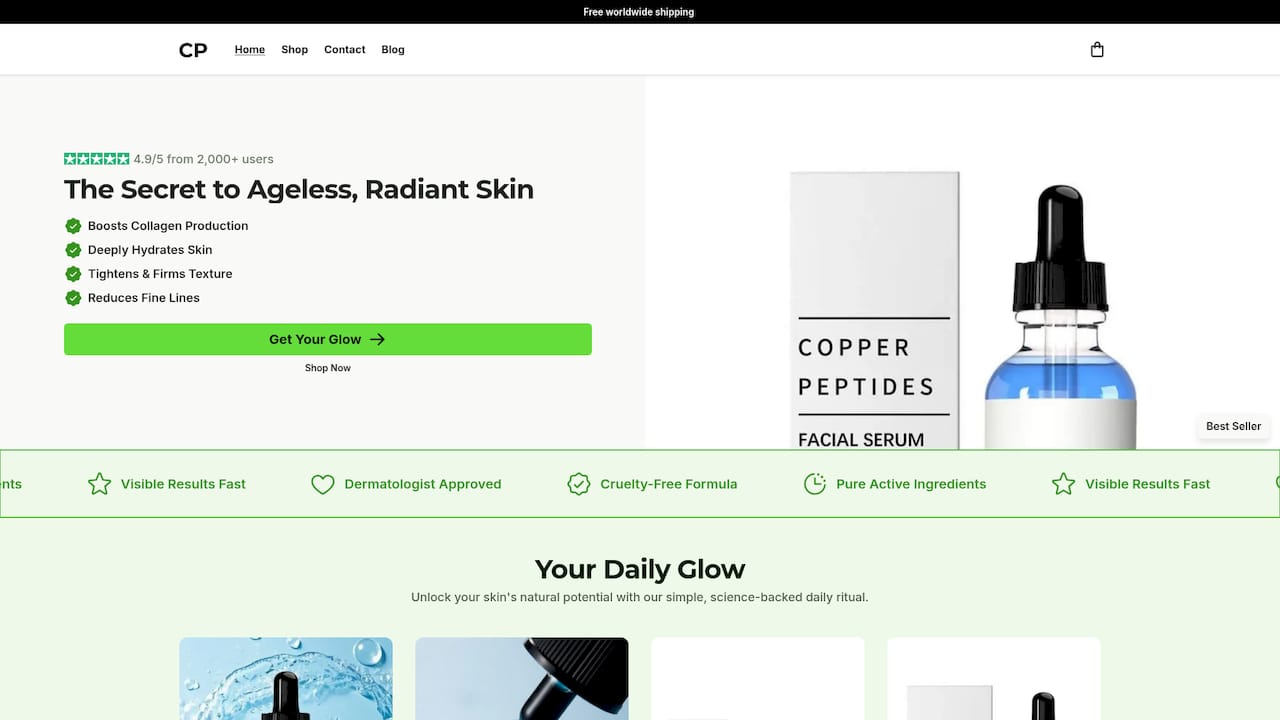
A fragrance-free serum may target fine lines, hydration, and firmness, with a gentle profile suitable for many skin types including sensitive skin; results may be visible within a few weeks of nightly use. Some products offer return policies to reduce risk when testing whether a fragrance-free leave-on active fits your routine. Check out the copper peptide anti-aging serum and see if it’s the right next step for your skin.
This article is general information, not a substitute for advice from a qualified doctor. Consult a qualified healthcare professional about your own circumstances before acting on anything here.
Sources
- American Academy of Dermatology — friendly products for eczema
- Safer Choice fact sheet — Fragrance-Free (EPA)
- PubMed — dermatology perspectives on fragrance and skin
- PubMed — studies on fragrance ingredients in labeled products