

Dehydration lines are usually reversible surface creases, not permanent wrinkles, and the fastest way to smooth them is a humectant applied to damp skin followed immediately by a moisturizer that seals it in. Most people notice softening within minutes to 48 hours, with fuller improvement over two to six weeks of consistent barrier repair. If the lines don’t budge after a few weeks of correct layering, or they look deep and stay put even when your skin is at rest, that’s your cue to talk to a board-certified dermatologist.
TL;DR:
- Dehydration lines usually respond quickly to proper hydration, softening within minutes to 48 hours, and show sustained improvement after two to six weeks.
- Using a humectant on damp skin followed immediately by a moisturizer is essential, as layering them correctly helps lock in water and smooth lines effectively.
- If lines persist or look deep after consistent barrier repair, they may be true wrinkles caused by collagen loss, requiring professional treatments rather than topical hydration.
- Common causes of dehydration lines include harsh cleansers, over-exfoliation, dry indoor environments, alcohol, and transient triggers like sleep deprivation or salty meals.
- Chronic contributors such as daily harsh cleansing or living in dry environments make dehydration lines recurrent unless barrier repairs are maintained daily with SPF, humidifiers, and protective habits.
Table of Contents
- What Are Dehydration Lines?
- Dehydration Lines vs. Wrinkles: What’s the Real Difference?
- What Causes Dehydration Lines in Everyday Life?
- How Do You Fix Dehydration Lines? A Step-by-Step Routine
- When Hydration Isn’t Enough: In-Office Options
- Preventing Dehydration Lines From Coming Back
- How Long Until Dehydration Lines Improve?
- What Actually Works vs. What Sounds Good on Skincare Aisles
- A Serum Built for This Exact Routine
- Where to Learn More
- Sources
- FAQ
What Are Dehydration Lines?
Dehydration lines show up when the outer layer of your skin loses water faster than it can hold onto it, a process called transepidermal water loss, or TEWL. Skin cells in the epidermis rely on water content to stay plump. When that water evaporates faster than it’s replaced, those cells shrink and pull the surface into fine, crepey creases, the same way a grape wrinkles into a raisin as it dries out.
You’ll usually spot dehydration lines in a few telltale patterns. They tend to form as fine, crisscrossing networks, sometimes described as cross-hatching, or as small triangular shapes at the outer corners of the eyes. The texture looks thin and slightly papery rather than deeply grooved. Common locations include:
- Under the eyes, where skin is thinnest and most reactive to water loss
- The forehead, especially in dry climates or heated rooms
- The cheeks, particularly after long flights or exposure to wind
- The backs of the hands, which lose barrier lipids quickly with age and washing
Two quick home checks can tell you a lot. Try the pinch test: gently pinch a small section of cheek skin. If it tents up and takes a beat to flatten back out, that’s a classic dehydration sign, since well-hydrated skin snaps back almost instantly. The second test is even simpler. Apply a hydrating serum and watch what happens over the next hour. If the lines visibly soften or nearly disappear, you’re looking at dehydration lines. True wrinkles won’t respond that way.
Dehydration Lines vs. Wrinkles: What’s the Real Difference?
The distinction comes down to what’s actually missing: water, or structural collagen. Dehydration lines are shallow, temporary, and driven by moisture loss in the skin’s outer layer. Wrinkles are deeper folds caused by the breakdown of collagen and elastin over time, and they don’t disappear just because you hydrate.
A few practical markers separate the two:
- Depth: Dehydration lines sit at the surface; wrinkles carve into deeper skin layers.
- Response to hydration: Dehydration lines soften noticeably after a humectant is applied; structural wrinkles barely change.
- Visibility at rest: Dehydration lines often fade when skin isn’t stretched or animated; true wrinkles remain visible even when your face is relaxed.
- Cause: One is a plumbing problem (water), the other is a construction problem (collagen and elastin loss).
This matters because treating the wrong problem can backfire. Reaching for a strong retinoid or an aggressive acid exfoliant to attack what you think is aging can actually worsen a compromised barrier, stripping moisture further and deepening the crepey look you were trying to fix. If a line doesn’t soften at all after a week of proper hydration and looks etched in even when your face is completely still, that’s a signal you may be dealing with a structural wrinkle rather than a dehydration line.
What Causes Dehydration Lines in Everyday Life?
The mechanism is almost always the same: barrier compromise that accelerates transepidermal water loss. Your skin barrier is a mix of lipids and ceramides that normally locks moisture in. Damage that breaks that seal, and water escapes faster than your skin can replace it.
- Harsh cleansers strip natural oils. Sulfate-heavy face washes and hot water both dissolve the lipid layer that keeps moisture locked in.
- Over-exfoliation thins the barrier. Daily use of strong acids or physical scrubs removes surface cells faster than they can regenerate, leaving skin more permeable to water loss.
- Dry indoor air pulls moisture out. Heated or air-conditioned rooms drop ambient humidity, and your skin loses water to the surrounding air.
- Alcohol and certain actives disrupt hydration. High concentrations of alcohol-based toners, along with retinoids used before the barrier is ready, can trigger flaking and tightness.
- Transient triggers add up fast. A long flight, a night of poor sleep, or a salty meal can each cause a temporary dip in skin hydration that shows up as lines the next morning.
Some of these are one-off events. A single flight or a bad night’s sleep usually resolves on its own within a day or two once you rehydrate. Chronic contributors, like daily harsh cleansing or living in permanently dry air without a humidifier, are the ones that keep dehydration lines showing up again and again. Drinking more water helps your body generally, but it does not directly reverse facial dehydration lines on its own. The fix has to happen at the skin surface, with ingredients that actually hold water there.
How Do You Fix Dehydration Lines? A Step-by-Step Routine
This is the part that actually moves the needle. The order and timing of your products matter almost as much as the ingredients themselves.
- Cleanse gently. Skip anything with sulfates, strip-heavy foaming agents, or scalding water. Use a lukewarm rinse and a cream or gel cleanser labeled for sensitive or dry skin.
- Apply a humectant to damp skin. Hyaluronic acid, glycerin, and polyglutamic acid all pull water into the skin’s surface. Applying these to slightly damp skin rather than dry skin gives the humectant more water to grab onto, which produces faster, more visible smoothing than using it alone. Lower molecular weight hyaluronic acid penetrates a bit deeper, while higher molecular weight versions sit on the surface and plump immediately.
- Layer on barrier-repair ingredients. Ceramides, squalane, and niacinamide rebuild the lipid matrix that keeps water from escaping again. This step is what turns a temporary plumping effect into something that lasts.
- Seal with a moisturizer or occlusive. At night, richer occlusives like petrolatum or shea butter physically block water from evaporating while you sleep. This one detail, sealing right after a humectant, is what separates people who see lasting results from people who apply serum and wonder why their skin still feels tight an hour later.
- Adjust for morning versus evening. Mornings call for a lighter humectant and moisturizer combination finished with sunscreen. Evenings can carry a heavier barrier-repair layer and occlusive since there’s no sun exposure to plan around.
- Reach for rescue treatments when you need speed. Overnight occlusive masks and hydrating sheet masks can show visible smoothing in under 48 hours for many people, which makes them useful before an event or during an acute flare-up. In-office hydrating facials can offer a faster boost too, though they’re not a substitute for a consistent daily routine.
A few small habits make a bigger difference than people expect. Pat products in with your fingertips instead of rubbing, which reduces friction that can micro-tear already fragile, dehydrated skin. Use a nickel-sized amount rather than piling on layers of product, since more isn’t better once your skin is saturated. And resist the urge to reintroduce strong retinoids the moment your skin feels smoother. Give the barrier a week or two of calm repair first.
Pro Tip: Keep a facial mist with glycerin or hyaluronic acid at your desk or in your bag, and mist before you moisturize, not instead of it. A humectant with nothing to seal it in just evaporates and can leave skin drier than before you started.
For a deeper breakdown of ingredient pairing, see this guide on hydrating serums for firming and anti-aging skin, and for the damp-skin technique specifically, this piece on applying hyaluronic acid before moisturizer walks through it step by step.
When Hydration Isn’t Enough: In-Office Options
Topical hydration fixes dehydration lines. It does not fix structural wrinkles caused by collagen and elastin breakdown, and no amount of humectant layering will change that math. If you’ve been consistent with barrier repair for several weeks and certain lines still look etched in at rest, you may be dealing with something a serum can’t touch.
Clinical and cosmetic treatments target different problems than dehydration:
- Dermal fillers address volume loss, restoring structure where fat and collagen have thinned, most often in the cheeks, temples, and under-eye hollows.
- Neuromodulators relax the muscle movement behind dynamic wrinkles, like the ones that form between the brows or at the outer eyes when you squint or frown.
- Energy-based devices (lasers, radiofrequency) stimulate collagen remodeling over months rather than delivering instant surface smoothing.
These treatments address structural wrinkles and volume loss, not surface dehydration, so they’re the wrong first move for a line that softens with hydration. If you’re not sure which you’re dealing with, a board-certified dermatologist can make that call in a single visit and save you from spending on the wrong treatment entirely.
Preventing Dehydration Lines From Coming Back
Fixing dehydration lines once is only half the job. Keeping them from resurfacing means protecting the barrier you just repaired, every single day.
Sunscreen belongs at the top of that list. Daily SPF isn’t just about preventing sun damage, it also protects the skin barrier itself from UV-driven degradation that accelerates water loss over time. Pair that with a few environmental adjustments:
- Run a humidifier in bedrooms or offices with dry, heated, or air-conditioned air.
- Swap scalding showers for lukewarm water, which won’t strip surface lipids the way hot water does.
- Avoid extreme heat exposure, including saunas and long, hot baths, on a regular basis.
Diet and sleep play a supporting role too. Water-rich foods like cucumber, watermelon, and leafy greens, along with healthy fats from sources like avocado and fatty fish, support the skin’s ability to hold onto moisture from the inside. Cutting back on excess alcohol and salty foods helps as well, since both can contribute to the kind of transient puffiness and dryness that show up as fine lines the next morning. Consistent sleep and stress management round out the picture, since poor sleep is one of the more common short-term triggers behind a tired, crepey look.
How Long Until Dehydration Lines Improve?
The timeline splits into two phases. The first is immediate: applying a proper humectant and sealing it can visibly smooth lines within minutes to about 48 hours. That fast response is actually one of the clearest signs you’re dealing with dehydration rather than true wrinkles.
The second phase is durability. Consistent barrier repair, meaning daily use of ceramides, gentle cleansing, and humectant layering, typically produces measurable improvement over two to six weeks. That’s the window where skin texture actually changes, rather than just looking temporarily plumped.
A few ways to track your progress without guesswork:
- Take a well-lit, close-up photo in the same spot and lighting each week.
- Repeat the pinch test periodically. Faster snapback over time means the barrier is recovering.
- Watch how makeup sits. Dehydrated skin tends to crease and cling to foundation in fine lines; a repaired barrier lets makeup sit smoothly.
Clinics use more precise tools like standardized photography and TEWL meters to measure barrier recovery, but the pinch test and photo comparison give you a reasonable at-home substitute. If lines persist despite weeks of correct layering, or if you notice pain, swelling, or signs of infection, stop self-treating and get a professional opinion.
What Actually Works vs. What Sounds Good on Skincare Aisles
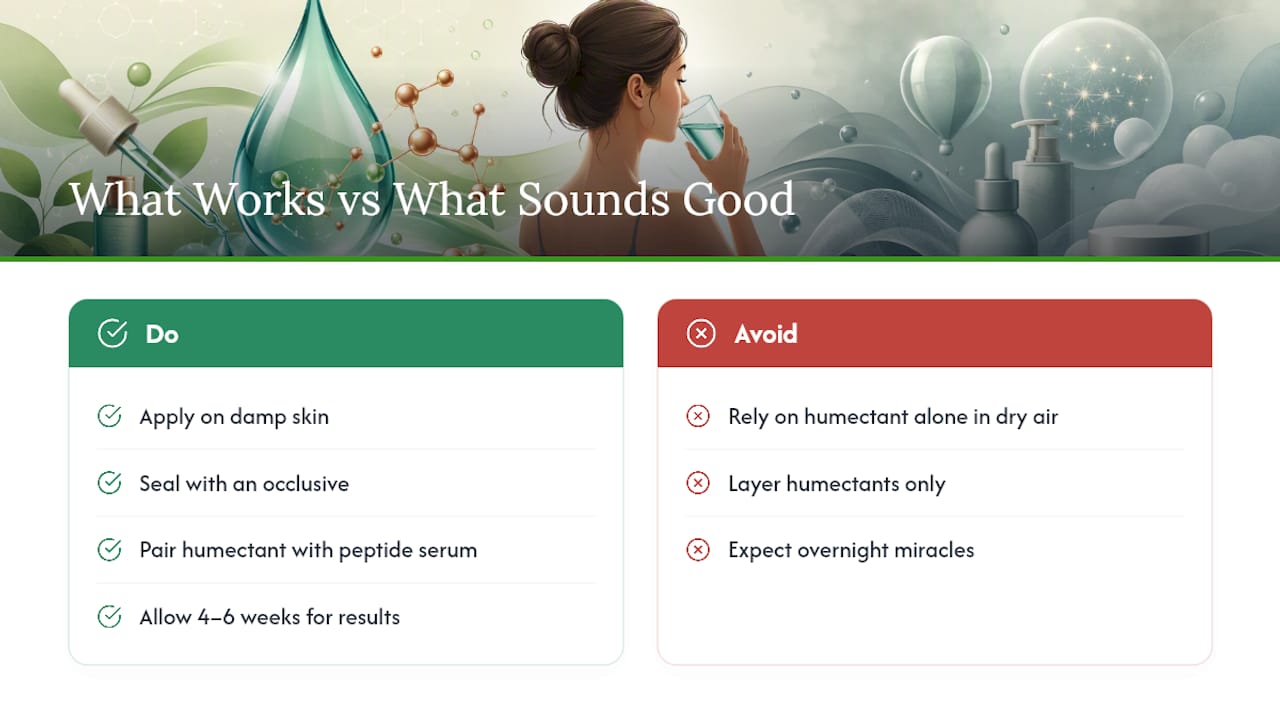
Most advice about dehydration lines gets one thing badly wrong: it treats hydration like a single product problem, when it’s really a sequencing problem. A humectant without a seal is close to useless in dry air, since water gets pulled to the surface and then evaporates right back out. That single detail, apply to damp skin, then lock it in, explains more of the “why didn’t this work for me” complaints than any ingredient debate.
The other overlooked issue is ingredient mechanism. Humectants like hyaluronic acid attract water; they don’t build structure. Peptides work differently, supporting the skin’s own collagen and repair processes rather than just holding moisture at the surface. That’s why pairing a humectant with a peptide-based serum, rather than layering humectants alone, tends to produce results that hold up over weeks rather than fading by afternoon. Copperpeptides formulates its serum around high-purity copper peptides combined with medical-grade hyaluronic acid specifically because these two mechanisms, moisture retention and structural support, solve different parts of the problem. Dermatologists who endorse the formula point to visible improvement in the four to six week range, which lines up with how long real barrier repair actually takes, not the overnight miracle timeline marketing often implies. For readers wanting the mechanism explained further, the science behind copper peptide benefits is worth a closer look.
— British
A Serum Built for This Exact Routine
Copperpeptides makes the humectant plus barrier repair step easier to execute in one product instead of three. The Copper Peptide Anti-Aging Serum combines high-purity copper peptides with medical-grade hyaluronic acid, so you get the water-drawing benefit of a humectant and the collagen-supportive, firming effect of peptides in a single application rather than stacking separate serums and hoping the layering order is right.

It fits directly into the routine outlined above: apply to slightly damp skin after cleansing, then follow with your moisturizer or occlusive to seal it in. The formulation is designed to be gentle enough for sensitive skin while still delivering visible firming and hydration, with most users noticing improvement within weeks of consistent use.
If you’ve been dealing with recurring crepey texture around the eyes or forehead and want a formulated option rather than piecing one together yourself, the Copper Peptide Anti-Aging Serum is priced at $20 and available through the full collection. A patch test on your inner arm 24 hours before full facial use is a smart first step with any new active.
Where to Learn More
A few sources are worth bookmarking if you want to dig deeper into the science behind any of this:
- American Academy of Dermatology for guidance on when a skin concern warrants a professional diagnosis rather than at-home treatment.
- Harvard Health Publishing for clinician-reviewed context on skin physiology and barrier function.
- Charlotte Tilbury’s ingredient guide for a rundown of humectant ingredients commonly used in hydration-focused formulas.
Sources
- How to get rid of forehead wrinkles, which might be dehydration lines - Business Insider
- American Academy of Dermatology (AAD)
- How to hydrate skin: Expert tips for a healthy glow - Glamour
- Dehydration lines vs wrinkles: Understanding the fine line between aging and hydration - Gulf Coast Facial Plastics
FAQ
Can You Reverse Dehydration Lines?
Yes, in most cases. Dehydration lines are surface level and respond to a humectant applied to damp skin followed by a sealing moisturizer, often within minutes to 48 hours, with fuller improvement over two to six weeks of consistent care.
How Long Does It Take to Fix Dehydration Lines?
Initial smoothing can show up within minutes to about 48 hours of proper hydration. Lasting improvement in skin texture generally takes two to six weeks of consistent humectant and barrier-repair use, with some products formulated around that same four to six week window for visible results.
What Helps Fine Lines Go Away?
Humectants like hyaluronic acid, glycerin, and polyglutamic acid draw water into the skin, while ceramides and squalane rebuild the barrier that keeps that water locked in. Sealing a humectant with a moisturizer right after application, rather than letting it sit alone, produces faster and more durable smoothing.
Are Dehydration Lines Permanent?
No, dehydration lines are not permanent when they’re truly caused by water loss rather than collagen breakdown. If a line doesn’t soften after several weeks of correct hydration and barrier repair, or stays visible even when your face is at rest, consult a board-certified dermatologist to check whether it’s actually a structural wrinkle.