

Most copper peptide serums vary in price, with common per-milliliter costs depending on concentration and brand positioning. Budget options sit near the bottom of the price spectrum, premium formulations with added actives sit near the top, and the real question isn’t the sticker price but what you get per milliliter at each tier. We’ll walk through how to translate that number into an actual value judgment before you buy.
TL;DR:
- Copper peptide serums commonly cost $1.50 to $6.00 per milliliter; compare prices after discounts and shipping, not sticker prices alone.
- Before comparing brands, check for a stated copper peptide percentage, an INCI ingredient list, supporting actives, and sourcing or purity test details.
- DIY powder costs $20 to $40 per gram, but dilution, carrier liquid, applicator, and storage add work and can erase savings if it degrades.
- A 30 milliliter bottle used once or twice daily typically lasts 4 to 6 weeks, so include repeat purchases in your budget.
- Buy from the brand or an authorized seller when possible, and check the return policy; marketplaces offer lower prices but less consistent authenticity guarantees.
Table of Contents
- Price overview: low, mid, and premium price bands
- Price by format and size: serums, powders, and creams
- What drives price: concentration, purity, and added actives
- How to compare offers and calculate real cost
- Where to buy and smart ways to save
- Evidence and brand proof: what to expect from a high-purity serum
- Full cost of ownership: how much you’ll actually spend to see results
- Why customer service and return policy affect what you’re really paying
- Our take: price tells you less than you think
- Buyer’s pick: Copper Peptide Anti-Aging Serum
- FAQ
- Sources
Price overview: low, mid, and premium price bands
Shopping for copper peptide serums without a reference point makes every price look arbitrary. It isn’t. The market splits into three fairly distinct bands, and each one tends to correlate with specific formulation choices rather than random markup.
Budget serums typically run within the lower price range for a 30ml bottle, with a lower per-milliliter cost. These formulations usually list copper peptides lower on the ingredient list, often paired with basic humectants like glycerin rather than medical-grade hyaluronic acid. They’re not necessarily bad products, but the concentration of active GHK-Cu peptide is frequently unstated or vague.
Mid-range serums usually fall in a moderate price range for similar bottle sizes, resulting in a mid-level per-ml cost. This is where most reputable brands sit, often with a declared percentage of copper peptide and at least one supporting active like hyaluronic acid or a basic antioxidant.
Premium formulations are at the higher end of the price spectrum, with per-ml costs that reflect concentration and added actives. At this tier, you should expect transparent concentration labeling, medical-grade hyaluronic acid rather than cosmetic-grade, and often third-party purity testing.
A few patterns show up consistently across bands:
- Budget products rarely disclose exact GHK-Cu percentage on the label or product page.
- Mid-tier products usually name at least one supporting active alongside copper peptides.
- Premium products tend to publish INCI lists and sourcing details for the peptide complex itself.
- Bottle size shrinks as concentration rises, since potent actives are formulated in smaller, more stable batches.
Statistic Callout: Copper peptide serums commonly fall in a per-ml range of roughly $1.50 to $6.00 depending on concentration and added actives. Knowing this range before you shop means you can spot an overpriced budget formula or an underpriced premium one in seconds.
The lesson from these bands isn’t “buy the most expensive one.” It’s that price alone tells you almost nothing until you divide it by volume and compare what’s actually inside the bottle.
Price by format and size: serums, powders, and creams
Copper peptides show up in more than just serums, and format changes the math significantly. Comparing a serum to a powder on sticker price alone is close to meaningless. You need per-unit numbers to make it fair.
Here’s how the three common formats typically compare on a per-unit basis:
- Ready-to-use serums are the most convenient and most expensive per active-ingredient unit, since you’re paying for stabilization, preservation, and packaging alongside the peptide itself. A 30ml serum at a typical mid-range price includes water, buffers, and preservatives alongside the peptide, affecting the per-ml cost calculation.
- Peptide powders sold for DIY mixing are typically priced per gram, often $20 to $40 for 1 gram of copper peptide concentrate. This looks cheaper upfront, but you still need to dilute it correctly, add a carrier, and store it properly, which most buyers underestimate.
- Creams and moisturizers containing copper peptides usually cost less per ml than serums ($0.80 to $2.50 per ml) because the peptide concentration is lower and the base is bulked out with emollients and occlusives rather than concentrated actives.
- Small trial sizes (10ml) almost always carry a higher per-ml price than standard 30ml bottles, sometimes 20% to 40% more, since fixed packaging costs don’t scale down with volume.
Running the math on representative sizes makes the comparison concrete. A 10ml serum priced at $25 comes to $2.50 per ml. The same formulation in a 30ml bottle at $55 drops to $1.83 per ml, a meaningful discount simply from buying more volume at once. A 1 gram powder concentrate at $30 sounds cheap until you account for the carrier liquid, applicator, and storage requirements needed to turn it into something usable on your skin.
Packaging and preservative systems also explain a chunk of the price gap between formats. Airless pump bottles, UV-protective glass, and stabilizer systems that keep copper peptides from oxidizing all add cost that a simple powder sachet avoids. That’s part of why serums command a premium over raw powder on a per-gram-of-active basis, even when the powder looks like the better deal at first glance.
The takeaway: always convert to a per-ml or per-gram figure before comparing formats, and factor in what you’re actually getting for that cost beyond the raw peptide itself.

What drives price: concentration, purity, and added actives
Two serums can look identical on the shelf and cost twice as much as each other for reasons that have nothing to do with marketing. The real cost drivers are concentration, purity, and what else is in the bottle.
GHK-Cu concentration is the single biggest factor. GHK-Cu is a naturally occurring tri-peptide with a long history of topical use and a generally favorable safety profile, but formulating it at a stable, effective concentration costs more than diluting it heavily. A product that declares a specific percentage, rather than simply listing “copper peptides” on the ingredient panel, usually reflects a more deliberate and more expensive formulation process.
Purity matters just as much as concentration. Pharmaceutical-grade or cosmetic-grade copper peptide sourcing varies in cost depending on manufacturing standards and third-party testing, and that cost gets passed through to the shelf price.
A few other factors consistently raise price:
- Medical-grade hyaluronic acid costs more to source and formulate with than cosmetic-grade HA, and it tends to perform better for hydration.
- Stabilizer and delivery systems that keep copper peptides active and bioavailable after the bottle is opened add manufacturing complexity.
- Third-party purity and stability testing adds a direct cost that shows up in retail pricing.
- Opaque or airless packaging designed to prevent oxidation of the peptide complex costs more than a basic clear bottle.
Pro Tip: Check the ingredient list for an actual INCI name and percentage rather than vague marketing language like “powered by copper peptides.” A declared concentration is a far more reliable signal of formulation seriousness than packaging claims.
Manufacturing standards also play a quieter role. Facilities that run third-party testing and batch verification carry higher operating costs than those that don’t, and that difference shows up most clearly at the premium end of the market, where buyers are paying partly for documentation and consistency, not just the active ingredient.
How to compare offers and calculate real cost
Once you understand what drives price, the next step is turning any product page into a number you can actually compare across brands and formats.
- Find the total volume (ml) or weight (g) listed on the product page, not just the price.
- Divide the price by that volume to get your per-ml or per-gram baseline figure.
- Check whether the listed price includes shipping, since some brands build it in and others add it at checkout.
- Look for a declared concentration percentage for the copper peptide complex itself, not just its presence on the ingredient list.
- Scan the INCI list for supporting actives like hyaluronic acid, and note whether they’re specified as medical-grade or simply listed generically.
- Check storage instructions and shelf life, since copper peptides can lose potency if stored or packaged poorly.
- Confirm batch or lot information is available, which signals quality control and makes it easier to track a product if something goes wrong.
- Read the return policy before buying, since a serum that doesn’t work for your skin is a sunk cost without one.
Shipping, subscriptions, and promo codes can shift your real cost by a meaningful margin even when the sticker price stays the same. Always calculate the per-ml cost after any discount is applied, not before, since the “deal” price is the one that actually matters.
Rather than hunting for red flags by name-checking specific brands, treat vague labeling, missing concentration data, or an absent return policy as items to check off before you commit. If a product page can’t answer these basic questions, that’s useful information in itself.
Where to buy and smart ways to save
Where you buy a copper peptide serum affects both the price and the guarantees that come with it. Each retail channel has a different tradeoff.
Buying brand-direct typically gives you the clearest formulation information, the most reliable return policy, and direct access to customer service if something goes wrong. Authorized e-commerce storefronts offer similar reliability, usually at a comparable price, though return policies can vary by retailer rather than by brand. Marketplaces often undercut both on sticker price, but authenticity and return guarantees are less consistent, which matters more for a product you’re applying to your skin daily. Labs and bulk suppliers selling raw peptide powder tend to offer the lowest per-gram cost, but they shift the formulation and dilution work onto you.
A few tactics reliably lower your real cost without sacrificing formulation quality:
- First-order discounts, often 10% to 20%, are common on brand-direct sites for new customers.
- Subscription or auto-replenish programs frequently offer a lower per-unit price in exchange for recurring delivery.
- Bundles pairing a serum with a complementary product, like a moisturizer, often cost less per item than buying separately.
- Seasonal sales around major shopping periods can temporarily drop premium serums into mid-tier pricing.
- Buying powder concentrate makes sense only if you’re confident in proper dilution and storage, since the savings disappear if the product degrades before use.
Shipping costs, local taxes, and import fees can add a meaningful amount to the final price depending on where you’re ordering from and where the product ships. Always check the total at checkout, not just the listed price, before deciding a deal is actually a deal.
Evidence and brand proof: what to expect from a high-purity serum
The case for copper peptides isn’t just marketing. GHK-Cu is a well-studied tri-peptide with documented regenerative and protective properties and a long history of topical use in skin care without widespread adverse reports. On tolerability, dermatology sources note that mild, transient irritation such as tingling or redness is the most common issue, and that persistent irritation is rare.
What this means in practice for a high-purity formulation like ours:
- Expect visible improvements in skin texture and hydration within 4 to 6 weeks of consistent use.
- Our serum is designed to be gentle and well-tolerated on sensitive skin.
- A purchase may be backed by a money-back guarantee if the results don’t match expectations.
These proof points matter because they turn a price comparison into a value comparison: paying more for documented purity and tolerability is a different decision than paying more for packaging alone.
Full cost of ownership: how much you’ll actually spend to see results
The sticker price on one bottle isn’t your real cost. Your real cost is what you spend to actually see a change in your skin, which depends on how long you need to use the product and how much you’ll go through in that time.
Visible results from copper peptide serums are commonly reported within 4 to 6 weeks of consistent daily or near-daily use, though a broader qualitative view of topical peptides suggests realistic expectation windows can run longer for some users. A standard 30ml bottle used once or twice daily typically lasts 4 to 6 weeks, which means your first meaningful cost checkpoint lines up almost exactly with one bottle.
That makes the math fairly simple: a $55 mid-to-premium serum used for a full 6 week cycle costs roughly $9 per week to find out whether it works for your skin. If you need a second bottle to maintain results, your effective monthly cost roughly doubles the per-bottle price, so it’s worth factoring that into your budget before you commit rather than after you’ve run out.

Buying a slightly larger bottle upfront, when the per-ml price is lower, often works out cheaper over a full treatment cycle than repeatedly buying smaller sizes.
Why customer service and return policy affect what you’re really paying
A low price loses its appeal fast if the product doesn’t work for your skin and you’re stuck with it. Return policy and customer service aren’t just reassurance, they’re part of the actual cost equation.
A serum with no return policy effectively transfers all the risk to you. If it doesn’t suit your skin, or you experience the mild irritation that dermatology sources note is the most common issue with topical copper peptides, you’ve paid full price for a product you can’t use. A 30-day money-back guarantee changes that calculation entirely, since it caps your downside at the time it takes to judge whether the serum is working.
Responsive customer service also matters more than it might seem for a skincare purchase. Questions about storage, how to introduce the product if you have reactive skin, or how to combine it with other actives are common, and a brand that answers them clearly reduces the chance you waste product through misuse. For sensitive or reaction-prone skin specifically, guidance on introducing copper peptides safely can be the difference between a serum that works and one that gets returned.
When you’re comparing prices, treat the strength of the return policy as a discount on risk, not just fine print.
Our take: price tells you less than you think
The biggest mistake shoppers make with copper peptides is treating price as the main variable. It isn’t. Two serums at the same price can differ enormously in concentration, purity, and what’s actually formulated alongside the peptide, and a cheaper bottle with a vague ingredient list can easily cost more per unit of actual benefit than a pricier one with transparent labeling.
Conventional buying advice tends to stop at “compare prices” and leave it there. That’s not enough. The unit-price conversion matters, but so does reading the INCI list closely enough to know what you’re actually diluting your money into. A bottle that doesn’t disclose concentration is asking you to pay for marketing, not formulation.
If we had to prioritize one thing, it’s this: before comparing prices at all, confirm the product declares its copper peptide concentration and what it’s paired with. Everything else, including format, size, and discounts, only matters once you know that.
— British
Buyer’s pick: Copper Peptide Anti-Aging Serum
Once you’ve run the per-ml math and checked the formulation details that actually drive price, our Copper Peptide Anti-Aging Serum is built to hold up under that scrutiny. We formulate it with high-purity copper peptides alongside medical-grade hyaluronic acid, the same combination that pushes serums into the mid-to-premium value tier described earlier, and we price it at $20 for the full product line, well below where that formulation profile typically lands.
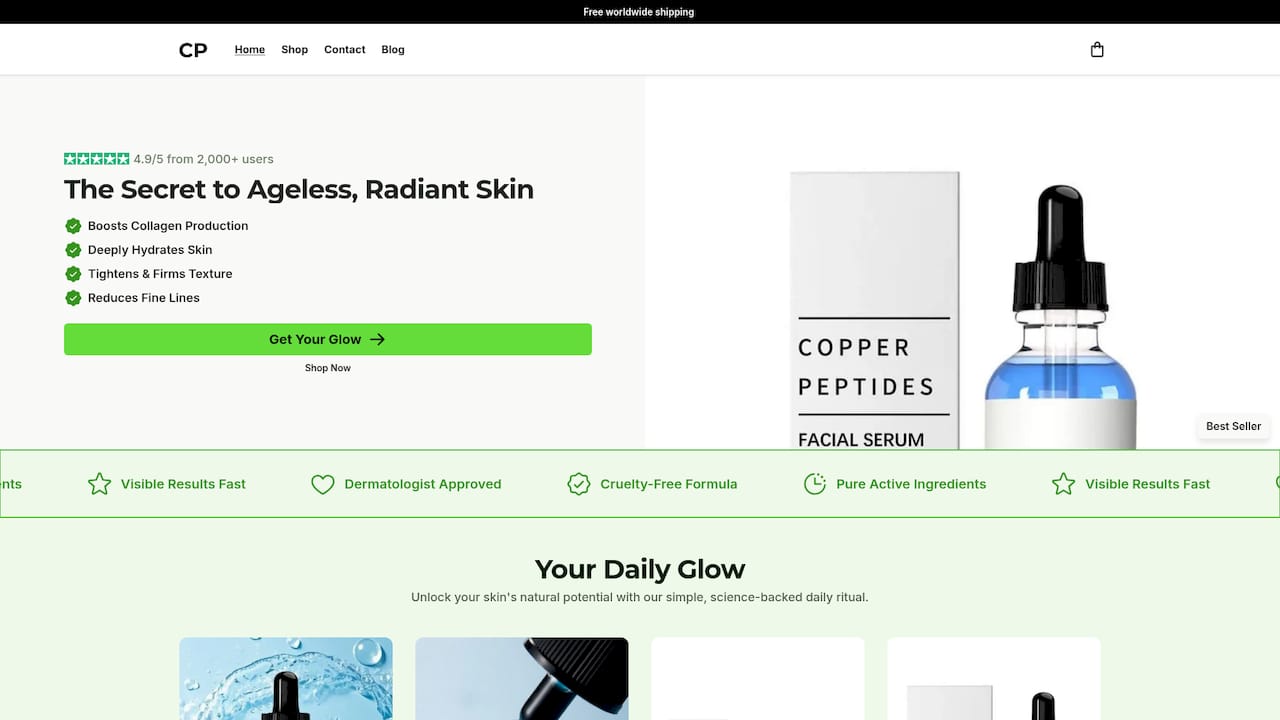
We built this serum to be gentle enough for sensitive skin while still delivering visible improvements in collagen support, hydration, and firmness, with most people noticing changes within 4 to 6 weeks of consistent use. If you want more detail on how copper peptides compare to other actives like growth factors or hyaluronic acid, our peptide layering guide breaks down how to combine them in a routine.
We back every purchase with a 30-day money-back guarantee, so trying it carries little financial risk if your skin doesn’t respond the way you’d hoped. You can buy the serum directly from our product page and start your first 6-week cycle today.
FAQ
Are copper peptides worth the money?
For most people with aging or dull skin concerns, copper peptides are worth the cost when the formulation is transparent about concentration and purity. GHK-Cu has documented regenerative and protective properties and a favorable safety profile, which supports its use as a reasonable investment rather than a speculative one.
Which brand of copper peptide serum is best?
The best choice depends on your skin type, budget, and how transparent the brand is about concentration and sourcing. We formulate our serum with copper peptides and hyaluronic acid designed for sensitive skin, and we offer a return policy for unsatisfactory results.
How often should I use copper peptides?
Most copper peptide serums are designed for once or twice daily use, typically as part of a morning or evening routine. Visible results are commonly reported within 4 to 6 weeks of consistent use, so sticking to a daily schedule matters more than using extra product at once.
What should I check before choosing a copper peptide serum?
Before buying, check that the product discloses its GHK-Cu concentration, lists supporting actives like hyaluronic acid clearly, and offers a return policy. Dermatology sources note that mild irritation is the most common issue with topical copper peptides, so starting with a patch test and introducing the product gradually, especially for reactive or sensitive skin, is worth doing before committing to a full-size bottle.
Sources
- Regenerative and Protective Actions of the GHK-Cu Peptide in the Light of the New Gene Data - PMC
- GHK-Cu copper peptides for skin care - Westlake Dermatology