

Copper peptides, specifically the compound GHK-Cu, can measurably improve skin firmness, elasticity, and the appearance of fine lines for many people, but the result depends heavily on how the peptide is formulated and delivered into skin. Encapsulation methods like liposomes, paired with hydrating partners such as hyaluronic acid, often decide whether a serum works. Most people who see change notice it between 8 and 12 weeks, with some reporting earlier improvements around 4 to 6 weeks.
TL;DR:
- Clinical improvements in firmness, density, and fine lines generally appear after 8 to 12 weeks of consistent topical use, while early texture or hydration changes may emerge sooner.
- Choose serums listing liposomal or encapsulated GHK-Cu and hyaluronic acid; concentration alone does not show whether the peptide reaches its target layers.
- A lab study found liposomes about 100 nanometers in size increased elastase inhibition to roughly 48.9%, but this in vitro result does not guarantee visible outcomes.
- Patch test for 24 to 48 hours, begin every other day, and increase to daily use only if your skin tolerates the serum.
- Keep strong exfoliating acids, high strength retinoids, and vitamin C out of the same application as copper peptides to limit irritation or formulation instability.
Table of Contents
- What copper peptides are and why skincare uses them
- How copper peptides support skin firming
- What the evidence says about firmness, elasticity, and wrinkles
- Why formulation and delivery decide whether a serum works
- How to use a copper peptide serum for firming
- Safety, compatibility, and what not to mix
- A practical view on copper peptides for firming
- A focused copper peptide serum with medical-grade hyaluronic acid
- FAQ
- Sources
What copper peptides are and why skincare uses them
GHK is a naturally occurring tripeptide, glycyl-L-histidyl-L-lysine, that binds copper to form the GHK-Cu complex found in human plasma and other tissues. Levels of GHK decline as we age, which is part of why skin loses some of its repair capacity over time, according to research on GHK peptide’s role in skin regeneration.
In clinical use, GHK-Cu has been studied for its reported effects on collagen and glycosaminoglycan turnover, wound healing, and inflammation control. These overlapping actions are why formulators describe copper peptides as multifunctional or carrier peptides rather than a single-purpose ingredient. The same molecule that supports tissue repair after injury appears to influence the structural proteins that keep skin looking taut, which is the connection that made it a serious candidate for firming serums rather than just a wound care compound.
How copper peptides support skin firming
The firming effect traces back to how GHK-Cu interacts with skin cells at a genetic level. Research on GHK-Cu’s regenerative actions shows the peptide regulates genes tied to collagen, elastin, matrix metalloproteinases (MMPs), and their natural inhibitors (TIMPs). This balance matters because MMPs break down structural proteins while TIMPs protect them, and shifting that ratio toward preservation and synthesis is what remodels the dermal matrix over time.
GHK-Cu also stimulates fibroblasts, the cells responsible for producing collagen and elastin, and supports keratinocyte proliferation in the outer skin layers. Increased fibroblast activity translates into greater skin thickness and density, which is what a dermatologist would measure as improved firmness. The same source notes the peptide supports blood vessel and nerve outgrowth, which may play a role in the broader tissue repair response that underlies visible skin changes.
None of this happens overnight. Gene expression shifts and fibroblast output build gradually, which is why firming results from copper peptides tend to emerge over weeks rather than days.

What the evidence says about firmness, elasticity, and wrinkles
Topical GHK-Cu applied in clinical studies over 8 to 12 weeks has been linked to improved skin laxity, reduced fine lines, and increased skin density and thickness, according to research on GHK’s cellular pathways.
In vitro work on liposomal delivery of GHK-Cu found that liposome carriers around 100 nanometers in size increased elastase inhibition to roughly 48.9%, a finding reported in a liposome carrier study. Elastase is the enzyme that breaks down elastin, so inhibiting it is directly relevant to maintaining skin’s bounce and firmness. The same study proposes these liposome systems as a route to better peptide delivery when paired with suitable lipid formulations.
It is worth being precise here: these are lab and clinical findings tied to specific formulations and timeframes, not universal guarantees. A serum with poorly delivered GHK-Cu will not reproduce results seen with an optimized carrier system, which is exactly why formulation is the variable that decides outcomes.
Why formulation and delivery decide whether a serum works
A copper peptide serum is only as effective as its ability to get the peptide into skin where it can act. In vitro penetration studies measuring a copper tripeptide found high retention in the stratum corneum along with measurable permeation into the epidermis and dermis, as shown in research on skin penetration of copper tripeptides. That penetration is what allows the peptide to reach the fibroblasts and gene pathways discussed earlier.
Encapsulation technology, particularly liposomes, can improve this delivery further and boost elastase inhibition compared to unencapsulated peptide, based on the liposome carrier research cited above. Hyaluronic acid and other humectants play a supporting role too: they hydrate the outer layers, help maintain a favorable environment for peptide activity, and contribute to the immediate plumping effect many users notice before deeper firming changes appear.

When comparing serums, look past the peptide concentration alone. Ingredient lists that mention encapsulated or liposomal GHK-Cu, along with multiple molecular weights of hyaluronic acid, suggest a formulation built for delivery rather than one relying on raw concentration.
How to use a copper peptide serum for firming
Copper peptides reward a steady, patient routine more than an aggressive one. A gradual introduction lets your skin adjust while giving the peptide time to work.
- Patch test on your inner arm for 24 to 48 hours before applying to your face.
- Start every other day and increase to daily use once your skin tolerates it, adjusting frequency for sensitive or reactive skin types.
- Apply copper peptide serum after cleansing and before heavier creams, layering a hyaluronic acid product beforehand to support hydration and plumping, following these layering guidelines.
- Use morning or evening, but keep the routine consistent rather than switching frequently.
- Track visible 12-week results with photos taken under the same lighting.
Pro Tip: Take a baseline photo before you start. Firming changes are gradual enough that memory alone will undersell the progress.
Most clinical improvements in firmness and density appear in the 8 to 12 week range, though some users notice early changes in texture and hydration within 4 to 6 weeks.
Safety, compatibility, and what not to mix
Copper peptides are generally well tolerated, including on sensitive skin and skin prone to rosacea, but a patch test remains the safest first step before full-face use.
Certain combinations can reduce effectiveness or increase irritation risk when used in the same routine:
- Strong exfoliating acids (high-strength AHAs or BHAs) applied at the same time as copper peptides.
- Unbuffered, high-strength retinoids layered directly with peptides in the same session.
- Direct-mixing with vitamin C in the same application, since copper and certain antioxidant formulations can interact and reduce stability.
If you notice persistent redness, stinging, or breakouts that do not settle after a few applications, stop use and consult a dermatologist before resuming.
A practical view on copper peptides for firming
Copper peptides make the most sense for two kinds of readers: people recovering from a cosmetic procedure who want support for skin repair, and people noticing the earliest signs of laxity who want to intervene before it progresses further. They are not a dramatic overnight fix, and anyone expecting that will be disappointed regardless of which serum they choose.
What actually separates a good result from a mediocre one is formulation, not marketing claims about concentration. A well-encapsulated peptide paired with proper humectants outperforms a higher-percentage peptide with no delivery system behind it. Patience matters just as much: track your skin over 8 to 12 weeks with consistent photos, because peptide-driven change is cumulative and easy to miss day to day.
— British
A focused copper peptide serum with medical-grade hyaluronic acid
If you want a straightforward entry point rather than comparing formulation chemistry across a dozen brands, we offer a single-ingredient Copper Peptide Anti-Aging Serum built around high-purity copper peptides and medical-grade hyaluronic acid.
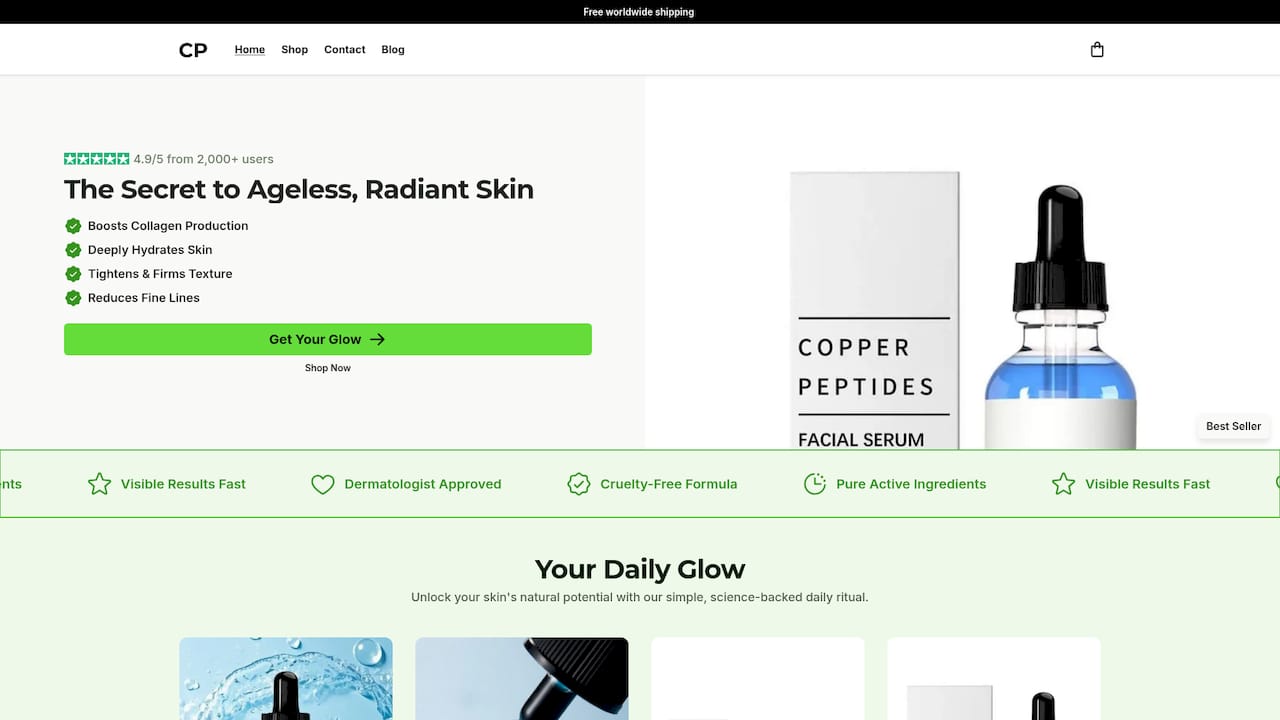
- We formulate for both firming and hydration, pairing copper peptides with medical-grade hyaluronic acid rather than relying on peptide concentration alone.
- Our serum is designed to be gentle enough for sensitive skin while still working toward visible firming results.
- We state that visible results may take time, and we back the serum with a money-back guarantee.
For readers who also want to see how peptides compare with other actives before narrowing down a routine, the Skin Glos peptide collection is a useful place to browse broader peptide-based formulations. When you are ready to try a focused formula built specifically around copper peptides, you can view our Copper Peptide Anti-Aging Serum.
FAQ
Are copper peptides good for skin tightening?
Yes, copper peptides, particularly GHK-Cu, are associated with improved skin firmness and reduced laxity in clinical research conducted over 8 to 12 weeks of topical use. Results depend on formulation quality, including encapsulation and the presence of supportive humectants like hyaluronic acid.
What should you check before using copper peptides?
Check how the product is formulated, since encapsulated or liposomal GHK-Cu tends to penetrate skin more effectively than unencapsulated peptide. It also helps to patch test first and confirm the serum avoids layering conflicts with strong acids or high-strength retinoids in the same routine.
What peptide will tighten loose skin?
GHK-Cu, the copper-bound tripeptide found in many firming serums, is the peptide most studied for stimulating collagen, elastin, and fibroblast activity linked to tighter-looking skin. Visible changes in firmness typically take 8 to 12 weeks of consistent use to appear.
What shouldn’t you mix with copper peptides?
Avoid combining copper peptides with strong exfoliating acids or unbuffered, high-strength retinoids in the same application, since this can increase irritation and may reduce peptide stability. Direct mixing with vitamin C in the same step is also best avoided, though the two can often be used at different times of day.
Sources
The claims in this article draw on peer-reviewed and clinical research into GHK-Cu, including gene-level studies, liposomal delivery research, and skin penetration data, along with broader coverage of copper peptides in skincare.
- Liposomes as Carriers of GHK-Cu Tripeptide for Cosmetic Application
- GHK Peptide as a Natural Modulator of Multiple Cellular Pathways in Skin Regeneration
- Regenerative and Protective Actions of the GHK-Cu Peptide in the Light of the New Gene Data - PMC