

You cannot restore your face to the collagen levels it had in your 20s, but you can slow the decline and stimulate meaningful new collagen with the right combination of habits, topicals, and clinical treatments. The evidence is clearest on a layered approach: daily broad-spectrum sunscreen, a retinoid routine, and depending on how advanced the changes are, an in-office procedure that triggers your skin to rebuild.
Start here:
- Apply SPF 30 or higher every single day, regardless of weather or skin tone.
- Introduce a retinoid (over-the-counter retinol or prescription tretinoin) two to three nights a week, building up slowly.
- Book a dermatology consult if you’re noticing volume loss, not just texture changes.
Expect topical results in 8 to 12 weeks. Procedural collagen remodeling takes 3 to 12 months depending on the treatment.
Table of Contents
- What Is Collagen Loss in the Face, Exactly?
- What Are the Signs You’re Losing Facial Collagen?
- What At-Home Treatments Actually Rebuild Collagen?
- What Professional Treatments Stimulate Collagen or Restore Volume?
- How Long Do Results Take and What Do They Cost?
- How Do You Choose the Right Treatment for Your Skin?
- What Does the Evidence Say About Peptides and Copper Peptides?
- What People Get Wrong About Fixing Collagen Loss
- Where Copper Peptides Fit Into Your Routine
- Frequently Asked Questions About Collagen Loss in the Face
- Sources
What Is Collagen Loss in the Face, Exactly?
Collagen is the structural protein that makes up roughly 70% to 80% of your dermis, the middle layer of skin sitting beneath the epidermis and above the fatty hypodermis. Types I and III dominate that dermal layer, woven into a mesh called the extracellular matrix (ECM) that gives skin its bounce, tensile strength, and ability to snap back after you smile or squint.
Fibroblasts are the cells that manufacture this collagen, and they don’t work in isolation. They respond to mechanical tension and chemical signals from the ECM itself, which is why a matrix in good condition tends to keep generating more collagen, while a degraded one sends weaker signals and produces less.
Two separate processes erode this system. Intrinsic aging is the slow, genetically programmed decline that happens to everyone regardless of lifestyle. Photoaging is the damage caused by ultraviolet exposure, and it’s the more aggressive of the two. Studies comparing sun-protected and chronically sun-exposed skin from the same person find meaningfully better collagen fiber structure in the protected areas, even at the same chronological age. This is the biological reason sunscreen keeps coming up in every section of this article.
What Are the Signs You’re Losing Facial Collagen?
Collagen loss doesn’t announce itself all at once. It shows up first as subtle textural shifts, then later as structural changes that alter your actual face shape.
Early signs tend to include:
- Skin that feels less firm or springy when you press it
- Fine lines visible even when your face is relaxed, not just when you smile or frown
- Pores that look larger, because the surrounding tissue supporting them has thinned
- Under-eye skin that appears thinner or more hollow
Later, more structural signs include midface flattening (the cheeks losing their forward projection), deepening nasolabial folds, a jawline that softens into jowls, and a face shape that gradually shifts from a defined oval toward something more rectangular or square along the lower third. Research on collagen decline estimates production drops by roughly 1% to 1.5% per year starting in your mid to late 20s, with women losing up to an additional 30% of dermal collagen in the five years following menopause.
Here’s the clinical distinction that matters for treatment: texture and elasticity changes usually respond to topicals and skin-stimulating procedures. Volume loss, particularly in the midface, often needs mechanical replacement through dermal fillers or structural intervention. Treating a volume problem with only a serum is why some people feel like their routine “isn’t working.”

What At-Home Treatments Actually Rebuild Collagen?
This is where most people start, and it’s also where the most misleading marketing lives. Not every ingredient labeled “anti-aging” earns that claim. Here’s what has real evidence behind it.
The core lineup:
- Sunscreen, SPF 30+, daily. This is the highest-leverage single habit for collagen preservation. Daily photoprotection prevents the matrix metalloproteinase (MMP) activation that fragments existing collagen, and no serum undoes damage from unprotected sun exposure faster than it accumulates.
- Topical retinoids. Tretinoin and over-the-counter retinol increase types I and III procollagen production and reduce MMP activity, with clinical trials showing measurable texture and wrinkle improvement over consistent months of use.
- Vitamin C (L-ascorbic acid). Works as a cofactor your body needs to crosslink collagen fibers properly, and it layers well underneath sunscreen in the morning.
- Peptides, including copper peptides. These small protein fragments send signals that encourage fibroblasts to get to work, functioning as a gentler, complementary stimulus alongside retinoids rather than a replacement for them.
- Hyaluronic acid. Doesn’t build collagen directly, but hydrates the dermis and improves the skin’s mechanical support, which helps everything else function better.
- Diet and lifestyle. Reducing added sugar limits glycation, a process where sugar molecules bind to collagen fibers and stiffen them. Quitting smoking, prioritizing sleep, and managing stress all slow collagen breakdown too.
A sensible routine layers vitamin C in the morning under sunscreen, and a retinoid at night, introduced two to three times weekly before working up to nightly use as tolerance builds. Copper peptides pair well with this structure when used on nights you skip retinoid, since combining strong actives on sensitive skin can cause irritation rather than better results.
Pro Tip: If your skin is sensitive or new to actives, don’t stack vitamin C, retinoids, and peptides all in one routine right away. Introduce one new active every two to three weeks so you can tell what’s working and what’s irritating you.
Set your expectations honestly. Topical improvements in texture and fine lines typically appear at 3 to 6 months of consistent use, not two weeks. Oral hydrolyzed collagen supplements have shown modest elasticity improvements in some randomized trials, though most of that research is industry-funded and formulation quality varies widely, so treat supplements as a possible supporting player, not a core strategy. Topical “collagen” creams, meanwhile, are mostly just moisturizers. Collagen molecules are too large to penetrate the skin barrier, so dermatologists point people toward ingredients that stimulate the skin’s own production instead. Our own guide on how to boost collagen production walks through building this kind of routine step by step.
What Professional Treatments Stimulate Collagen or Restore Volume?
At-home care has a ceiling. Once you need more dramatic remodeling, in-office procedures work by creating controlled injury or delivering targeted energy that triggers your skin’s wound-healing response, which is a far stronger neocollagenesis signal than any topical can generate.
Collagen-stimulating procedures:
- Microneedling, sometimes combined with platelet-rich plasma (PRP), creates thousands of micro-injuries that prompt fibroblasts into repair mode. Results build gradually over a series of sessions.
- Non-ablative lasers (like fractional non-ablative devices) heat the dermis without damaging the surface, meaning less downtime but a milder effect per session.
- Ablative lasers (fractional CO2, erbium) remove and resurface the outer skin layer, producing the most dramatic single-session results along with the longest recovery.
- Radiofrequency (RF) and RF microneedling combine heat energy with mechanical injury for a middle-ground effect between non-ablative lasers and full ablative resurfacing.
- HIFU (high-intensity focused ultrasound) delivers energy deep into the dermis and even the SMAS layer, primarily targeting laxity rather than surface texture.
- Medium-depth chemical peels remove damaged outer layers and prompt regeneration underneath.
Volume-restoring options work differently. Hyaluronic acid dermal fillers replace lost volume mechanically rather than stimulating new collagen directly, though the added mechanical support can secondarily re-engage fibroblasts by giving them a firmer structure to build against. Biostimulatory injectables like poly-L-lactic acid work more slowly, encouraging your body to lay down collagen gradually over months. Surgical lifts and thread lifts enter the conversation only when skin laxity has progressed beyond what injectables or energy devices can meaningfully address.
Ablative lasers carry the highest hyperpigmentation risk, particularly for darker skin tones, and require real recovery time. RF and non-ablative options trade some effect size for a much easier recovery.
Pro Tip: Ask any provider which specific device or technique they’re using and why, not just the category name. “Laser resurfacing” covers treatments with wildly different downtime and risk profiles.
How Long Do Results Take and What Do They Cost?
Timelines vary enormously depending on the method, and understanding this upfront prevents the frustration of quitting a treatment right before it would have worked.
| Treatment type | Time to visible results | Typical downtime |
|---|---|---|
| Topicals (retinoids, vitamin C, peptides) | 3 to 6 months | None |
| Microneedling/PRP series | 3 to 6 months cumulative | 1 to 3 days per session |
| Non-ablative laser/RF | 3 to 6 months | Minimal to a few days |
| Ablative laser | 6 to 12 months for full remodeling | 1 to 2 weeks |
| Biostimulatory injectables | 3 to 6 months | Minimal |
| HA dermal fillers | Immediate | Minimal, some swelling |
Costs vary widely by region and provider, so a proper local consultation is the only reliable way to get pricing. As a rough guide, topical routines sit at the low end of ongoing spend, series treatments like microneedling or laser sit in the medium range per session with multiple sessions typically needed, and combination plans involving fillers or biostimulatory injectables trend toward the higher end.
Maintenance matters as much as the initial treatment. Energy-based procedures usually need annual touch-ups to sustain results. Fillers require repeating every 6 to 18 months depending on the specific product used. None of this holds if daily habits slide backward: new collagen generated by any treatment is vulnerable to the same UV exposure and inflammatory triggers that caused the original decline, which is why sunscreen isn’t a one-time fix but a permanent line item.
How Do You Choose the Right Treatment for Your Skin?
Match the problem you actually have to the intervention that addresses it, rather than reaching for whatever treatment is trending.
- Texture and fine lines only? Start with topicals: retinoids, vitamin C, peptides, and sunscreen. Give it a full 3 to 6 months before judging results.
- Mild to moderate laxity with no major volume loss? Consider microneedling, RF, or non-ablative laser series.
- Volume loss in the midface or under the eyes? This usually needs fillers or biostimulatory injectables, not more serum.
- Significant sagging or structural change? A consultation with a board-certified dermatologist or plastic surgeon should come before any device-based treatment.
When vetting a provider, ask about their credentials, how many similar cases they’ve treated, what a realistic timeline looks like, expected downtime, and their follow-up plan. Walk away from anyone who guarantees specific results, pressures you toward an expensive procedure in the first conversation, or skips a genuine informed-consent discussion. A cosmetic clinic consultation is fine for lower-risk options like microneedling, but structural concerns deserve a board-certified specialist.
What Does the Evidence Say About Peptides and Copper Peptides?
Peptides work by signaling fibroblasts rather than delivering collagen directly, since collagen molecules themselves are too large to penetrate skin. Copper peptides specifically have been studied for their role in supporting this signaling process alongside their antioxidant properties.
The strongest evidence in topical anti-aging still points to ingredients that trigger your skin’s own production machinery. Retinoids have the deepest research base, vitamin C supports the collagen-crosslinking process, and peptides, including copper peptides, add a gentler complementary signal, particularly useful for people who can’t tolerate retinoids at full strength.
- Copper peptides work best paired with, not instead of, retinoids and vitamin C.
- Evidence is strongest for retinoids, more limited but promising for copper peptides specifically.
- Individual results vary, and anyone considering prescription-strength retinoids should discuss it with a dermatologist first.
Our detailed breakdown of copper peptide benefits covers the mechanism and current research in more depth.
Facial collagen loss can be meaningfully slowed and partially rebuilt, but only through daily photoprotection combined with proven topicals and, when needed, clinical procedures.

| Point | Details |
|---|---|
| Sunscreen is non-negotiable | Daily SPF 30+ prevents the MMP activation that breaks down existing collagen faster than any product rebuilds it. |
| Retinoids have the strongest evidence | Consistent use over 3 to 6 months increases procollagen production and improves texture. |
| Volume loss needs mechanical solutions | Midface flattening usually requires fillers or biostimulatory injectables, not topical serums. |
| Match treatment to the actual problem | Texture issues respond to topicals; structural changes need microneedling, lasers, or fillers. |
| Copper peptides complement core actives | Copper peptide serums like Copperpeptides work alongside retinoids and vitamin C to support fibroblast signaling gently. |
What People Get Wrong About Fixing Collagen Loss
Most advice treats collagen loss like a shopping problem: buy the right cream, solve the issue. That framing sets people up to fail. The research points somewhere less convenient: prevention and repair are two different jobs, and most people are only doing one of them.
The daily maintenance side, sunscreen, retinoids, decent sleep, gets treated as boring compared to the appeal of a dramatic in-office procedure. But skip the maintenance and any procedure you pay for gets undone by the same UV exposure and inflammation that caused the problem in the first place. That’s not a reason to skip procedures. It’s a reason to stop treating them as substitutes for the basics.
The other misconception is expecting topicals to do a structural job. No serum, however well formulated, replaces lost midface volume. If your face has changed shape, not just texture, an honest read of the evidence points toward fillers or energy-based procedures, with topicals working underneath to support skin quality between treatments. Prioritize sunscreen and a retinoid first, always. Then be honest with yourself about whether your concern is texture or structure before spending money on the wrong category of fix.
Where Copper Peptides Fit Into Your Routine
If you’ve read this far, you already know retinoids and sunscreen carry the strongest research and peptides work best as a complementary signal, not a replacement. That’s exactly the gap Copperpeptides fills. The Copper Peptide Anti-Aging Serum pairs high-purity copper peptides with medical-grade hyaluronic acid, formulated for the nights you’re not using a retinoid or for anyone whose skin can’t tolerate one at full strength yet.
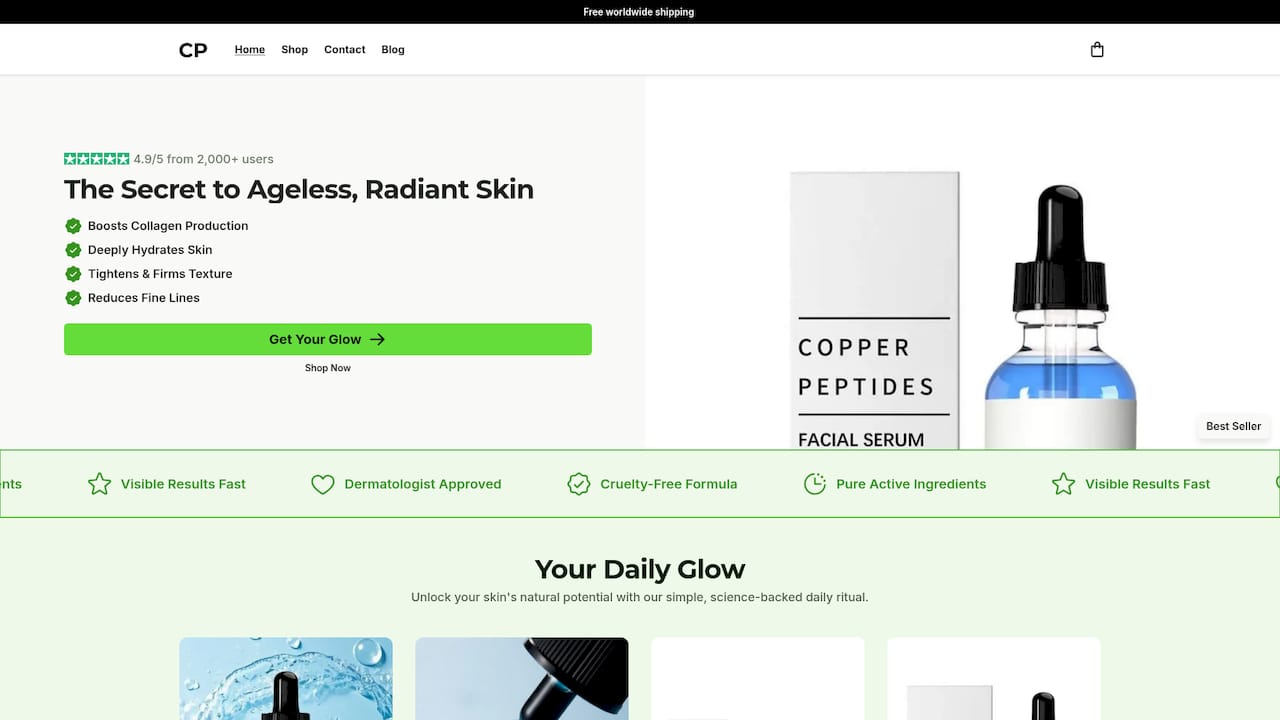
It’s gentle enough for sensitive skin, backed by dermatologist endorsement, and most people notice visible improvement in firmness and hydration within four to six weeks. If you’re building the layered routine this article describes, sunscreen every morning, an active at night, this serum slots in as the peptide layer that supports fibroblast signaling without the irritation risk of stacking multiple strong actives. Visit Copperpeptides to check the full ingredient breakdown and place an order backed by their return policy.
Frequently Asked Questions About Collagen Loss in the Face
Can collagen loss in the face be reversed completely? No. You can’t return skin to its 20s-level collagen density, but a combination of daily sunscreen, retinoids, and clinical treatments can meaningfully slow further loss and generate new collagen.
What is the first sign of collagen loss in the face? Reduced firmness and fine lines that show up even when your face is relaxed, not just when you make an expression, tend to appear first.
Do collagen supplements actually work for facial skin? Some trials show modest improvements in skin elasticity, but most of that research is industry-funded, and results depend heavily on the specific formulation used.
How long does it take to see results from a collagen-boosting skincare routine? Expect 3 to 6 months of consistent topical use before meaningful texture and fine-line improvement becomes visible.
Are copper peptides as effective as retinoids for collagen? No, retinoids have the deeper research base. Copper peptides work best as a complementary ingredient, particularly for people who can’t tolerate retinoids at full strength.
This article is general information, not a substitute for advice from a qualified doctor. Consult a qualified healthcare professional about your own circumstances before acting on anything here.
Sources
Recommended
- How to Boost Collagen Production for Younger Skin – Copper Peptides Store
- Best Serums for Crepey Skin: Dermatologist-Backed Picks – Copper Peptides Store
- Best Hydrating Serums for Firming and Anti-Aging Skin – Copper Peptides Store
- Dermatologist Approved Skincare: Best Copper Peptide Serum – Copper Peptides Store